
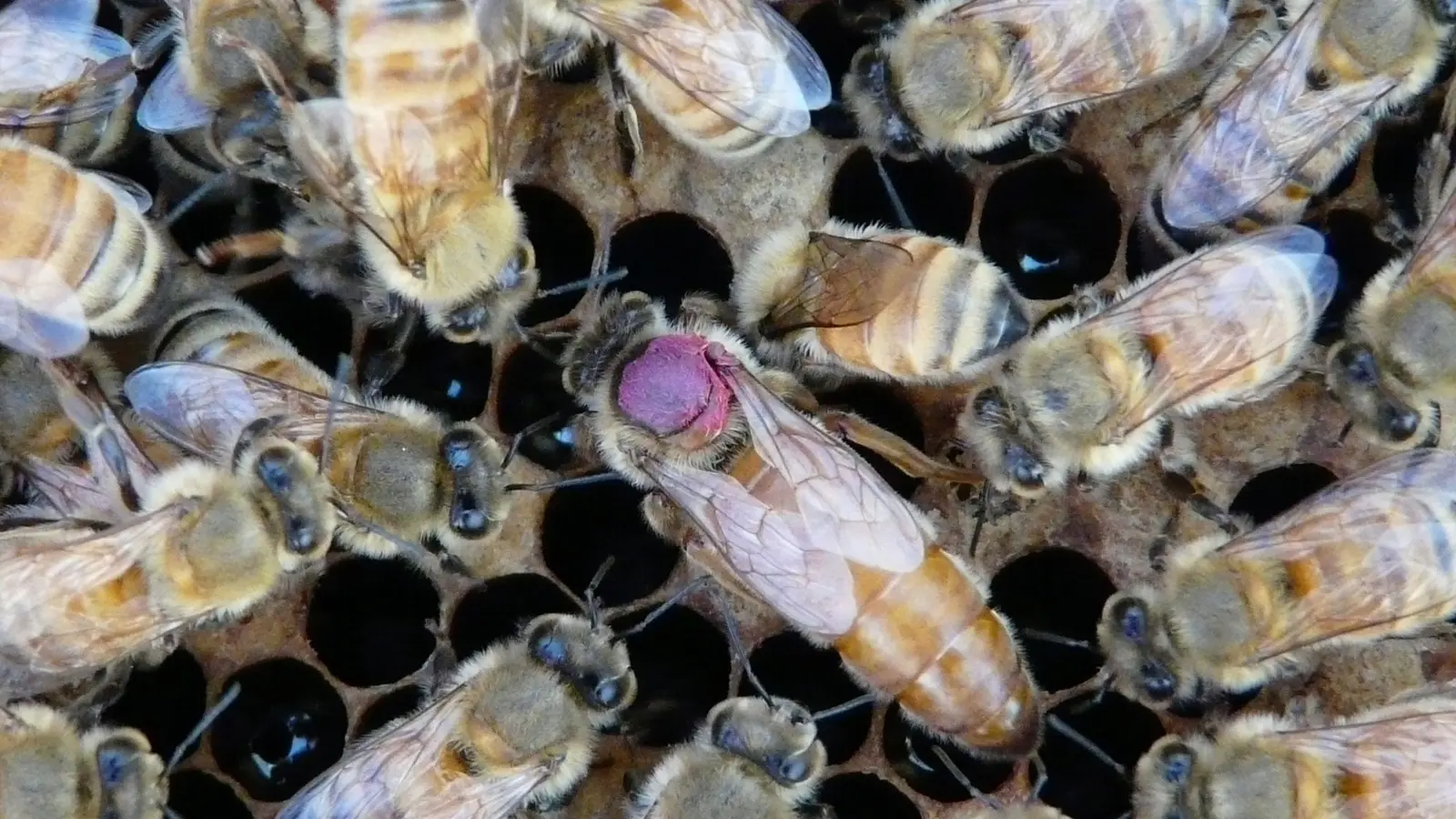
A single queen sits at the center of a hive and quietly decides the colony's future. She also quietly inherits a burden.
Worker bees often act like a living barrier, intercepting pesticide residues that arrive in pollen, nectar, and water. For a time, that barrier works. But it is not invincible. When exposure persists, filtration falters. The queen then appears to move the problem down one generation by depositing chemicals into her eggs. Scientists call that process maternal offloading.
Tracking toxins where it matters most
Until now, most toxicology work focused on workers because they forage and face direct contact with pesticides in agricultural landscapes. What was less clear was what happened inside the hive: did contaminants stop at the worker level, or did they travel deeper to the queen, her ovaries, and the eggs that will become the next wave of workers?
Researchers from the University of California, Davis, together with colleagues at Lawrence Livermore National Laboratory and the U.S. Department of Agriculture Agricultural Research Service, set out to answer that exact question. They used a conservative tracer and a controlled experimental system to follow a pesticide through the colony’s internal food web.

Honeybee eggs in hive comb cells.
Nanocolonies: a simplified hive for precise measurements
Rather than large, complex hives, the team created compact experimental groups called nanocolonies. Each one housed a single queen and about 60 workers inside a conical plastic container. The arrangement preserved the essential social roles—food processing, feeding, grooming—while making it possible to measure tiny chemical flows.
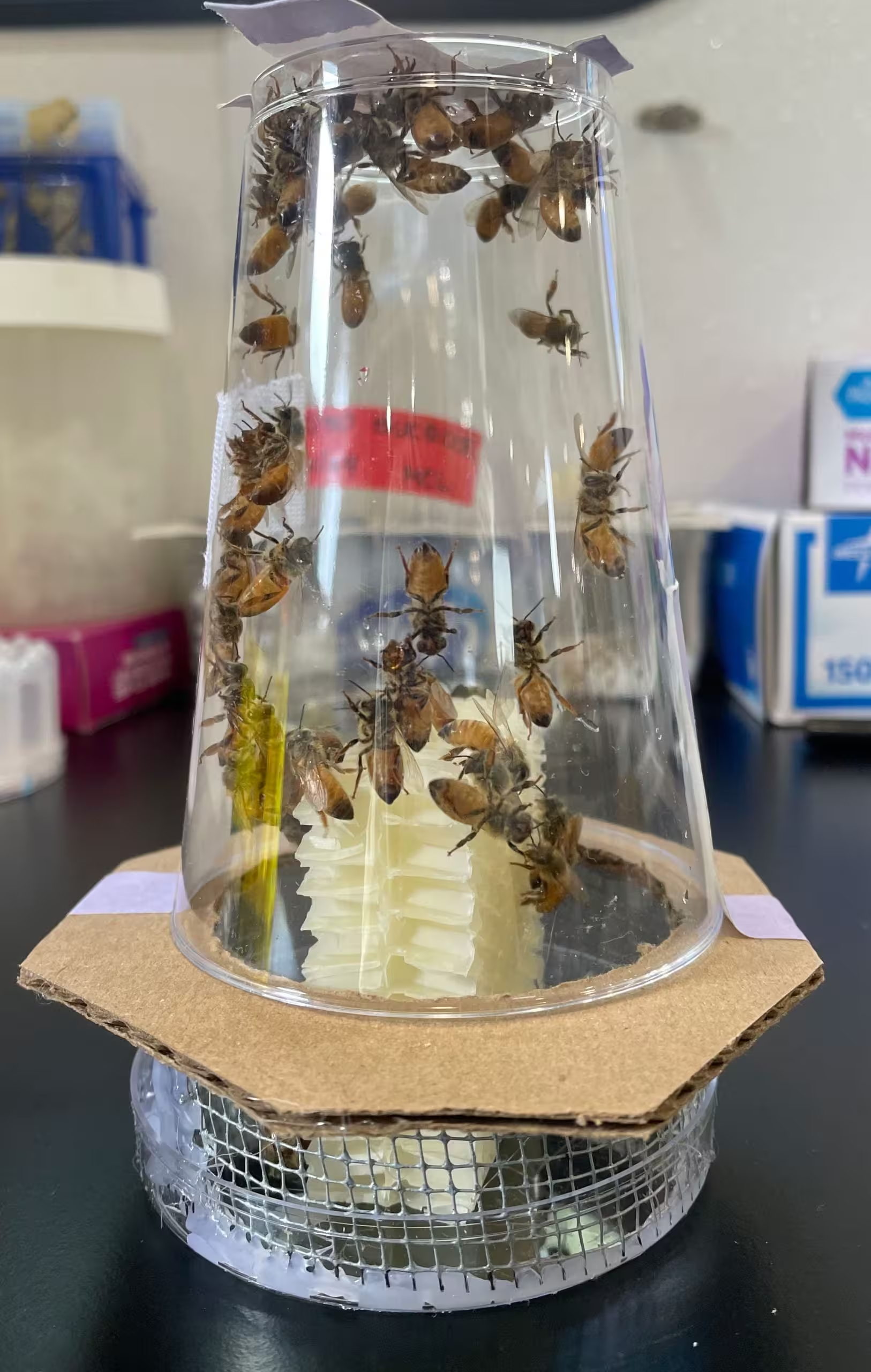
Researchers created nanocolony environments like this one to represent a typical honeybee hive.
The researchers fed the bees pollen and syrup laced with methyl parathion, a pesticide chosen for its environmental relevance, and tagged the compound with a low-level radioactive marker. That marker was not intended to harm the insects. It was a tracing tool that allowed scientists to detect vanishingly small amounts of the chemical as it moved through workers, wax, the queen’s tissues, and eggs.
Findings that complicate a simple defense
Results were revealing. On the first day of exposure, worker bees intercepted roughly 95 percent of the pesticide from food destined for the queen, depositing much of it in comb rather than passing it on. That sounds like protection. But protection declined over time. By day ten the workers’ filtration rate had fallen to 86 percent. That drop is not massive in a single reading, but it indicates a steady erosion of the colony’s buffering capacity under continued pressure.

As filtration weakened, measurable amounts of the tracer accumulated inside queens and showed up in their eggs. The picture that emerges is of a two-step response: workers filter until they can no longer keep up; then queens offload to eggs as a last-resort detox strategy. Maternal offloading reduces the adult queen’s internal load, but it creates a chemical inheritance for the next generation.

A sample of paraffin wax removed from a research nanocolony.
Why does this matter beyond laboratory curiosity? Because a queen lays thousands of eggs each day. Those eggs form the pipeline of future workers that keep the colony functioning and pollinate crops. If eggs carry pesticides at levels that impair development, the colony may experience delayed declines rather than immediate die-offs. That creeping effect could contribute to colony weakening over weeks or months, a pattern that complicates detection and management.
Scientific context and methodology notes
The study combined expertise across institutions. UC Davis researchers designed the toxicology work and interpreted bee behavior. USDA scientists provided biological and experimental design support. Specialists at Lawrence Livermore applied biological accelerator mass spectrometry, or BioAMS, to count rare marked atoms and quantify the tracer at concentrations too small for many instruments. The approach let the team track contamination paths with high sensitivity while using environmentally realistic exposure levels.
The pesticide concentrations were not lethal under the study conditions, but they were sufficient to reveal how contaminants can move and accumulate in unexpected places inside a colony. That subtlety is important. Not all harmful outcomes begin as acute mortality; many begin as altered reproduction, developmental changes, or chronic stress that undermines colony resilience.
Expert Insight
"This study highlights an underappreciated pathway by which chemical stressors can cross generational boundaries in social insects," said Dr. Elena Marquez, an apicultural ecologist who studies pollinator health. "If queens routinely transfer contaminants into eggs, then monitoring only worker residues will miss an important piece of the exposure puzzle. Beekeepers and regulators should consider maternal effects when assessing risk and recovery trajectories."
Her point is practical. Better detection methods and management strategies could identify when worker filtration is nearing capacity, allowing beekeepers to move hives, change forage, or implement other mitigations before the queen begins offloading.
Conclusion
The UC Davis-led work does more than name a phenomenon. It reframes how we think about contamination in social insect societies. Worker filtration is real and meaningful, but it has limits. When those limits are breached, queens may protect themselves at the cost of eggs and future workers. That trade-off raises questions about long-term colony stability, pollination services, and how integrated pest management should be timed and applied around active apiaries.
Open questions remain. How long will queens continue to offload under chronic exposure? Do different pesticide chemistries trigger the same response? And what are the developmental outcomes for offspring exposed at egg stage compared with exposure later in larval development? Addressing those gaps will require field studies that link hive-level observations to landscape management, and experiments that test multiple compounds and exposure scenarios.
For now, the take-home is clear. Protecting pollinators is not just about preventing immediate die-offs. It is also about preserving the invisible defenses within the colony that keep those die-offs from becoming delayed, generational losses.
.webp "Occupational Pesticide Exposure Tied to Increased ALS Risk")

“The cosmos has always fascinated me. I write about space missions, astronomy, and the technologies pushing humanity beyond Earth.”

Discussion
Leave a Comment
Comments (3)
Makes sense that worker buffering has limits. Long term effects from egg exposure worry me though, slow declines are the sneakiest threat
Is the tracer approach really reflecting real pesticides in the field? Lab nanocolonies seem neat but how transferable are results to full hives
Wow didn't expect queens to offload toxins into eggs… that's heartbreaking. So the hive protects then sacrifices next gen? Ugh, humans ruin everything