
The idea that space was a chemical nursery for life just gained striking support. Tiny mineral grains returned from the asteroid Ryugu now show the five molecular "letters" that form RNA and DNA. That is not a small detail. It is a direct chemical link between the early Solar System and the recipe for life.
Fragments from Ryugu: letters preserved in stone
Inside a fist-sized rain of rock are molecules that read like a primitive alphabet. Japanese researchers report that samples returned by JAXA's Hayabusa2 mission contain adenine, guanine, cytosine, thymine and uracil. These five nucleobases are the nitrogen-bearing compounds that, when joined to sugars and phosphates, form nucleotides - the units of RNA and DNA.
Finding one of these compounds in space is notable. Finding all five inside a single pristine asteroid sample is rare. It shifts the conversation from "could space make life ingredients" to "it likely did so often."

How the five nucleobases make up RNA and DNA.
Method and context: why Ryugu matters
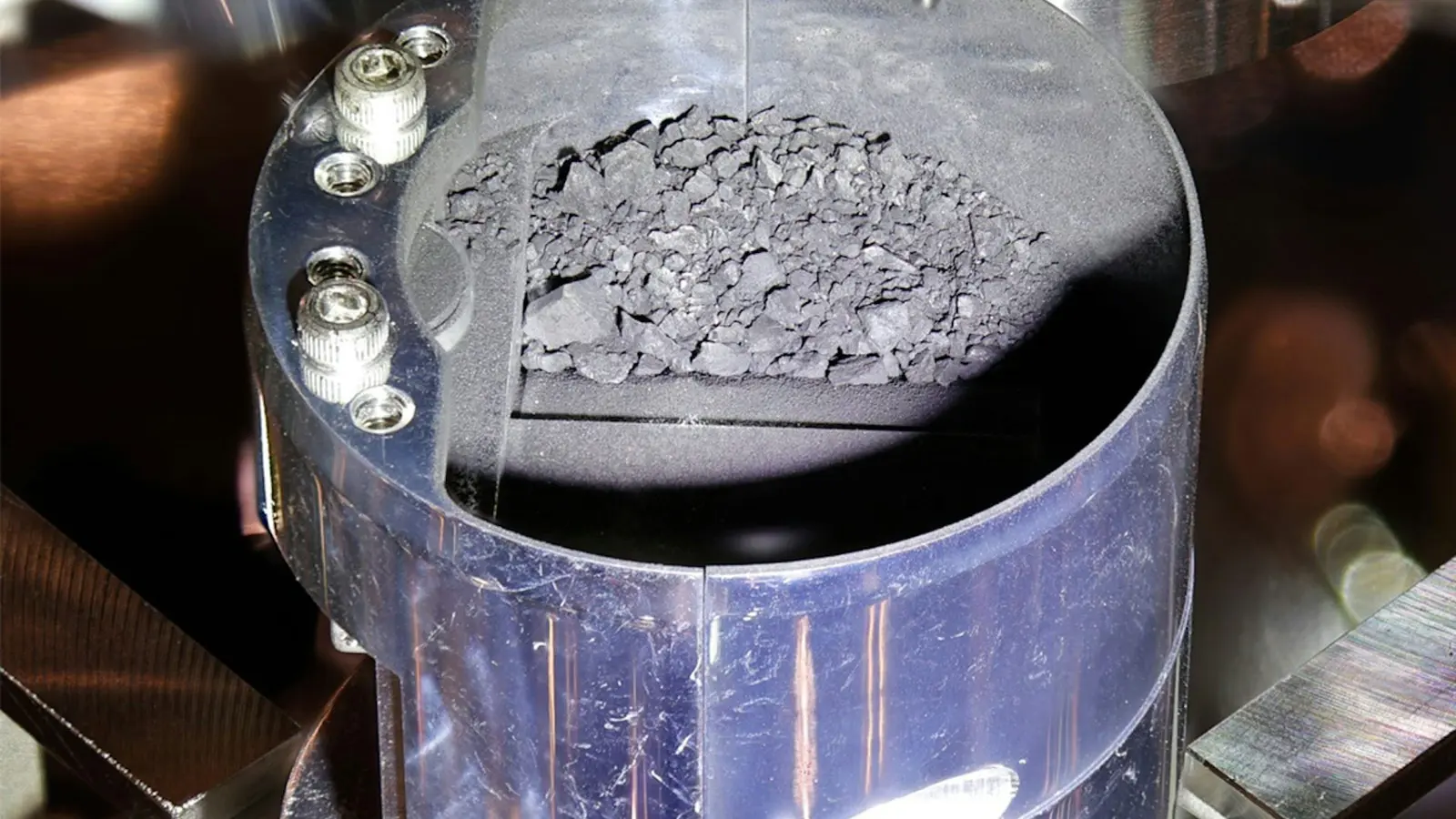
Hayabusa2 returned about 5.4 grams of Ryugu material to Earth in 2020. That might sound small. But in planetary science, carefully preserved grams matter immensely. These grains were handled in ultra-clean laboratories. Scientists extracted organics using water and mild acid, then purified and analyzed the extracts with sensitive mass spectrometry and chromatography. Controls were strict to rule out laboratory contamination.

Microscope images of Ryugu samples collected from the first and second touchdown sites of the Hayabusa2 mission.
The team found all five nucleobases in two separate Ryugu samples and in comparable abundances. That pattern echoes results from other space rocks. The Fall 1969 Murchison meteorite and the Orgueil meteorite catalogued in the 19th century both carry abundant organic molecules, including nucleobases. More recently, NASA’s sample-return mission from asteroid Bennu reported the full set in 2025. Those independent discoveries strengthen the interpretation: these compounds are not rare curiosities but likely widespread across carbon-rich asteroids.

What controls which bases form?
The balance between purines (adenine and guanine) and pyrimidines (cytosine, thymine, uracil) appears to depend on local chemistry. Ammonia, ice content, and the presence of simple organics can tilt synthesis toward one group or another. Murchison is relatively enriched in purines. Bennu and Orgueil show stronger pyrimidine signatures. Ryugu now joins the dataset and helps paint a more nuanced picture of prebiotic chemistry in space.

A coloured view of 162173 Ryugu taken by JAXA’s space probe Hayabusa2 in 2018.
What this means for the origins of life
If carbon-rich asteroids routinely carried nucleobases, then Earth received a steady chemical influx during its early history. Meteorite and micrometeorite delivery would have deposited a complex mixture of organic molecules across the primordial surface and shallow waters. Those molecules could have fed surface chemistry that later organized into self-replicating systems.
That does not answer how life began on Earth. It does, however, change where we draw the starting line. Rather than inventing every ingredient locally, early Earth may have mixed and matched components that were already available in space. Prebiotic chemistry becomes a story that spans planets and small bodies, not an event confined solely to our planet.
Expert Insight
"What makes the Ryugu results compelling is the combination of pristine sampling and careful laboratory work," says Dr. Maya Fernández, planetary chemist at a European research institute. "We are seeing consistent chemical themes across different asteroids. That pattern suggests the early Solar System had fertile chemistry for making the building blocks of life. The next step is to map how those molecules evolve once delivered to planetary environments."
The broader implication touches missions and models. Sample-return programs like Hayabusa2 and the OSIRIS-REx/Bennu campaign provide ground truth that remote sensing cannot. Laboratory studies of recovered material allow researchers to test reaction pathways, to see which molecular assemblies survive space, and which are sensitive to alteration. Those insights inform laboratory simulations and sharpen our models of early Earth chemistry.
Conclusion

Ryugu’s grains are a small but clear message: some of the chemical pieces for life were already present in the Solar System long before life took hold on Earth. The discovery of all five nucleobases in pristine asteroid material strengthens the view that delivery of extraterrestrial organics was a meaningful contributor to the prebiotic inventory. Future sample returns and targeted laboratory experiments will refine how these molecules influenced the path from chemistry to biology.

“My work centers on sustainability, energy, and environmental science — examining how innovation can lead to a greener future.”

Discussion
Leave a Comment
Comments (2)
Is contamination really ruled out though? Lab work messes up easily, curious what extra checks they ran... skeptical but intrigued
Whoa this is wild. Letters for life in asteroid dust? If true that's huge, mind blown. Makes me wonder how many planets got the same starter kit maybe life is just waiting?