
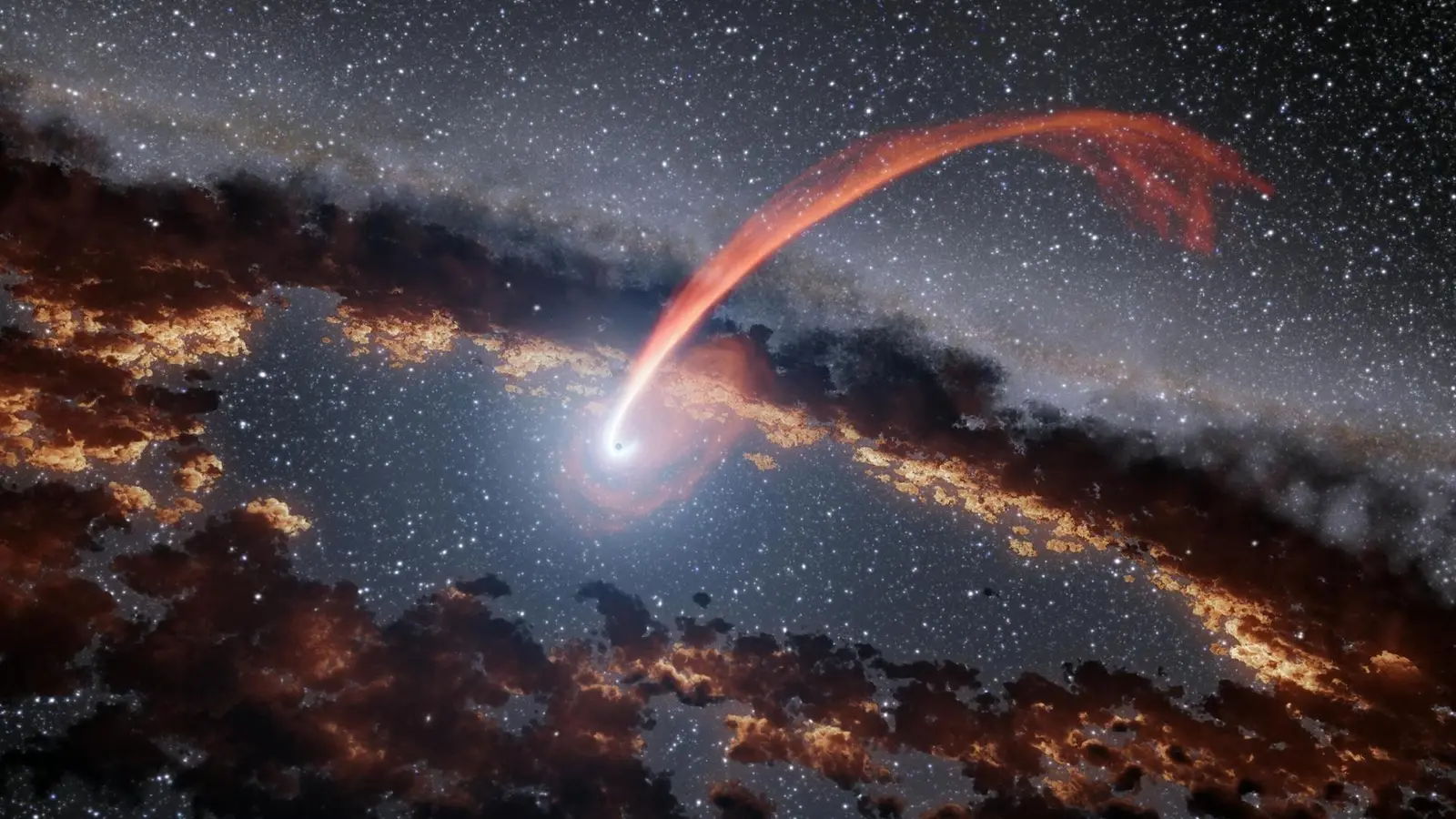
It looks like a cosmic dare. A sunlike star swings so close to the Milky Way’s central black hole that its orbital speed climbs to more than eight percent of light speed. Short, violent, and unmistakably telling.
The star that puts gravity on trial
Designated S301, this star is now the most relativistic member of the S-star family orbiting Sagittarius A*. Slightly more massive than our Sun, S301 completes a full circuit in just 8.7 years, the shortest orbital period recorded among its peers. Its path is highly elongated, bringing it to within roughly 140 radii of the black hole at closest approach, about 24 astronomical units in human units. At pericenter the star rockets between the orbits of Uranus and Neptune in our Solar System.
Why does this matter? Because at those distances and speeds, Newtonian gravity is no longer an adequate description. The differences between Newton’s law and Einstein’s general relativity become measurable. Some effects are familiar. Others only show up under extreme conditions.

Relativistic fingerprints: precession, redshift, and more
One of the clearest signatures is orbital precession. You may remember Mercury’s tiny perihelion advance as a successful early test of general relativity. S301 takes that test into a different regime. Each orbit produces roughly a two degree advance of the perihelion, orders of magnitude larger than Mercury’s effect. That kind of precession is impossible to miss with current astrometric techniques.
But precession is only the first-order story. At S301’s velocity, second- and third-order relativistic terms matter. Gravitational redshift will shift the star’s light toward longer wavelengths when it is deep in the black hole’s potential well. The transverse Doppler effect will alter the observed frequency because the star is moving at a significant fraction of light speed. Together these effects provide multiple, independent checks on relativistic predictions.
Spin, higher-order terms, and competing theories
General relativity is not the only theoretical framework on the table. Many attempts to reconcile gravity with quantum mechanics predict tiny deviations at high velocity or in strong fields, often at levels proportional to (v/c) squared or cubed. The spin of Sagittarius A* itself, and how that spin interacts with the star’s motion, adds another layer of subtlety. Measuring these higher-order contributions could help discriminate between GR and alternative models.
So S301 is not just a fast-moving star. It is a natural laboratory where competing gravitational theories leave different traces on motion and spectra.
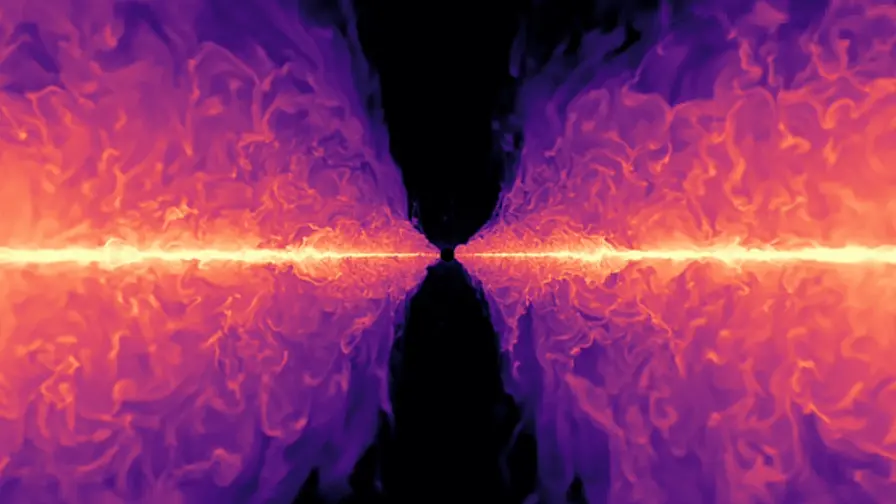

The observed orbit of the star S301.
Observational hurdles and the path forward
Despite the promise, S301 is a difficult target. The inner Milky Way is shrouded in dust, blocking optical light. Observers rely on infrared instruments to see through that veil. Yet a sunlike star at tens of astronomical units from a supermassive black hole is not especially bright in the infrared. Current facilities can track S301’s position and motion, but extracting high-quality spectra at key orbital phases remains a challenge.
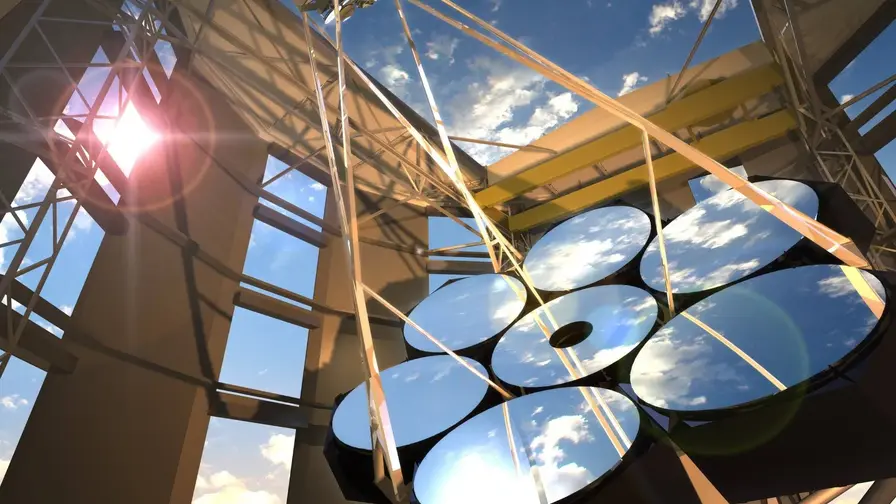
That is where the next generation of telescopes enters the story. Instruments such as the Giant Magellan Telescope will provide the spectral precision needed to measure second- and third-order relativistic effects. With sufficiently precise spectra taken near pericenter, astronomers could detect the combined signature of gravitational redshift, Doppler shifts, and frame-dragging caused by the black hole’s spin.
Timing matters. The most discriminating measurements will come as S301 passes close to Sagittarius A*. These windows are brief, and they require coordinated campaigns using the largest ground-based facilities and adaptive optics systems. Patience will be rewarded.
Expert Insight
"S301 gives us a rare opportunity to stress-test gravity in a regime we simply cannot reproduce on Earth," said Dr. Elena Márquez, an observational astrophysicist familiar with galactic center monitoring. "We already detect clear relativistic motion. With next-generation spectra we will be able to separate effects from the black hole’s spin, the star’s velocity, and any small anomalies that might hint at new physics."
Her remarks underline the practical and theoretical payoff. Even incremental improvements in measurement precision can rule out families of alternative theories or point the way toward necessary refinements in our understanding of gravity.
Conclusion
S301 is more than a remarkable speed record. It is a probe of strong-field gravity, a testbed for higher-order relativistic phenomena, and a target that will reward patience and technical investment. The coming decade of large telescopes and precise infrared spectroscopy promises to turn this fast-moving star into one of the clearest probes we have of how gravity behaves when pushed to its limits.

“The cosmos has always fascinated me. I write about space missions, astronomy, and the technologies pushing humanity beyond Earth.”

Discussion
Leave a Comment
Comments (2)
Ok cool, but can we really disentangle frame dragging from noise? IR dust, faint signal, instrument systematics, and tight timing windows... seems messy, hope they accouted for that
Whoa, S301 basically taunting the black hole? Gives me chills. Imagine the spectra we could get... will we catch the pericenter window? gotta be ready