
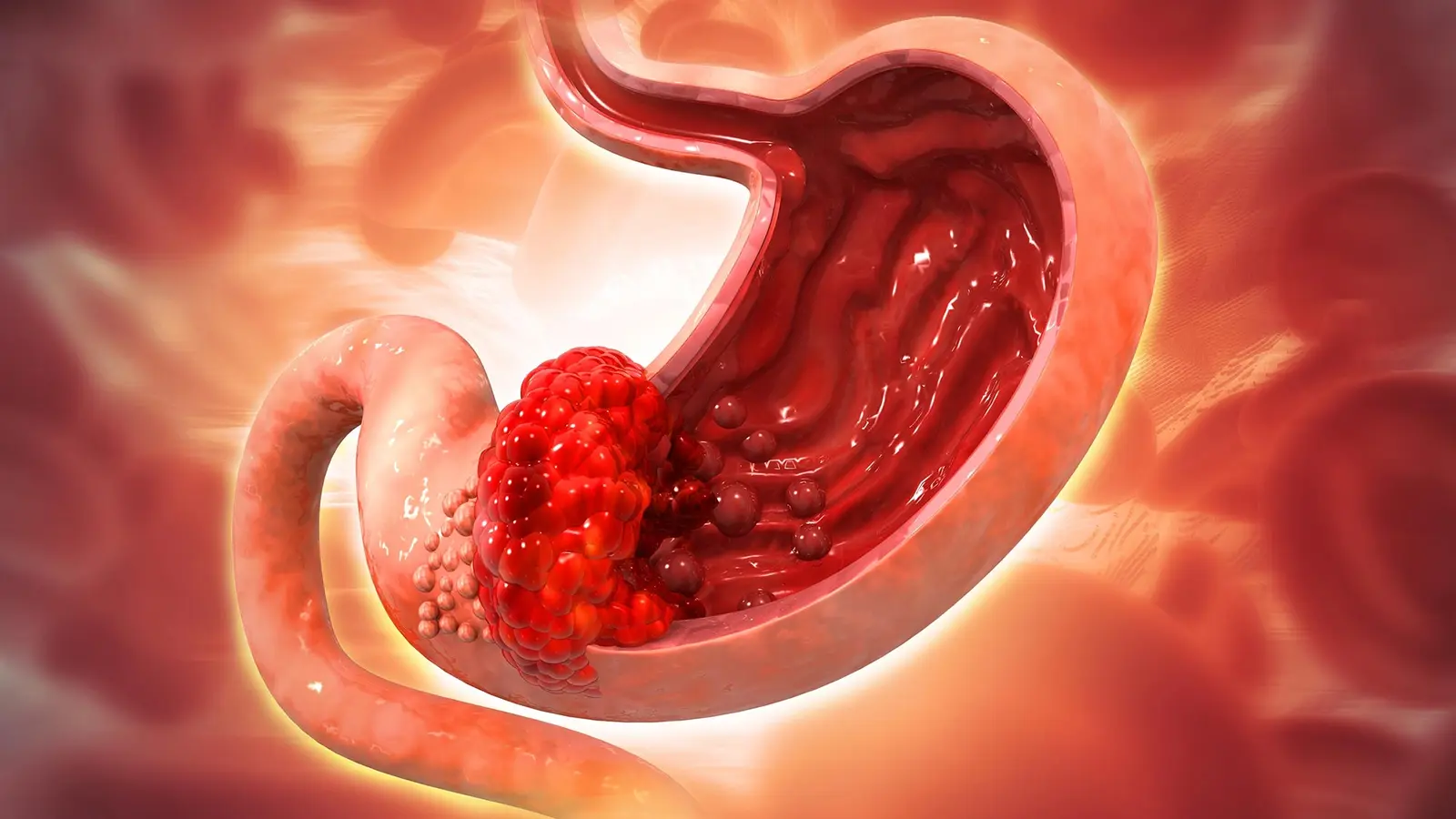
Imagine the stomach lining slowly changing its identity over years, like a city where the street signs subtly shift and new neighborhoods sprout where none existed before. No single event. A drawn-out drift. That is precisely what researchers at Charité in Berlin have been tracing: how a common bacterium nudges gastric tissue into a precancerous trajectory long before a tumor appears.
Stomach cancer often develops slowly, with changes in the stomach lining beginning years before a tumor appears. Scientists are studying how infections, inflammation, and altered cell signaling contribute to this process in hopes of finding ways to prevent the disease earlier. Credit: Shutterstock
When infection becomes a long conversation between cells
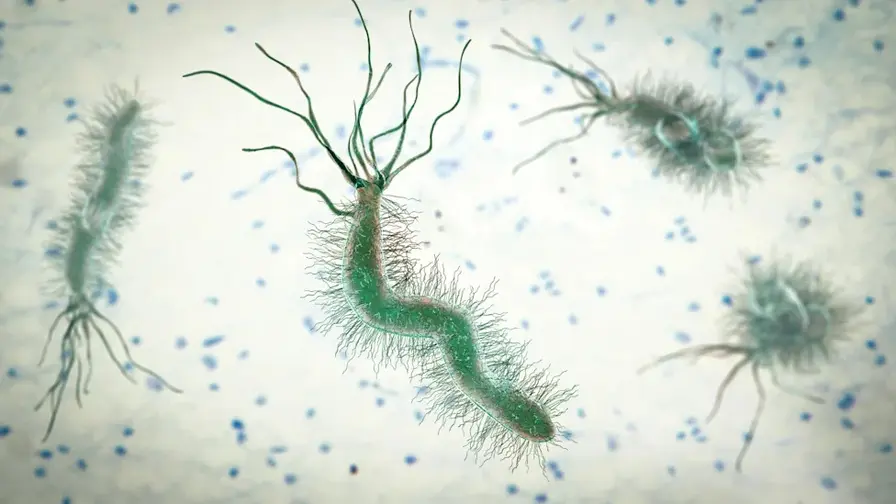
Helicobacter pylori is nothing exotic. It colonizes millions worldwide and can live in the stomach for decades. For most people it causes no immediate crisis. For a subset, particularly those with a family history of gastric cancer, the long-term presence of H. pylori sets a quiet but consequential chain of events into motion.
Researchers led by Professor Michael Sigal and Dr Manqiang Lin focused on that slow evolution. Their question was simple and stubborn: how does a chronic bacterial infection produce the structural and molecular changes that make healthy gastric lining look and behave differently, often years before any tumor is detectable?
It turns out the answer hides in the tissue between the epithelial surface and immune cells. The mucosa does not simply swell and proliferate because stem cells go haywire. Instead, the stomach activates a repair-like program normally reserved for wound healing and embryonic development. Under continuous inflammatory pressure, that program stays on and steers tissue toward a precancerous state.
Reconstructing the cellular conversation
To map this process the team used single-cell sequencing on tens of thousands of cells taken from diseased stomach tissue. This approach reads which genes are active in individual cells, and from that the researchers reconstructed who was signaling and who was listening.
They added layers to the experiment. Animal models allowed selective gene knockouts in certain cell types so the team could test causality instead of only correlation. In the lab they grew organoids, miniature stomach tissues, and assembled them with connective tissue cells to form assembloids. These hybrid systems let the scientists interrupt particular signaling pathways and watch which cell populations changed behavior.
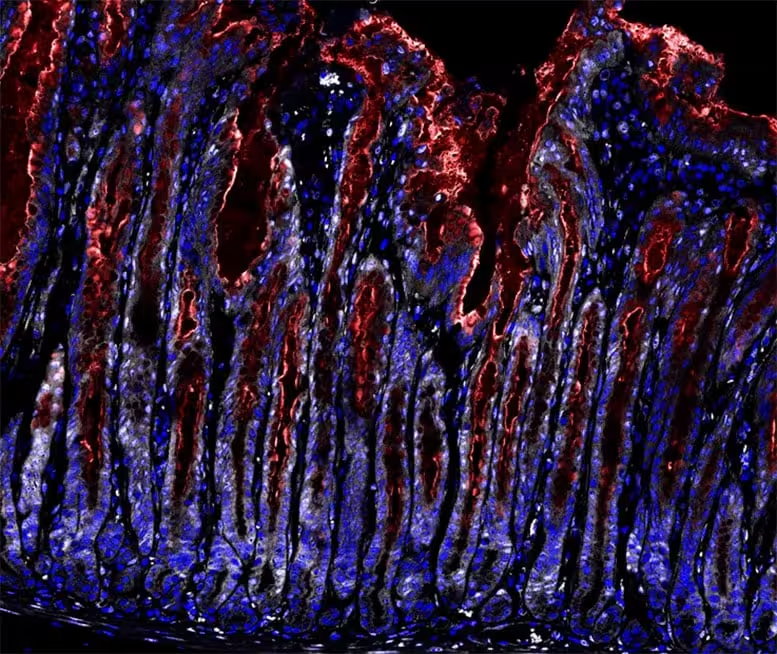
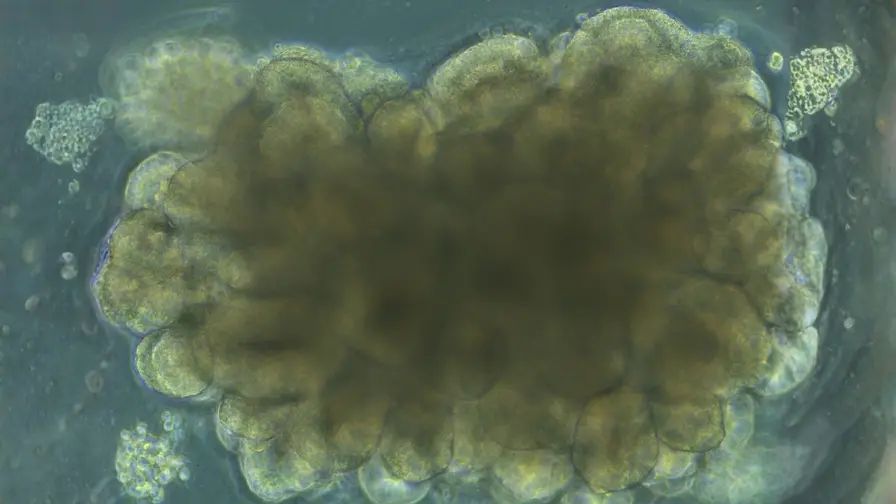
Stomach tissue infected with Helicobacter pylori. What starts off as a repair response, transitions into a chronic condition after years of infection and creates the preconditions for precancerous lesions. The mucus-producing surface cells are stained red. The active signaling pathway, which induces rapid tissue growth, is shown in white. In a healthy stomach, this function is almost completely shut down.
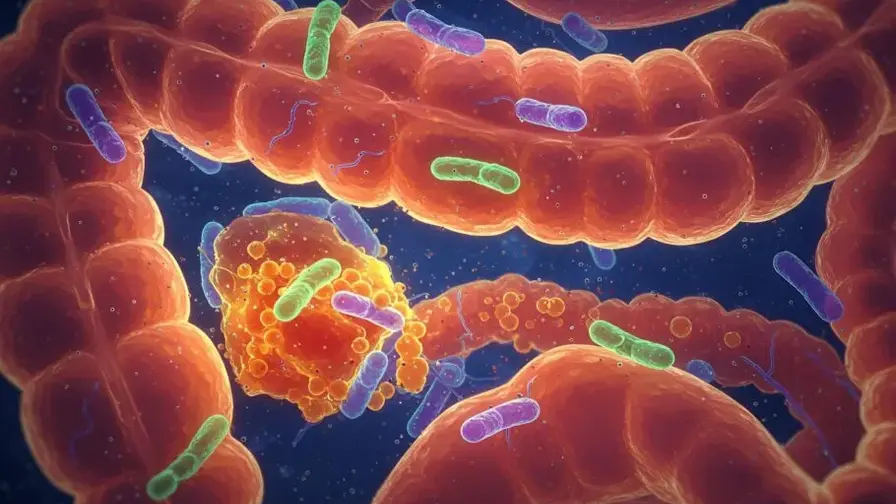
How inflammation, connective tissue, and epithelium conspire
The emerging picture is triangular. First, H. pylori compromises the stomach lining's usual bacterial tolerance and homeostatic signaling. That loss of balance recruits immune cells, which flood the tissue and release inflammatory molecules, prominently interleukin-1beta.
Crucially, interleukin-1beta does not act primarily on the epithelial surface. It changes the connective tissue beneath. Those fibroblast-like connective tissue cells respond by producing a wound-healing hormone. That hormone, in turn, flips a molecular switch in the mucosa, pushing surface cells into a rapid growth and repair program that is normally muted in the adult stomach.
A sequential chain, not a single trigger
One event primes the next. Loss of epithelial regulatory signals allows immune infiltration. Immune signaling rewires connective tissue. Connective tissue then reprograms the epithelium. Over years, this stepwise sequence sculpts tissue architecture and gene expression toward a precancerous identity.
Giulia Beccaceci, a first author on the paper, summarized the result as a familiar program taking an unfamiliar form: the stomach lining is not merely proliferating. It is adopting a developmental repair state and staying there under chronic insult.
Where interventions might break the chain
These mechanistic insights create clear opportunities for prevention. The most direct measure remains eradication of H. pylori. Remove the persistent irritant and you remove the ongoing stimulus that keeps the chain running.
Yet eradication is sometimes insufficient. In a subset of patients the stomach lining appears to remain reprogrammed even after the bacterium is gone, leaving a lingering cancer risk. That persistence is why Sigal and colleagues are hunting for molecular markers that indicate whether tissue has already embarked on a precancerous path. Identifying those markers could let clinicians triage patients who need more intensive surveillance or targeted therapy.
On the therapeutic side, the study points to the connective tissue response to interleukin-1beta as an actionable node. If fibroblasts and related stromal cells could be made insensitive to that inflammatory cue, the downstream activation of the epithelial repair program might be prevented.
Population studies offer a hint of support. Regular use of certain anti-inflammatory drugs has been associated with lower risk of gastrointestinal tumors. Those drugs can inhibit COX-2, an enzyme that participates in inflammatory networks linked to tissue remodeling. This does not prove causality for this specific chain, but it aligns with the idea that modulating inflammation and stromal response could lower risk.
From discovery to clinic: testing and monitoring
What should clinicians and at-risk individuals take away now? First, testing and treating H. pylori remains a practical and proven cancer-prevention strategy for people with risk factors such as a family history, persistent gastrointestinal symptoms, or known infection. Eradication therapy is straightforward and reduces long-term risk by removing the chronic irritant.
Second, not everyone returns to a pre-infection state. That uncertainty motivates the Charité team to create molecular assays that detect reprogramming in mucosal biopsies. The goal is to recognize a tissue on the road to precancer before malignant cells appear.
To support that work the institution is establishing a Cancer Prevention Clinic aimed at people with elevated stomach cancer risk. Paired with the ImmunoPreCept Cluster of Excellence, researchers will collect tissue over time and refine the molecular staging of precancerous changes. The larger aim is prevention before a tumor exists, not just earlier detection.
Expert Insight
'This study reframes the problem,' says Dr Laura Chen, a gastroenterologist and translational researcher not involved in the study. 'It highlights the stroma as an active participant, not background tissue. From a clinical viewpoint, that opens new biomarker strategies and therapeutic windows. If we can intervene at the stromal level, we may stop the process while it is still reversible.'
Chen notes the practical implications. 'Testing for H. pylori is cheap and effective. But combining eradication with targeted monitoring for tissue reprogramming could be the step-change in prevention we have been missing.'
Implications and future prospects
There are broader implications beyond stomach cancer. The idea that chronic infection and inflammation can push adult tissue into developmental repair programs might apply to other organs and diseases. Whenever stromal cells sit between immune signaling and epithelial behavior, similar triangular dialogues could exist.
For now, the immediate takeaways are tangible. Eradicate H. pylori when found. For those with persistent risk, pursue monitoring. And support research into stromal-targeted therapies and biomarkers. The Charité study supplies a mechanistic map. Translating that map into clinical tools will require validation, trials, and time, but the route is now visible.
Conclusion
Stomach cancer does not appear overnight. It is the outcome of a multi-step process that can begin with a common bacterium. By tracing the conversation between immune cells, connective tissue, and epithelial cells, researchers have identified how a wound-healing program goes off course and how that derailment can be intercepted. Eradication of H. pylori remains essential. The next frontier is to detect tissue reprogramming earlier and to block the stromal signals that lock tissue into a precancerous state.

“My work centers on sustainability, energy, and environmental science — examining how innovation can lead to a greener future.”

Discussion
Leave a Comment
Comments
No comments yet. Be the first.