
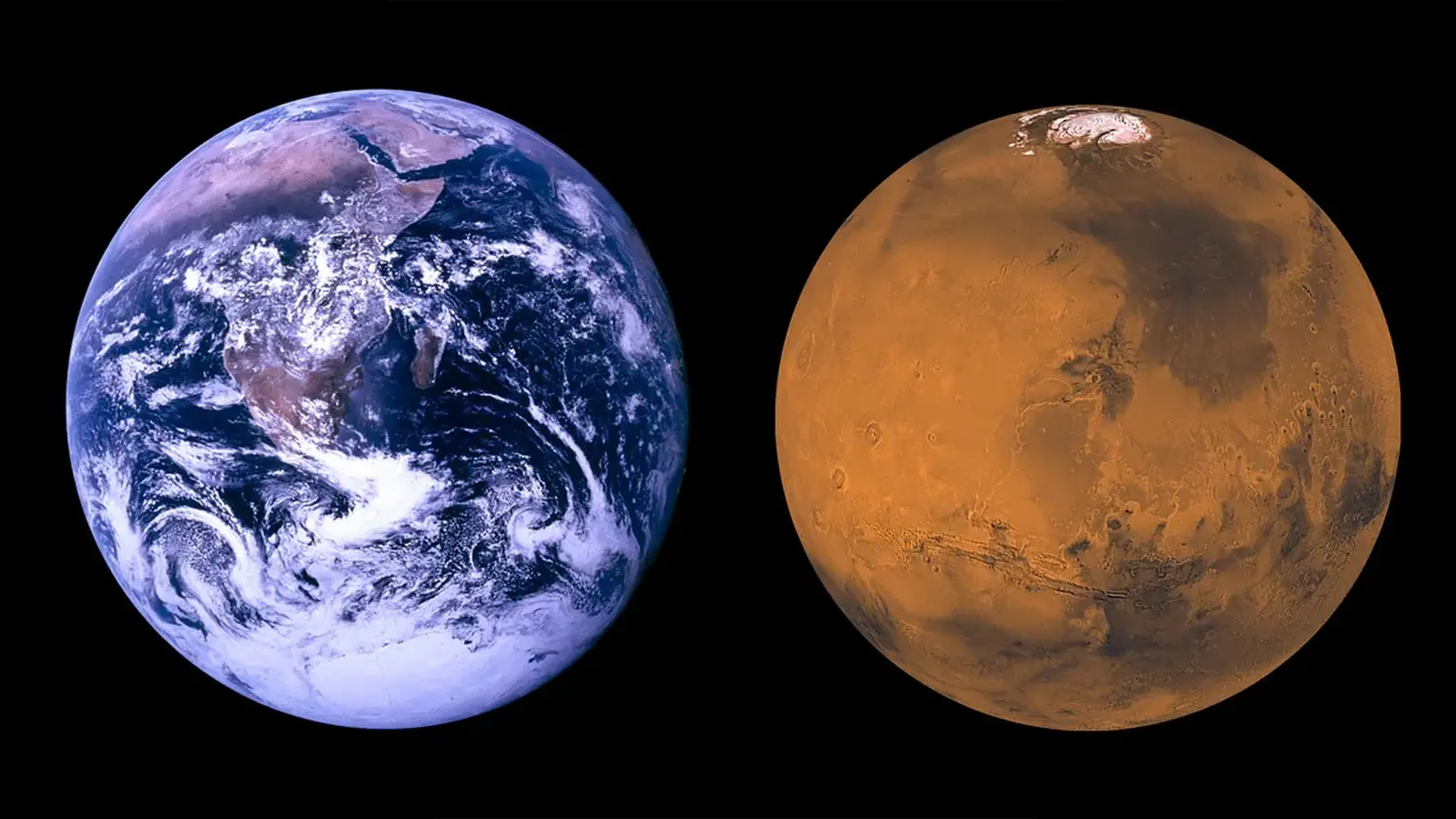
Earth and Mars were born in the same neighborhood of a young Sun, yet they ended up with markedly different blueprints. That contrast is not a quirk. It is a fingerprint left by how each world assembled itself when the Solar System was still a chaotic construction site.
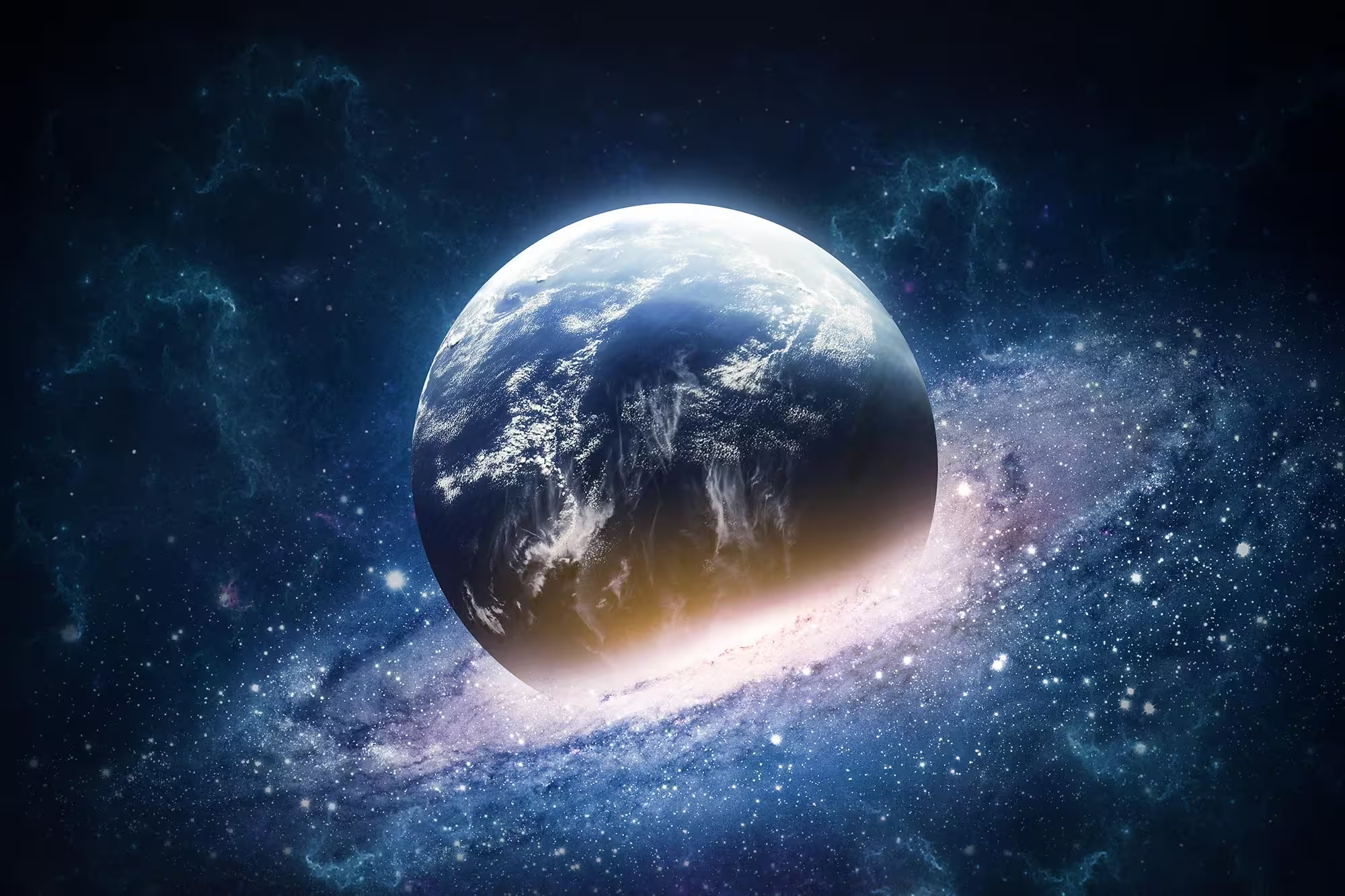
Earth formed about 4.5 billion years ago from dust, rock, and gas surrounding the young Sun. Over time, this material collided and merged into a growing planet, while intense heat, impacts, and internal melting helped shape Earth’s core, mantle, crust, and eventually the conditions that made life possible.
Why two nearby planets tell such different stories
New work led by researchers at the Globe Institute, University of Copenhagen, suggests Earth and Mars grew through different mixes of the same building processes. The result feels counterintuitive at first. If two planets form side by side, shouldn’t they share a common origin story? Not necessarily.
Planetary growth can follow several routes. One is violent: kilometer-scale planetesimals collide and merge, building ever-larger bodies in a series of energetic impacts. The other is subtler: pebble accretion, where centimeter- to meter-sized particles are swept up efficiently by a growing protoplanet’s gravity and gas drag. Both can act together, and the balance between them changes a planet’s chemistry and thermal history.
The Copenhagen team combined chemical data from planetary interiors with numerical models to test which assembly histories match what we see in Earth and Mars today. Their conclusion: Earth and Mars are cousins with different upbringings. Earth’s bulk appears to trace back mainly to two sizeable protoplanets that grew rapidly by gobbling pebbles, while Mars looks more like a patchwork of planetesimals.
A tale of pebbles, planetesimals and volatile clues
The key evidence comes from volatile elements such as sodium, zinc, and potassium. These elements vaporize more easily at high temperatures, so their present-day abundances in a planet’s crust and mantle preserve clues about the heat and processing that occurred during formation. Think of them as thermometers and time capsules combined.
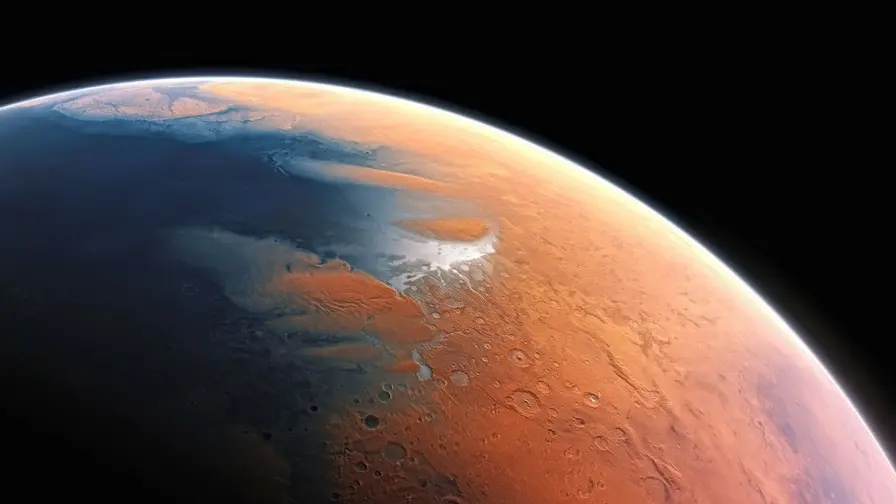
By matching modeled accretion scenarios to those chemical fingerprints, the researchers estimate that at least three quarters of Earth’s mass derived from two protoplanets that had grown large through pebble accretion, with planetesimals contributing the rest. Mars shows nearly the opposite split: roughly 75 percent of its mass appears to come from planetesimals, and about 25 percent from pebble accretion.
That difference matters. Pebble-dominated growth tends to be fast and can heat and mix material differently than a planet assembled primarily from larger collisions. The temperature history controls how many volatile elements survive, which in turn affects water delivery and the inventory of life-essential compounds.
Limits and assumptions
No model is free of uncertainty. The initial composition of the Solar System’s dust and rocks is not known precisely. The team tested multiple starting assumptions and found the Earth-versus-Mars contrast persisted, even if the exact percentages shifted. Compared to isotope-based reconstructions, which can be open to multiple interpretations, this chemistry-plus-model approach aims to be more direct about the physical processes that drove growth.
Why this matters beyond our backyard
Understanding the mechanics of rocky planet formation has clear payoffs. A planet’s formation pathway helps determine how much volatile material it retains, including water. That influences surface conditions, atmosphere formation, and long-term habitability. If pebble accretion often produces volatile-poor interiors, while planetesimal-heavy growth preserves more volatiles, then the assembly history becomes a crucial variable when we assess whether exoplanets might host oceans or atmospheres suitable for life.
The method used here could be adapted to characterize distant rocky worlds once we can constrain their bulk compositions. Spectra, combined with refined models, could eventually reveal whether an exoplanet grew through pebbles, planetesimals, or a mix of both. That would move us from simple size-and-distance classification toward a formation-based taxonomy of terrestrial planets.
Expert Insight
"These results push us to treat planetary siblings as individuals rather than carbon copies," says Dr. Mira Solano, a planetary scientist at the Jet Propulsion Laboratory. "Knowing how a planet assembled gives context for everything from its magnetic field history to its capacity to hold water. It's not just where a planet formed, but how it got there."
The Copenhagen study reshapes a familiar narrative: proximity in space need not imply similarity in origin. Earth’s relatively pebble-rich upbringing and Mars’ planetesimal-dominated past hint at the varied architectures that can arise in a single planetary system. That variety will be important to keep in mind as telescopes and missions collect ever more detailed chemical fingerprints from planets near and far.

“The cosmos has always fascinated me. I write about space missions, astronomy, and the technologies pushing humanity beyond Earth.”

Discussion
Leave a Comment
Comments
No comments yet. Be the first.