
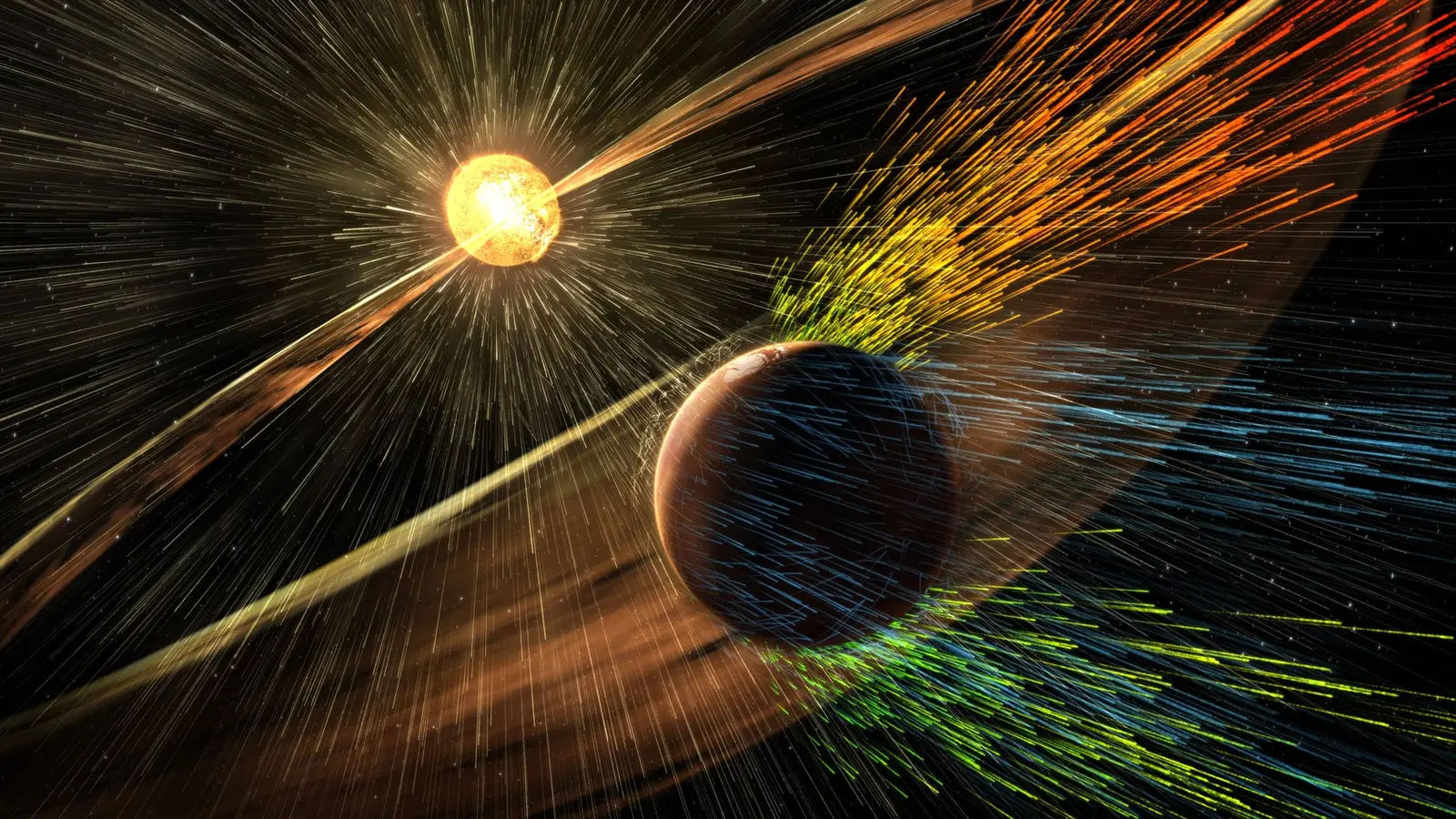
A ripple forms at the edge of Mars’ upper atmosphere. Not a tide of water, but a shear-driven wave where thin ionized gas meets the onslaught of the solar wind. It looks small. Yet these ripples—Kelvin-Helmholtz waves—could be one of the subtle mechanisms peeling ions away from the Red Planet.
When wind meets sky
Observations from NASA’s MAVEN spacecraft captured an unbroken sequence: the solar wind hitting Mars, the birth of Kelvin-Helmholtz waves at the planet’s atmospheric boundary, and a measurable loss of atmospheric ions streaming away. In plain terms: the Sun’s charged breeze skims past Mars and rolls up the tenuous upper atmosphere like wind-driven ripples on a pond. Where those ripples grow, they can tug charged particles free.
What are Kelvin-Helmholtz waves? They are a fluid-dynamics phenomenon that appears whenever two layers of fluid or plasma move at different speeds. On Earth, you might glimpse them in cloud bands. Around Mars, they form where the solar wind slips past an atmosphere lacking a strong global magnetic shield.
Why this matters
We know Mars lost much of its air over billions of years. The big question is how. Sputtering by charged particles, photochemical escape, and interactions with the solar wind all play roles. These new observations provide a direct link in one sequence: incoming solar wind conditions, the formation of Kelvin-Helmholtz waves, and the resulting removal of ions. That chain bolsters the idea that boundary waves are a meaningful contributor to atmospheric escape.

Depiction of Solar wind and electric field interacting.
“Future research will focus on identifying the conditions that favor the formation and growth of Kelvin-Helmholtz waves and determining how much they contribute to atmospheric escape from Mars,” said Jingnan Zhang, summarizing the priorities laid out by the MAVEN science team. Short answer: we can now see the process in action, but we do not yet know how often it happens or how large its cumulative effect has been.
Practical limits remain. MAVEN is entering the closeout phase of its mission, so a continuous, long-term dataset will require additional assets. Fortunately, researchers expect NASA’s ESCAPADE mission to extend this work. ESCAPADE offers another chance to observe how changing solar-wind conditions trigger or suppress these waves and to compare their impact against other escape mechanisms.
There is also a broader implication. Any planet without a strong global magnetic field—whether in our solar system or orbiting another star—could develop similar boundary waves when stellar winds push directly into an upper atmosphere. That makes these findings relevant to exoplanet habitability studies as well as to understanding Mars’ transition from a warmer, thicker world to the cold, arid planet we see today.
“We want to know when these waves are most likely to form, how they evolve, and how strongly they can drive atmospheric escape,” said Chuanfei Dong, a faculty member at Boston University’s Center for Space Physics. The sentence sums up the path forward: targeted observations paired with advanced numerical models.
More spacecraft and better simulations will be needed to turn snapshots into statistics. Only then can scientists quantify how much of Mars’ missing atmosphere can be blamed on waves rolled up by the Sun.

“The cosmos has always fascinated me. I write about space missions, astronomy, and the technologies pushing humanity beyond Earth.”

Discussion
Leave a Comment
Comments
No comments yet. Be the first.