

Before dawn on a coming Friday, a giant rocket will attempt to write its next chapter. SpaceX announced a planned liftoff at 02:15 local time, when its Starship system will make another run after a dramatic scrub in mid-July.
A second chance at first light
On July 16 the thirteenth test flight of Starship was halted seconds before ignition because of a propulsion fault. The sudden cancellation rippled through markets and, by some estimates, erased about €93 billion from SpaceX’s market valuation. Now the company says it has optimized and repaired the propulsion system that caused the abort.
Short sentences. Long explanations. Engineers go over telemetry. They tweak valves and software. Then they test again. That is how experimental rocketry advances.
What this flight will actually do
This thirteenth attempt is not a pure orbital insertion test. Starship will carry 20 Starlink satellites intended to validate the satellite release mechanism and inter-satellite laser links. The satellites are scheduled to follow a suborbital trajectory and will re-enter the atmosphere shortly after separation, burning up on re-entry. The run is a rehearsal of deployment and communications hardware rather than a full operational satellite deployment to orbit.
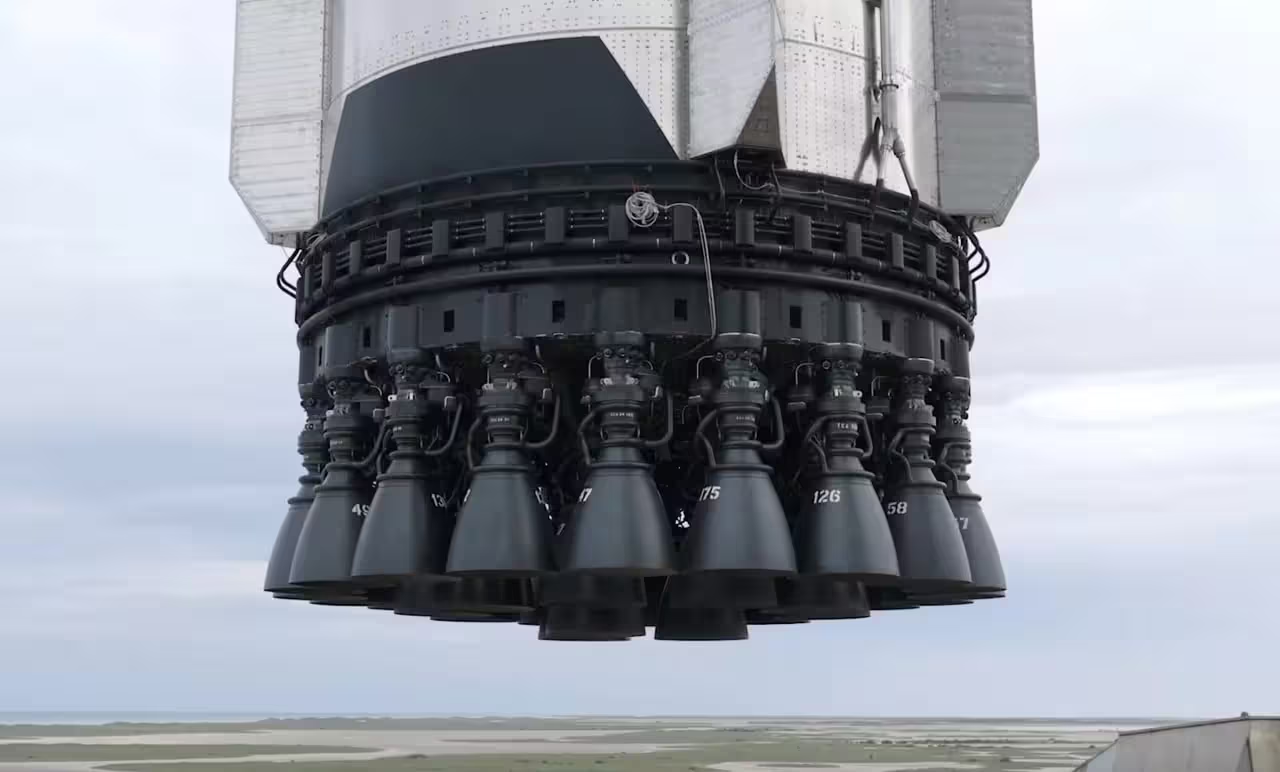
SpaceX has run a dozen test flights of Starship since 2023. The program, valued at roughly €14 billion in development costs, has been notable both for engineering milestones and for high-profile failures that pushed design improvements. Each explosive test has taught teams where materials, avionics, or engines need reinforcement.
Why send Starlink hardware on a flight that ends in re-entry? Simple: live tests reveal how release springs behave in real conditions, whether pointing accuracy of laser links meets expectations, and how separation dynamics affect the parent vehicle. Simulations are essential. But nothing substitutes a real-flight proof-of-concept.
SpaceX issued a concise statement saying the propulsion anomaly had been addressed and that teams were confident in the mitigations. The company also reiterated an internal goal to begin placing Starlink satellites into orbit aboard Starship by the end of the year, followed by regular operational launches should tests proceed successfully.
There is risk. There is schedule pressure. And there is the bigger picture: Starship is designed as a heavy lifter for science, commerce, and eventually human missions. Every test brings the system closer to routine access to space, even if the path has been uneven.

“My work centers on sustainability, energy, and environmental science — examining how innovation can lead to a greener future.”

Discussion
Leave a Comment
Comments
No comments yet. Be the first.