
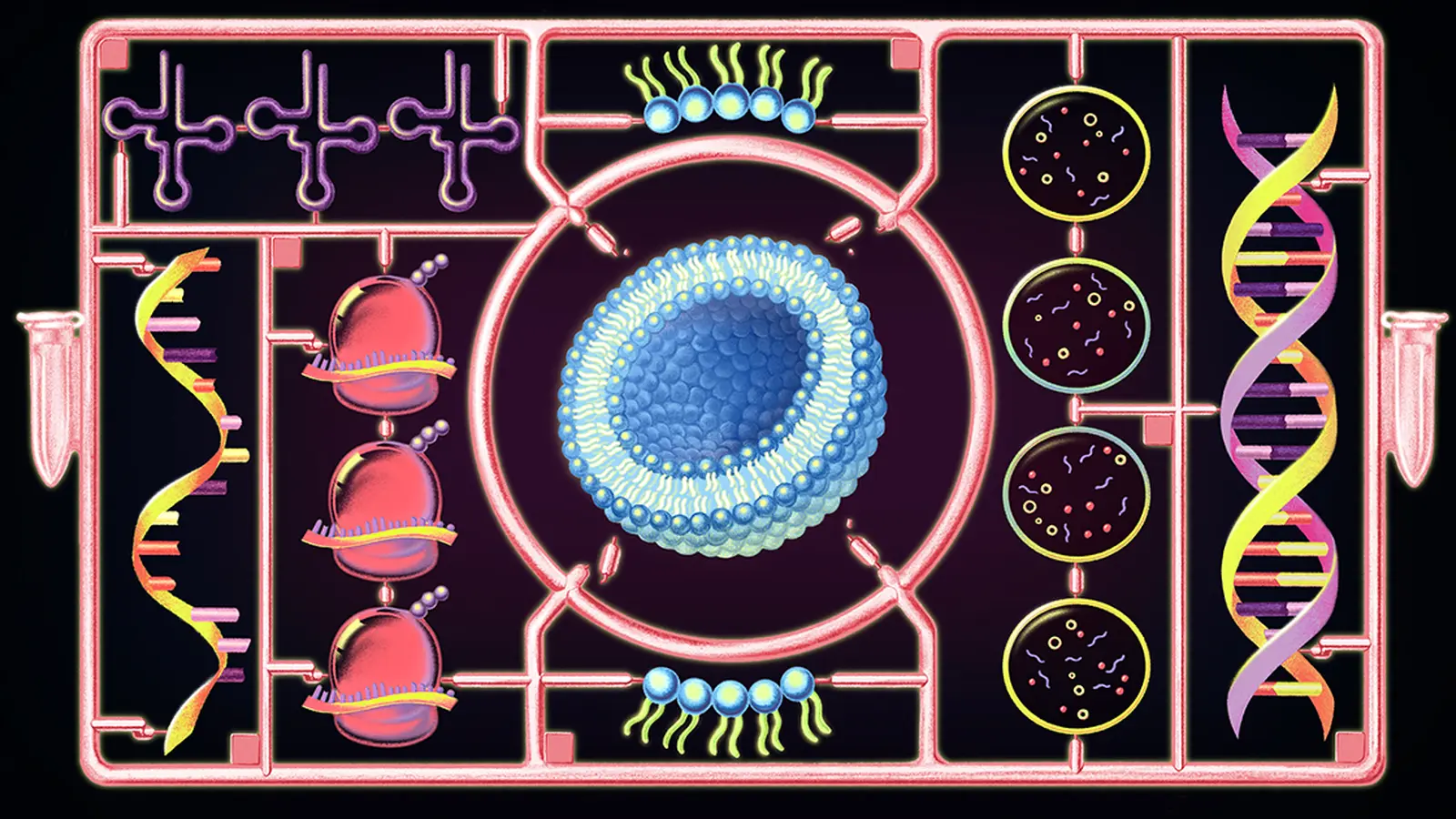
Imagine a tiny bubble of fat that reads DNA, manufactures proteins, grows and then splits. It is not alive in the fullest sense, but it behaves like a cell for a single life cycle. Scientists at the University of Minnesota have announced just such a construct, calling it SpudCell, and the result forces us to rethink where chemistry ends and biology begins.
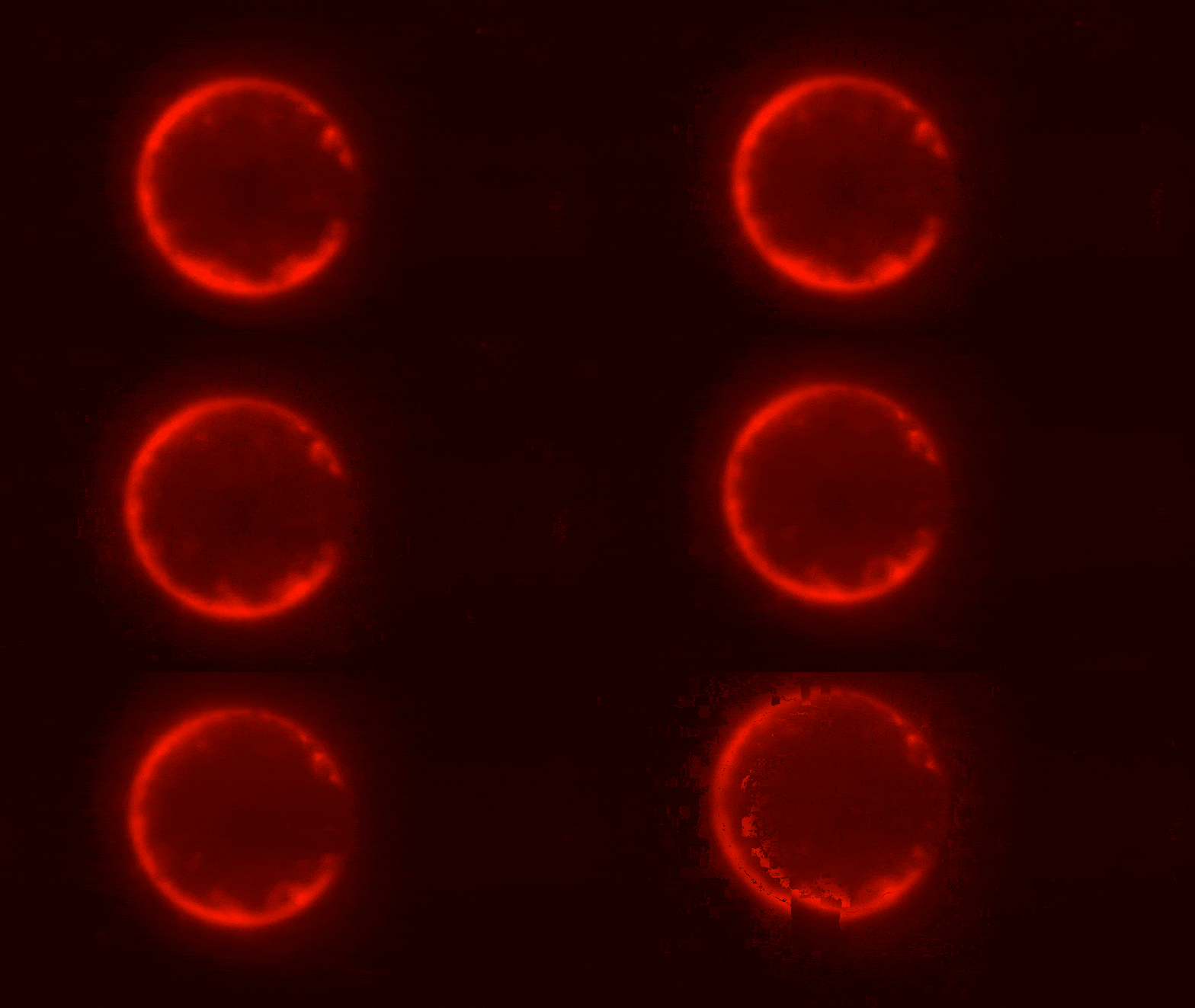
A video of SpudCell - a synthetic cell assembled entirely from non-living chemical components - containing both a genome and the metabolic machinery to read it. The red membrane is stained with lipid dye.
“This is likely the most exciting project I’ve ever worked on,” says synthetic biologist Kate Adamala, who co-led the effort. The team reports that SpudCell completed a full cell cycle, including growth, genome replication and division. They describe a system built entirely from non-living parts that carries and uses genetic information to make functional proteins.

A super-resolution image of SpudCell's liposomes with an encapsulated genome and active protein expression. SpudCell is the first synthetic cell system built from non-living components to complete a full cell cycle.
How SpudCell is assembled and what it does
At its heart SpudCell is a liposome, a spherical shell of lipids that mimics a cell membrane. Inside that shell the researchers placed seven plasmids that together total about 90 kilobase pairs of DNA. For scale, the human genome is roughly 3 million kilobase pairs and earlier estimates for a minimal viable genome placed the floor near 113 kbp. SpudCell undercuts that threshold and still carries out recognizable cellular behaviors.

Fluorescent microscopy of SpudCell, a synthetic cell assembled entirely from non-living chemical components, undergoing division.
The system includes a built-in protein expression apparatus. In plain language, the cell has the chemical machinery to read instructions encoded in its DNA and translate them into proteins. Those proteins then enable resource uptake from the surrounding liquid, build components, and ultimately drive division. The researchers summarize the observed functions as selection, genome replication, growth, resource acquisition via feeding, and genetically encoded division.
Where SpudCell stretches the boundary between chemistry and life
SpudCell is a proof of concept. It is not living in the evolutionary sense, because it cannot sustain indefinite self-replication or evolve over multiple generations. That limitation prompted one reviewer at the journal Cell to argue the work did not qualify as conventional biology. The team has shared a preprint on the website of Biotic, a nonprofit bioengineering institute co-founded by Adamala, while formal peer review continues.
The simplicity is both a strength and a constraint. SpudCells do not make their own expression machinery; they depend on molecules supplied in the surrounding medium. They lack an internal cytoskeleton, so they cannot move cargo inside the compartment, nor can they actively clear waste. As a result each synthetic cell survives for only a few generations at best.

The cell cycle of synthetic cells with 90 kbp genome, undergoing selection replication.
Potential uses and realistic limits
Why build something like this? There are two big motivations. One is scientific: to locate the threshold where non-living chemistry becomes life-like behavior. The other is practical: a minimal, synthetic cell could be programmed as a bespoke microfactory for making drugs, specialty chemicals or biomaterials with precision that living microbes cannot match.
Yet hurdles remain. Without autonomous production of its protein-making machinery or internal regulation of metabolism, a synthetic cell cannot yet replace engineered bacteria in industrial or medical production. The absence of evolution is a double-edged sword. It prevents unwanted mutation in production strains, but it also blocks adaptive improvements that can make biological systems robust in real-world conditions.
Expert Insight
“This is a pivotal demonstration,” says Dr. Lina Morales, a synthetic biology researcher not involved in the work. “SpudCell shows that a carefully designed set of polymers and enzymes can recreate core cell behaviors. The next steps will be adding stability, error correction and metabolic autonomy. If those can be engineered without introducing the hazards of self-sustaining life, the applications are significant.”
Beyond practical concerns, the experiment has philosophical weight. It forces a clearer definition of life. Do we require open-ended evolution, metabolic autonomy, or simply the capacity to read and act on genetic information? SpudCell sits at the edge of that question.
For now the paper is a preprint, and the community will scrutinize replication, controls and limits. If independent groups reproduce the findings, SpudCell will become a landmark in bottom-up synthetic biology: a chemical system that reproduces a full cellular cycle while remaining transparently engineered.
There is no magic spark here. Instead, there is chemistry arranged with intent. That arrangement is valuable whether the goal is to understand life’s origins or to design new, contained platforms for manufacturing. Expect fast follow-up work, careful debate, and gradual improvements. The story is just beginning.

“The cosmos has always fascinated me. I write about space missions, astronomy, and the technologies pushing humanity beyond Earth.”

Discussion
Leave a Comment
Comments (2)
is this even true? impressive demo but depends on lots of supplied parts, no metabolic autonomy yet.. feels a bit overhyped tbh
wow, tiny fat bubble that reads DNA? no way. if they add stability and error correction, this could change biotech. mind blown