
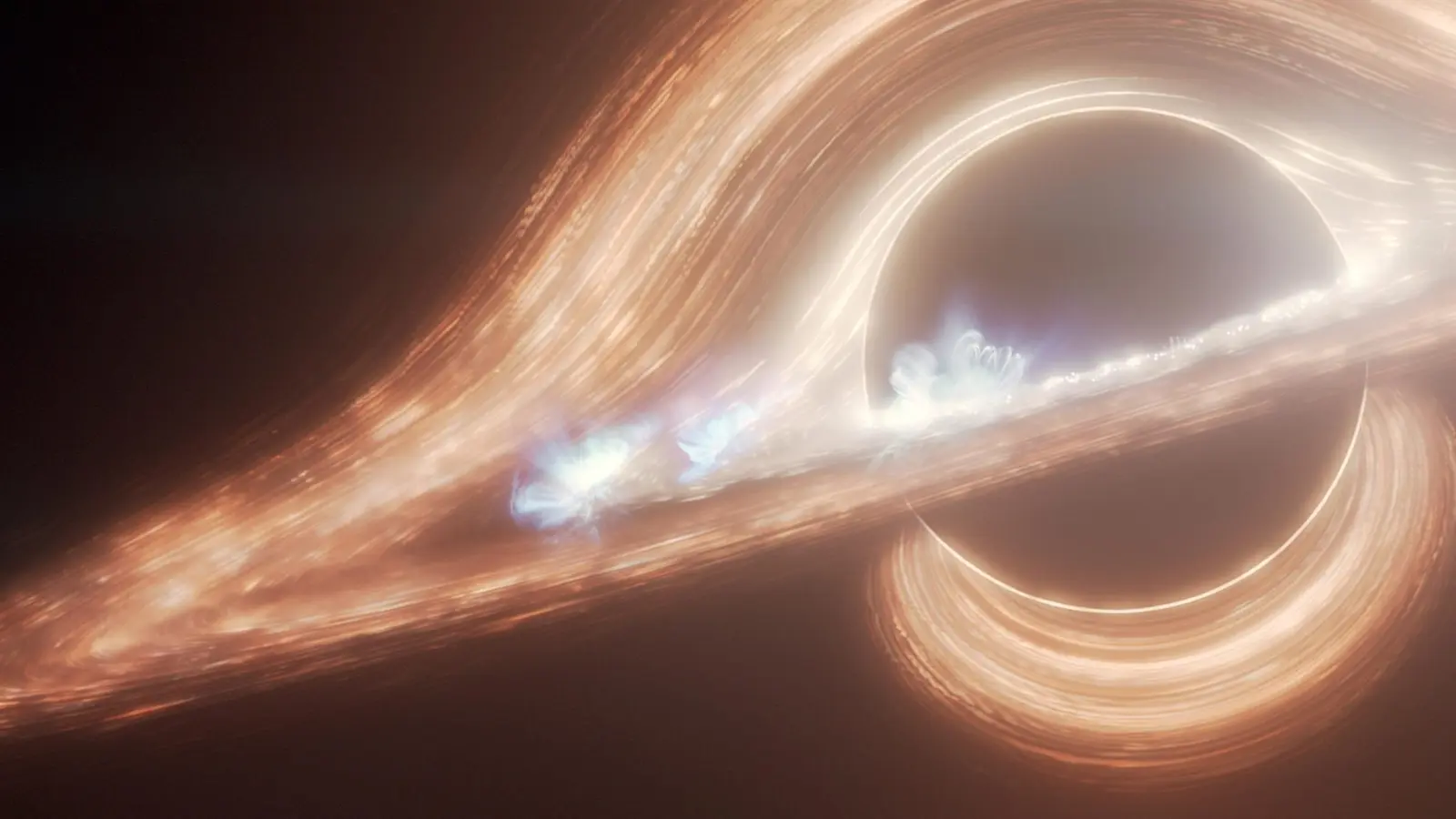
This is not a quiet fade into darkness. Close to the Milky Way’s central black hole, a mature star called IRS 3 is shedding gas and dust at a speed that surprises astronomers, expanding a vast envelope of material into an environment once thought too hostile for molecules to survive.
How Webb changed the picture
The scene comes into focus thanks to the James Webb Space Telescope and its Mid-Infrared Instrument, MIRI. Using mid-infrared wavelengths, Webb reveals thermal emission from dust and spectral fingerprints from molecules, allowing astronomers to map both the size and the chemistry of IRS 3’s envelope. The team that led the observations is headed by PD Dr. Florian Peißker at the University of Cologne, and their results appear in Astronomy & Astrophysics.
IRS 3 sits roughly 0.6 light-years from Sagittarius A*, which equals about 42,000 astronomical units. For scale, Voyager 1, humanity’s most distant probe, would need around 10,000 years to travel that distance at its current speed. On galactic terms, IRS 3 is unusually close to the supermassive black hole.
A star in a superwind phase
The new observations revise earlier ideas about IRS 3. Previously the object was enigmatic; now MIRI data point to a phase known among astronomers as a superwind. That term describes a late stage in a massive star’s life when radiation pressure and internal processes drive off prodigious amounts of mass. For IRS 3, the loss is dramatic: roughly one Earth mass every 18 days is blown into space, continuously inflating an envelope that reaches about 10,000 astronomical units from the star.
That rate of loss explains two things at once: why the envelope is so large, and why it remains dense despite the chaotic environment near the Galactic Center. Dense clumps of dust and gas can survive radiation and shocks far longer than a diffuse shell would.
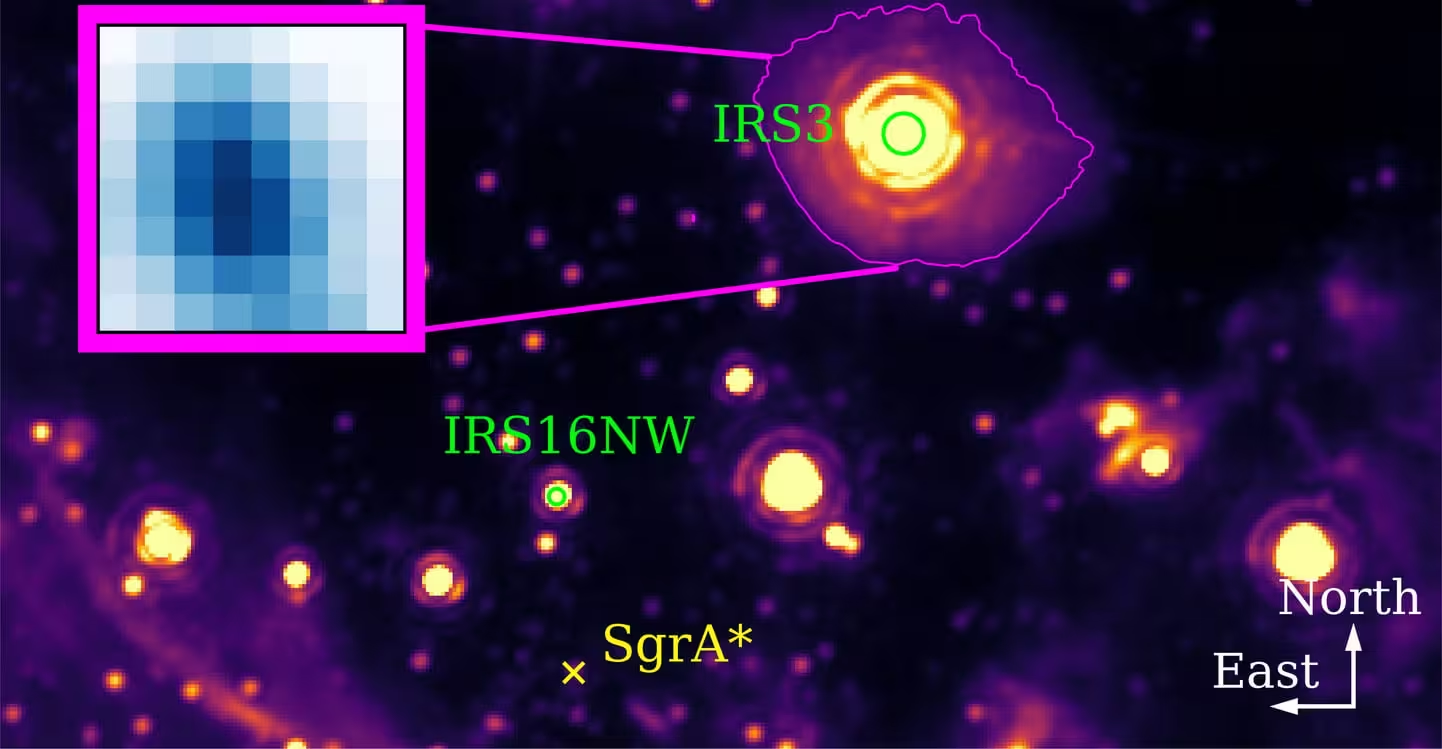
The center of our galaxy and the surroundings of the supermassive black hole SGR A*.
Water where you might not expect it
Even more striking is the chemical inventory inside that envelope. Webb detected signatures consistent with water. The galactic center is flooded with high-energy photons, stellar winds, and past activity from Sgr A* that should, in theory, destroy fragile molecules. Yet water appears to survive inside IRS 3’s cocoon.
Why does this matter? Because it shows that stars near a supermassive black hole can inject molecular material into their surroundings. Those molecules include species linked to organic chemistry, and their survival challenges assumptions about how extreme environments cleanse the interstellar medium. The finding implies a more complex and resilient chemistry in the central parsec of our galaxy than models had suggested.
Numbers that catch the eye
- Distance from Sgr A*: about 0.6 light-years (42,000 AU)
- Envelope extent: roughly 10,000 AU
- Mass-loss rate: about 1 Earth mass every 18 days
- Instrument: JWST MIRI (mid-infrared)
The scale and pace of IRS 3’s mass loss invite questions about supply and fate. Is some of this material destined to drift inward and feed the black hole? Will it mix with other gas in the central molecular zone, or form new, cold clumps that survive for millennia? Observations alone cannot yet answer every aspect, but they offer a new set of constraints for theoretical models.
What comes next: instruments and implications
Researchers at the University of Cologne, including groups led by Professor Dr. Lucas Labadie, are already preparing follow-up studies with next-generation ground-based facilities. The Extremely Large Telescope, outfitted with the METIS mid-infrared instrument, should resolve finer structure within IRS 3’s envelope and probe the temperature and composition of its dust and gas in greater detail.
Better spatial resolution will help determine whether the outflow is isotropic, shaped by binary interaction, or sculpted by the harsh tidal forces of the Galactic Center. Each scenario carries different implications for how material circulates near Sgr A* and for the life cycle of dust and molecules in the region.
Expert Insight
"IRS 3 gives us a laboratory very close to a supermassive black hole where stellar feedback and chemistry interact in unexpected ways," said an astrophysicist familiar with the study. "Detecting water at this proximity forces us to rethink how molecules form and survive where radiation fields are strong. Future ELT observations will be the key to unwrapping this puzzle."
Conclusion
IRS 3 is more than an astronomical curiosity. It is a dynamic actor in the Milky Way’s central environment, producing a stream of material that changes local chemistry and potentially the feeding environment of Sagittarius A*. Webb’s mid-infrared gaze has revealed a star in the act of shedding its outer layers at extraordinary rates, and the discovery of water adds a chemical twist that will guide observations and theory for years to come.

“The cosmos has always fascinated me. I write about space missions, astronomy, and the technologies pushing humanity beyond Earth.”

Discussion
Leave a Comment
Comments (2)
Is that mass loss rate real? 1 Earth mass every 18 days sounds extreme, maybe clumps inflate the numbers, or models missing something, if that's real then...
Wow, water THAT close to Sgr A? Mind blown. Webb keeps proving the center is messier than textbooks say... but awesome, curious what ELT finds