

A tired hamstring, a missed step, an older person pushed to the limit by a flight of stairs. What if the body’s own repair code could be strengthened rather than replaced?
A sulfur-based compound may help aging muscles stay stronger by supercharging a key repair signal.
When the repair call gets muffled
Skeletal muscle weakens with age in ways we can see and in ways we do not. Muscle fibers thin, scar tissue creeps in, and fat infiltrates the tissue that once produced explosive power. Clinically, that loss shows up as slower stairs, a stiffer gait, and a greater risk of falls. At the molecular level, some of the problem is not absence. It is damage.
Researchers at Kyushu University, led by Professor Ryuichi Tatsumi, focused on a key molecular messenger called hepatocyte growth factor, or HGF. In muscle, HGF is stored in the extracellular matrix and acts like an emergency signal that wakes satellite cells, the tissue's resident stem cells. These satellite cells multiply and fuse with fibers to repair or grow muscle. But with age, HGF often fails to do its job.
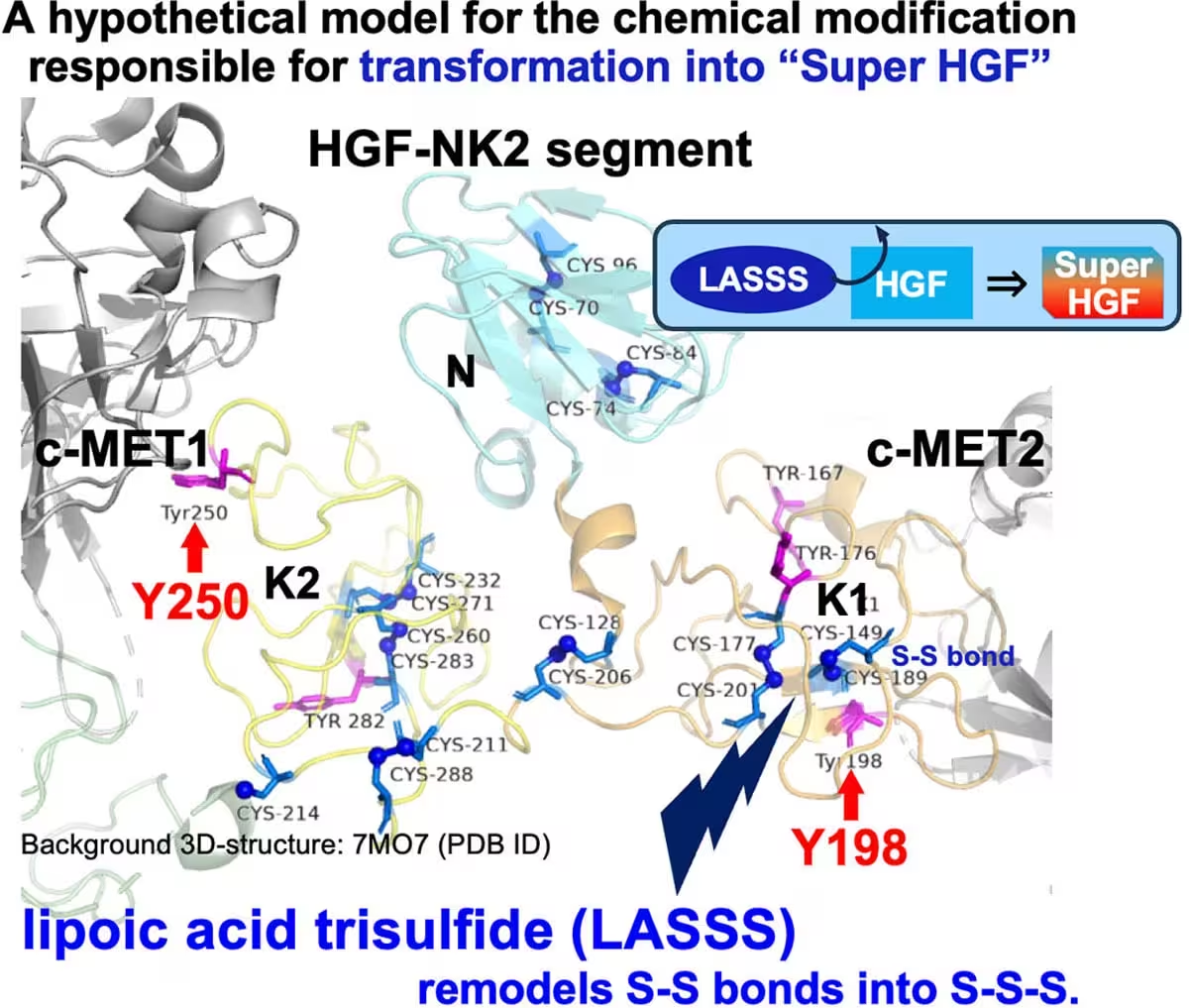
HGF is a key activator of muscle stem cells that normally resides in the extracellular matrix but becomes dysfunctional with age due to nitration. Researchers show that interaction with lipoic acid trisulfide (LASSS) can convert HGF into “Super HGF,” a form with enhanced receptor-binding affinity and resistance to nitration-induced dysfunction. Disulfide bonds may be potential targets for LASSS-mediated remodeling into trisulfide bonds.
How a chemical tweak can silence a signal

The team had already observed a precise chemical modification that undercuts HGF’s function. Reactive nitrogen species can add nitro groups to tyrosine residues on the protein, a process called nitration. When two specific tyrosines, Y198 and Y250, acquire nitro groups, they distort the part of HGF that must contact the c-met receptor on satellite cells. The protein remains present in the tissue but is no longer effective at calling satellite cells into action.
This helps explain a puzzling detail of aging muscle: some repair machinery is still physically present yet clinically inactive. Fast-twitch fibers, which are crucial for sudden bursts of power like catching your balance, appear particularly vulnerable. If HGF is chemically disabled, the cascade that restrains fibrosis and fat accumulation can also falter, accelerating multifactorial muscle decline.

The trisulfide test
Tatsumi and colleagues asked a simple question with sophisticated chemistry: could a sulfur-containing antioxidant protect HGF or even restore its function? They compared two trisulfide compounds, glutathione trisulfide (GSSSG) and lipoic acid trisulfide (LASSS). Trisulfides carry three sulfur atoms in sequence and have unusual redox behavior, which has drawn attention from pharmacology researchers.
In vitro experiments produced a partial win. Both compounds reduced nitration at Y198 and Y250 when applied to HGF, but neither fully brought receptor binding back to normal at low concentrations. The team then altered the stoichiometry, increasing the molar ratio of HGF to trisulfide from 1:4000 to 1:8000. The result was unexpected and striking.
At the higher dose, LASSS did more than protect HGF. Treated HGF bound to c-met with more than double the affinity of untreated HGF. It also resisted the functional loss caused by nitration, especially at Y198. GSSSG did not confer the same enhancement. The researchers therefore propose that LASSS interacts directly with HGF to induce a subtle structural change, effectively creating a reinforced version the authors call “Super HGF.”
Evidence from an animal model
Biochemistry on a bench is valuable, but physiology is the ultimate test. The Kyushu team used a mouse tail-suspension model that mimics disuse atrophy, a common cause of rapid muscle loss during bed rest or immobilization. Mice pretreated with LASSS showed significantly less HGF nitration than controls. The protective effect tracked with improved biochemical signaling, although the study stopped short of human trials.

The contrast between LASSS and GSSSG is important. Both are antioxidants, yes, but only LASSS produced the receptor-binding enhancement. That suggests the mechanism is not simple scavenging of reactive species. Instead, LASSS may directly modify or stabilize HGF’s local structure, perhaps through sulfur-mediated remodeling of disulfide groups into trisulfides. Those molecular rearrangements would change how the protein interfaces with c-met without destroying its biological activity.
Potential implications and realistic limits
Think of two therapeutic strategies: replace a missing part, or fix the part that still exists but is broken. This work points toward the latter approach. Protecting or enhancing endogenous HGF could restore the muscle’s innate capacity to recruit satellite cells, reduce fibrosis, and limit fat infiltration. The idea is appealing because equivalent HGF sequences exist across mammals, so the mechanism could, in principle, apply to people and companion animals.
That said, caution is warranted. These results are preclinical. The experiments combine purified proteins and a murine model of disuse atrophy. Important questions remain about dosage, delivery, safety, and off-target effects. Trisulfides have reactive chemistry; systemic administration might have unintended consequences. Translational research will need to define therapeutic windows and whether localized delivery to skeletal muscle is viable.
Expert Insight
Dr. Maya Bennett, a muscle physiologist at a European biomedical institute, commented on the study’s potential. "This is a clever pivot. Instead of trying to flood tissue with growth factors, the team asks whether we can restore what the tissue already has. If LASSS genuinely stabilizes HGF structure and raises receptor affinity, that could change how we think about therapies for disuse and age-related sarcopenia. The next steps must carefully map safety and mechanism in larger preclinical models."
Her point underscores a practical path forward: nuanced biochemistry followed by rigorous, staged testing in vivo, then controlled early-phase human studies.
Conclusion
Kyushu University’s experiments identify a promising chemical interaction that may convert vulnerable HGF into a more robust signaling form. Lipoic acid trisulfide, at sufficient concentration, both reduced nitration and increased c-met binding, producing a biochemical effect the authors describe as transforming HGF into “Super HGF.” The findings open a new avenue for addressing muscle decline by repairing and reinforcing existing repair signals rather than replacing them. Moving from mouse tails and test tubes to human therapies will take time, but the concept reframes how we might preserve muscle strength with age or after prolonged inactivity.

“My work centers on sustainability, energy, and environmental science — examining how innovation can lead to a greener future.”

Discussion
Leave a Comment
Comments (3)
Feels a bit overhyped but clever idea. Local delivery, dosing, toxicity , huge hurdles. still curious how long effects last
is this even true? mouse tails and test tubes are a long way from people. neat chemistry tho, need larger animal data pls
wow didnt expect that... if LASSS really turns HGF into "Super HGF" that could be wild, but also kinda scary, side effects?