
Imagine standing on a rust-colored plain and watching rain fall for the first time. The water soaks into soil that was permanently frozen for millennia. It is a scene that lives in science fiction and in the hopes of many planetary explorers. The reality is far more stubborn.

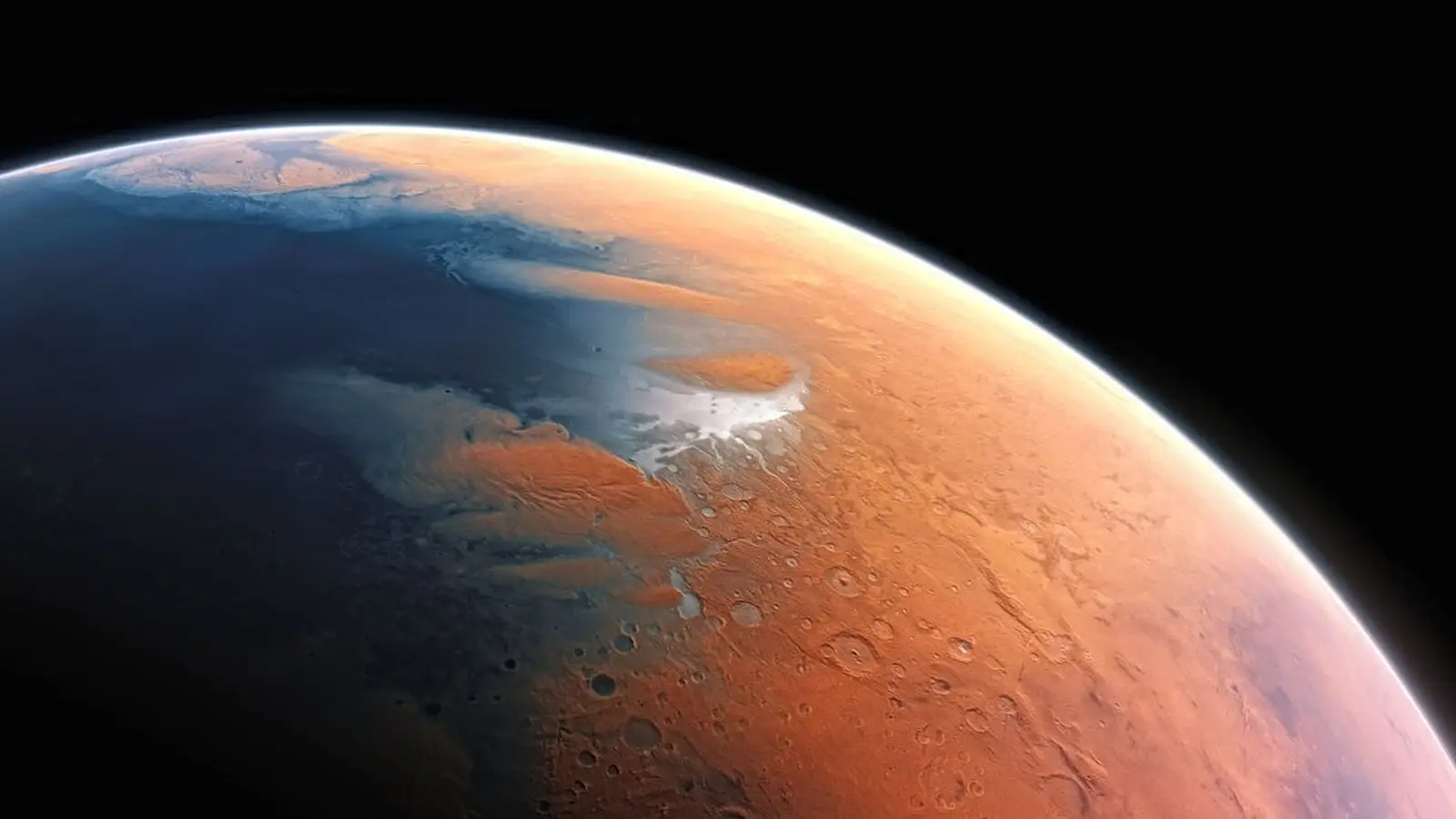
Realistic image of a completely terraformed Mars.
Five milestones on a long road
When engineers talk about making Mars habitable, they do not mean a single finish line. Instead, there are several discrete milestones that mark progress — each one exponentially harder than the last. A practical roadmap often uses five stages.
Stages toward habitability
- Present-day Mars: cold, thin air, and hostile surface conditions that force humans to live inside pressurized habitats and wear life-support suits outdoors.
- Transient liquid water: raising surface pressure above the triple point of water (about 6.1 millibars at 0 degrees Celsius) so water can exist, even briefly, as liquid on the surface.
- Paraterraforming or shirtsleeve greenhouses: enclosed regions with higher internal pressure and temperature where large-scale agriculture and comfortable living are possible without full planetary transformation.
- Global pressure sufficient to prevent bodily fluids from boiling at normal human temperature — roughly 62.7 millibars — a physiological step toward broader human mobility without special equipment.
- A truly breathable atmosphere: a thick, nitrogen-rich envelope with roughly 210 millibars of oxygen inside an overall pressure near 500 millibars and much warmer global temperatures.
Each of those steps matters because they change the kind of infrastructure humans must build, the energy required, and the timeline for achieving self-sufficiency. The first two are daunting but locally achievable. The last two demand planetary-scale interventions.
Mass and temperature: the arithmetic of atmosphere
Numbers have a way of clarifying fantasies. To add just 1 millibar of atmospheric pressure to Mars you must deliver about 3.89 × 10^15 kilograms of gas. That is nearly the mass of Deimos, the smaller Martian moon. To assemble a breathable atmosphere as we know it on Earth, the required mass balloons to the order of 10^18 kilograms — comparable to some small moons in the outer solar system.
Temperature is the other unforgiving variable. Globally stable liquid water would require raising Mars’ average temperature by roughly 60 degrees Celsius. Proposed engineering solutions range from injecting light-absorbing particles into the atmosphere to redirecting carbon dioxide or building massive orbiting mirrors to concentrate sunlight. But the scale is dizzying: calculations suggest mirrors covering about 70 million square kilometers would be needed to deliver the required insolation boost, a manufacturing and deployment task that dwarfs current global industry.
Oxygen production adds another layer of difficulty. To reach an atmosphere where blood will not boil and humans can breathe more easily, about 8.2 × 10^17 kilograms of oxygen are needed. The most straightforward source is water, split into hydrogen and oxygen. That conversion loses some mass to the escaping hydrogen, so the water demand climbs even higher — roughly six cubic meters of water per square meter of Martian surface, on average.
There is a sliver of good news: researchers estimate Mars’ accessible surface ice could supply much of the water needed to create an oxygen-rich atmosphere. In other words, we would not have to engineer dozens of comet impacts to import water from elsewhere in the solar system. Still, even if raw materials exist locally, gathering and processing them at planetary scale remains a monumental technical and logistical problem.
Energy: the immovable ceiling
Mass and materials are challenging but conceptually solvable if you can spend enough energy. Energy is the real bottleneck. To produce the oxygen necessary for a breathable atmosphere requires on the order of 1.2 × 10^25 joules. Spread over a millennium, that equates to a sustained power output of roughly 380 terawatts. For comparison, humanity’s current total power use is around one twentieth of that sustained level.
Put bluntly: even if future generations commit to a thousand-year program of constant work, they would need to generate and dedicate an energy flux vastly beyond today’s global systems. New, massive power sources would be essential — think large-scale space-based solar arrays, advanced fusion, or other technologies that are not yet mature.
The energy hurdle also explains why staged approaches are attractive. Building compact, high-efficiency habitats and paraterraforming domes can produce immediate, local benefits without attempting to transform the entire planet. These incremental projects serve as laboratories for the bigger physics and engineering problems while providing livable space for settlers.
Expert Insight
“Terraforming is not a single engineering project; it is a civilization-scale enterprise,” says Dr. Elena Morales, a planetary scientist who has worked on atmospheric modeling for mission planners. “We can make pockets of Mars hospitable within decades, but turning the whole planet into an Earth analogue demands orders of magnitude more mass and energy. That means long timelines, sustained political will, and technologies that are arguably a few centuries away.”
Her assessment echoes the recent analysis by Slava Turyshev at NASA’s Jet Propulsion Laboratory, published in APS Open Science, which breaks down the arithmetic and physics behind these claims. The takeaway: local adaptation and powerful, steady energy sources are the levers that will determine whether terraforming remains a thought experiment or becomes a multi-generational project.
Conclusion
We can say with confidence that making Mars Earth-like is not forbidden by physics. The materials exist and the processes are known at fundamental levels. What is lacking is concentrated energy and the industrial capacity to move and transform planetary-scale mass. Incremental strategies — paraterraforming, domes, and regional climate engineering — are both realistic and necessary first steps.
Terraforming Mars is physically possible but practically likely to take centuries unless revolutionary energy and manufacturing breakthroughs arrive.
That reality does not diminish the appeal of Mars. It reframes the goal. If future explorers are patient, methodical, and inventive, the Red Planet might one day wear blue where today it is only red.

“My work centers on sustainability, energy, and environmental science — examining how innovation can lead to a greener future.”

Discussion
Leave a Comment
Comments (3)
Feels practical to start with domes and local habitats, not remake an entire planet. Still, kinda underplays social and ethical costs, imo
Is the mirror calc really 70 million km2? sounds like a rough order of magnitude, but do they factor in reflectivity losses, dust, maintenance? also where do we get the energy to manufacture that much stuff?
wow those numbers hit hard. 380 terawatts?? centuries of work, insane logistics, but kinda poetic... humans as planet builders if that ever happens, yikes