
Imagine standing at the edge of two alien nights. One is a smog-blanketed moon circling Saturn, where lakes of methane mirror a faint, orange sky. The other is a cold, distant dwarf world, glittering with fields of nitrogen ice and sculpted by frozen volcanoes. Separating these places are billions of kilometers and radically different environments. Yet both now show the same mysterious spectral footprint.
When telescopes spot a fingerprint
NASA’s James Webb Space Telescope recorded an absorption feature in infrared light that does not match any familiar molecule. The signal first caught the eye of a team led by Bruno Bézard at the French National Center for Scientific Research. They were probing Titan’s surface and atmosphere as part of a program called "Titan Climate, Composition and Clouds." The spectrum returned a line — a dark notch where light was missing — and it did not line up with known absorbers studied in laboratory libraries.

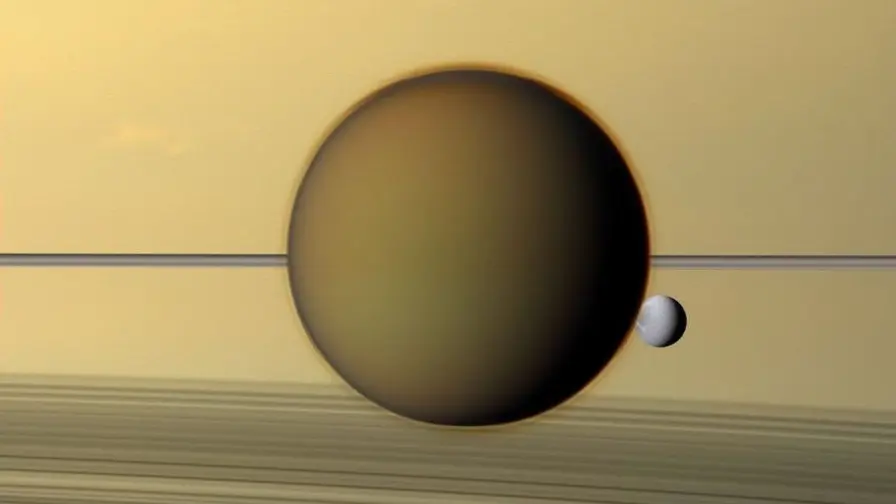
A near-infrared color mosaic of observations from the Cassini probe released in 2014, showing sunlight glinting off Titan's seas.
Spectra are how astronomers read chemistry from afar. Different molecules take bites out of specific wavelengths. Each bite is a spectral fingerprint. When an expected fingerprint fails to match, two possibilities open: either a genuinely unknown substance is present, or known compounds are behaving differently in extreme, unfamiliar contexts.
What raised the stakes was a second, surprising discovery. JWST spectra of Pluto, gathered independently, revealed the same absorption feature. On Pluto the signal appears stronger and broader. Titan and Pluto are chemically related in the sense that both host nitrogen and hydrocarbons and both produce haze from photochemical reactions. But their temperatures, pressures and surface geologies are dramatically different. That the same spectral mark turns up on both bodies points to a shared, and previously unrecognized, aspect of cold planetary chemistry.

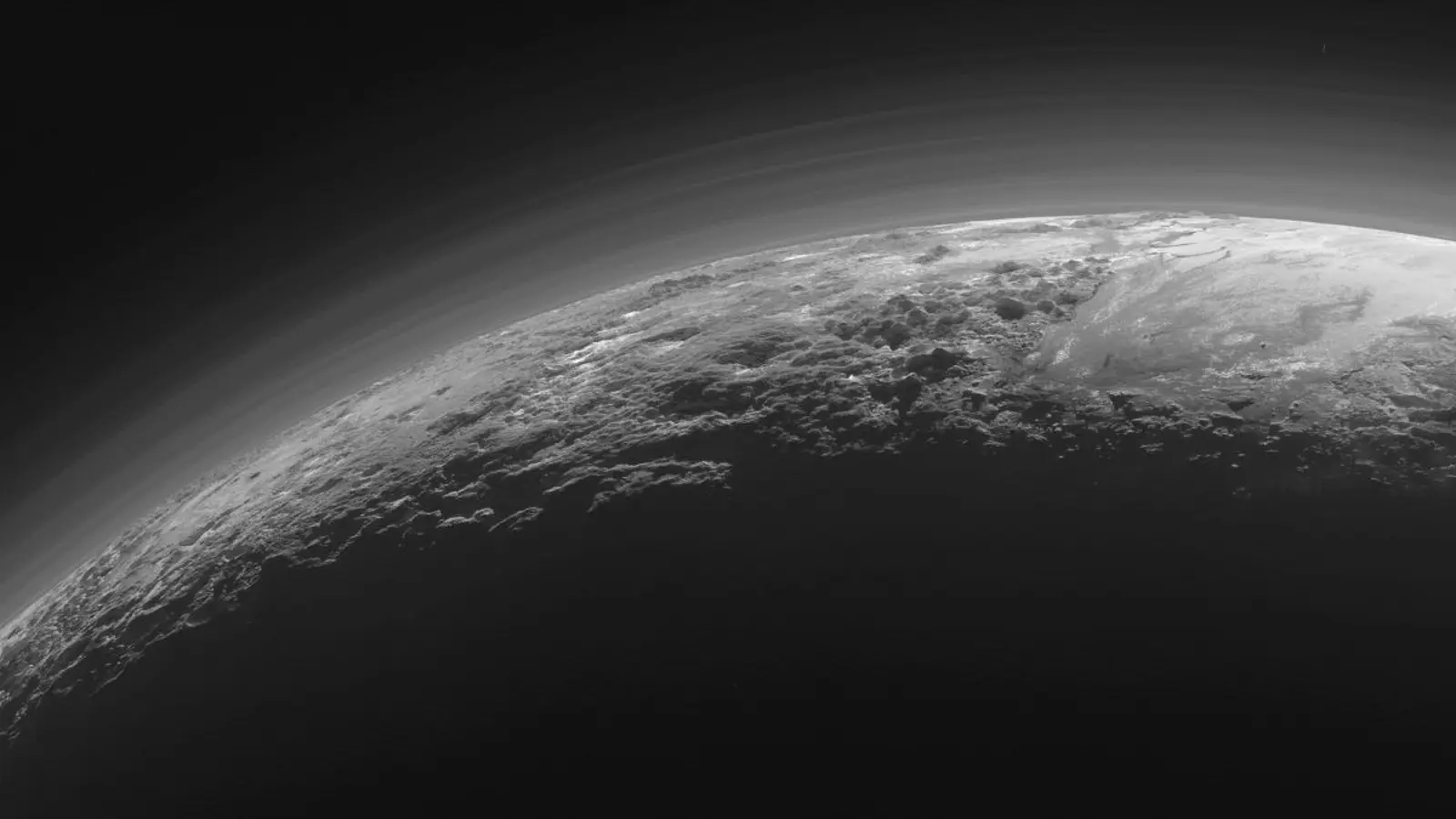
A close-up of mountains on the surface of Pluto.
Why Titan and Pluto are chemical laboratories
Titan has long been a playground for chemists who study how organic molecules form without biology. It carries a thick nitrogen atmosphere laced with methane. Sunlight and charged particles break those molecules apart and reassemble them into a rich mix of organics that precipitate to the surface. Cassini revealed rivers, dunes and seas on Titan, making the moon a near-perfect natural laboratory for prebiotic processes.
Pluto, on the other hand, is an extreme freeze frame of surface chemistry. Nitrogen, methane and carbon monoxide ices dominate, with temperature swings and seasonal transport of volatiles. New Horizons mapped terrains that suggest active processes, including possible cryovolcanism. Both bodies show how simple atmospheric ingredients can evolve into complex surface chemistry when energy is available.

The near-infrared spectra of Titan (left) and the mid-infrared spectra of Pluto (right) showing the same absorption feature.
What the spectra tell us
The feature appears in near-infrared spectra at wavelengths where solid-phase materials often leave signatures. On Titan the band is faint but definite. On Pluto the band is more prominent, suggesting either a higher abundance, a different physical state, or a surface context that accentuates absorption.
Researchers compared the unknown band with dozens of candidate substances. Simple hydrocarbons such as benzene and acetylene, and more exotic small molecules like propadiene and ketene, produced similarities but no exact match. One plausible explanation is that a known molecule, mixed with other ices or arranged as a thin film, shifts its absorption characteristics enough to appear new. Solid-state interactions can move band positions by measurable amounts.
Implications for planetary organic chemistry
This detection opens two lines of inquiry. First, it suggests that cold, nitrogen-rich, methane-bearing worlds can host an overlapping inventory of organic or organics-related materials. Second, it underlines the limits of laboratory databases built under Earthlike conditions. Surface mixtures, radiation processing and low temperatures can produce absorption features that laboratory spectra do not yet capture.
The fact that JWST saw the same feature with two different instruments on Titan reduces the likelihood of an instrumental artifact. The Pluto observation came from an independent program. The result is a consistent, reproducible mystery across instruments and targets.
Expert Insight
"When a spectrum refuses to behave, that's where new chemistry lies," says Dr. Sarah Malik, a planetary chemist at a major university who was not involved in the study. "Either we are seeing a compound that hasn't been characterized under these extreme conditions, or the material is a mixture that creates emergent spectral behavior. Both scenarios are exciting because they push laboratory studies to mimic real planetary surfaces more closely."
Dr. Malik adds that surface context matters: particle size, porosity and layering can all alter how light is absorbed and scattered. "Remote sensing gives us clues. Ground truth from spacecraft will be crucial to turning those clues into identifications."
How upcoming missions and observations can help
Several avenues exist to narrow the possibilities. Continued JWST mapping of Titan will reveal whether the absorption feature correlates with particular terrains, latitudes or seasons. Spectral mapping could show whether the unknown band concentrates in dune fields, on lake margins, or in highlands where different chemical pathways might dominate.
Closer to the surface, NASA’s Dragonfly mission, scheduled to arrive at Titan in the mid-2030s, carries a mass spectrometer capable of identifying organic molecules in situ. If the feature is produced by a substance accessible to Dragonfly’s instruments, the mission could provide definitive identification. On Pluto, prospects are more limited because no dedicated orbiter is planned, but future far-reaching missions or flybys with modern instruments could test the hypothesis.
Laboratory work will be essential. Scientists can reproduce Titan- and Pluto-like conditions: cryogenic temperatures, mixed ices and energetic particle processing. By expanding spectral libraries to include mixtures, layered structures and irradiated ices, researchers may match the mysterious band. This is painstaking work, but it’s exactly the kind of slow, deliberate chemistry that yields breakthroughs.
Conclusion
Two distant worlds have whispered the same chemical secret. The unknown absorption feature seen on Titan and Pluto refuses easy explanation, yet its persistence across instruments and targets suggests a real, shared phenomenon. Whether the culprit is a new molecule, a surprising behavior of a known compound, or a structural effect of mixed ices, the result forces scientists to rethink how complex organics form and persist in the coldest places of our Solar System. Observations, laboratory experiments and upcoming missions will together unwrap this mystery, and with it, broaden our understanding of planetary chemistry beyond Earth.

“The cosmos has always fascinated me. I write about space missions, astronomy, and the technologies pushing humanity beyond Earth.”

Discussion
Leave a Comment
Comments (3)
Feels a bit overhyped, until Dragonfly brings samples. But ok, cool clue, labs gotta hustle. Also Pluto's stronger band? odd, imo
Is this even true? Could it be instrument noise or analysis artifact... JWST is solid but I want independent confirmation, not just spectra
wow, goosebumps, this is wild. Titan and Pluto whispering the same thing? mind blown but lab work will be the real hero