
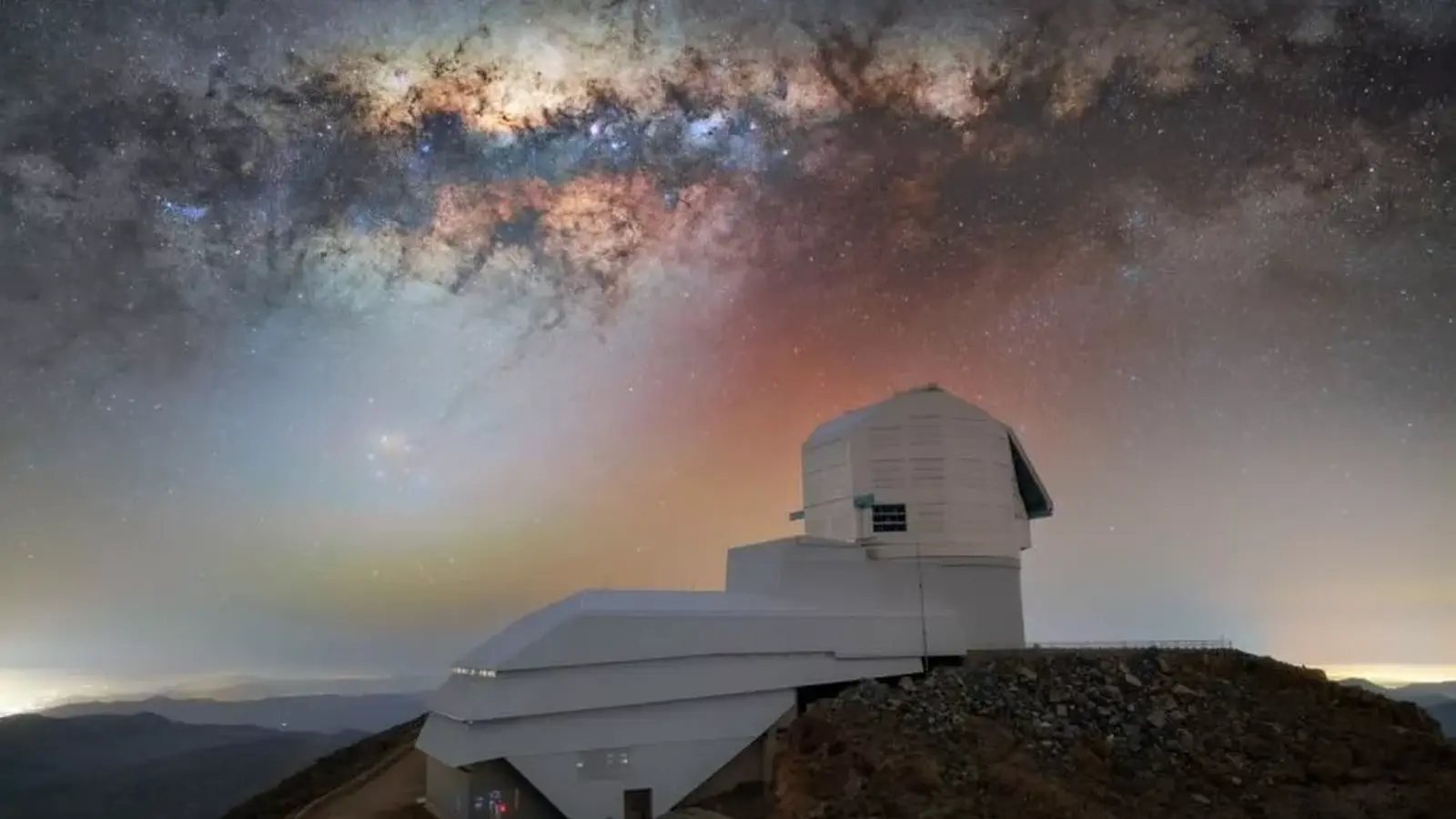
Vera C. Rubin Observatory Begins Ten-Year Cosmic Survey
A giant camera opens its eyes
Atop a clear Chilean summit, a camera the size of a small car has begun a marathon of sky watching. The Vera C. Rubin Observatory has started a planned ten-year survey designed to map vast swaths of the southern sky with unprecedented depth and cadence. Night after night the observatory will capture hundreds of images, returning to the same sky patches again and again to reveal objects that were once invisible to us.
Why repeat the pictures? Because layering many exposures increases depth, and revisiting the same field lets astronomers track motion and change. That combination reveals dim stars in our own Milky Way, distant galaxies across cosmic time, and transient events that flare, fade, or move.
Counting the cosmos
The Rubin Observatory is not a single discovery machine. It is a census. Scientists expect it to catalog billions of stars within the Milky Way and billions more galaxies beyond. The facility’s huge digital camera — one of the largest ever built for astronomy — will generate an enormous dataset that researchers worldwide can mine for clues about how structure in the universe forms and evolves.

"A large community of scientists will work with this dataset and study the universe in ways we could not before," said Phil Marshall, deputy operations lead for the observatory. The first color-rich images released last year already showed striking vistas: nebulae in vivid detail and star-forming regions thousands of light-years away.
Over the months since, engineers and astronomers have been fine-tuning the instruments and software so the survey achieves the depth and precision required for decade-scale science. The goal is not only to see fainter objects, but to measure them well enough to deduce their distances, motions, and histories.
What scientists hope to find
Two of the survey’s headline ambitions concern the dark stuff and the unknown force. Vera Rubin, the pioneer after whom the observatory is named, provided some of the first compelling evidence that ordinary matter is only a fraction of the universe. Rubin’s work hinted at an invisible component we call dark matter. The survey will map mass across immense regions using the subtle gravitational bending of light, a technique known as weak lensing, and improve constraints on how dark matter clumps on different scales.
At the same time, repeated measurements of millions of supernovae and galaxies will test how the expansion of the universe changes with time, offering new insights into dark energy — the label for whatever drives cosmic acceleration.
Beyond fundamental physics, the Rubin survey will be a treasure trove for transient astronomy: near-Earth asteroids, fast optical transients, and variable stars will all be captured in large numbers. The data will be distributed to a broad scientific community, supported by funding from the U.S. National Science Foundation and the U.S. Department of Energy.
The observatory begins its long stare with a promise: by compiling a high-resolution, time-resolved map of the southern sky, it will open new paths to understanding how galaxies assemble, how structures have grown since the Big Bang, and where the dark components of the cosmos hide.

“My work centers on sustainability, energy, and environmental science — examining how innovation can lead to a greener future.”

Discussion
Leave a Comment
Comments (2)
Impressive tech, but can we trust the pipelines? Data deluge will mean lots of junk, false positives. Someone has to clean it, tho.
wow a car-sized camera prowling the sky every night... mind blown. Hope the data lives up to the hype, fingers crossed.