
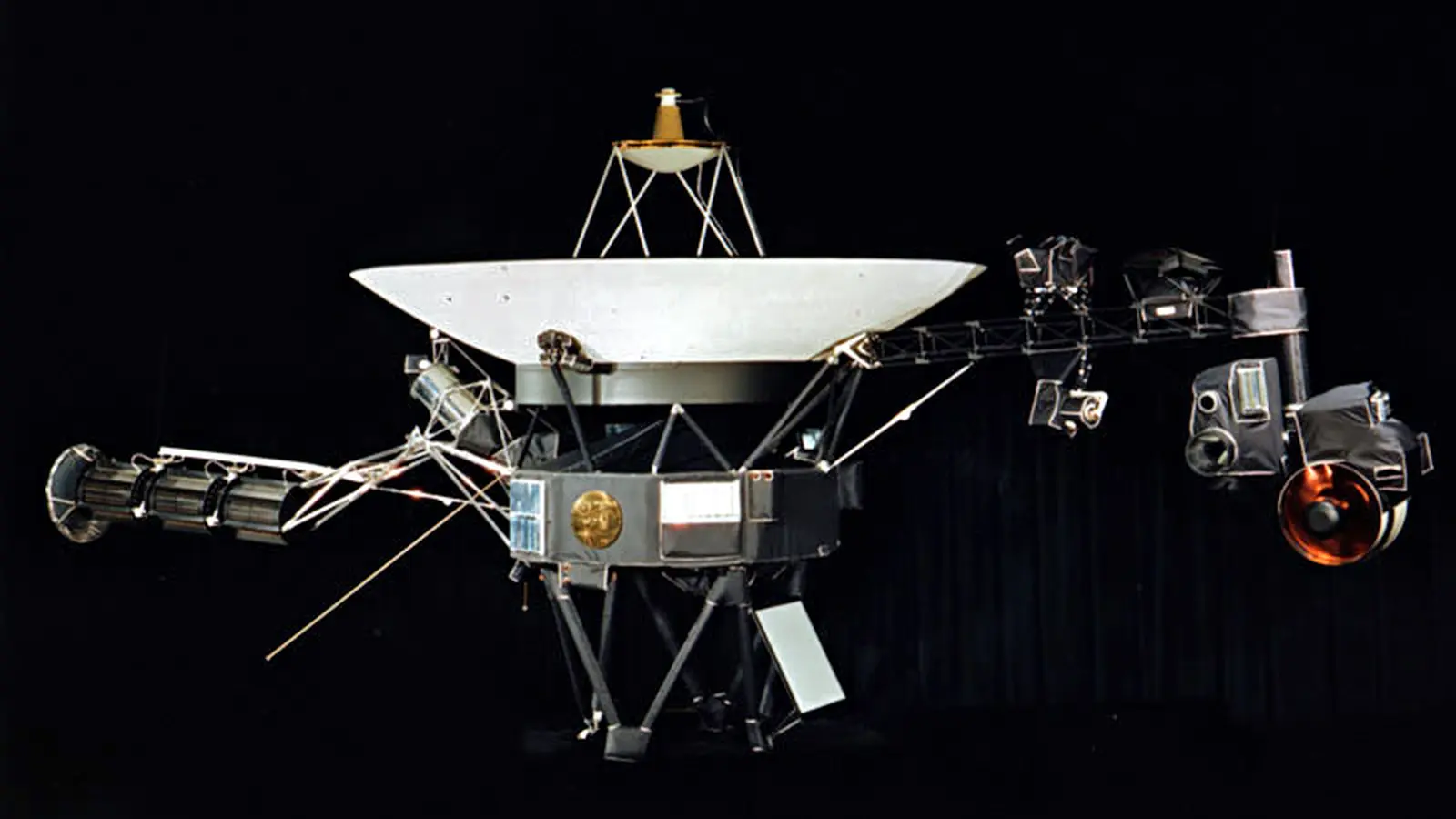
The image of two battered, century-old voyagers still whispering to Earth feels like science fiction. Yet Voyager 2 recently completed a daring, precisely timed procedure engineers nicknamed Big Bang, and the payoff could be more working years for these legendary probes.
Power is the quiet enemy of long-duration missions. Voyager 1 and Voyager 2 run on radioisotope thermoelectric generators that convert heat from plutonium-238 decay into electricity and warmth. That decay is relentless and predictable. Each year a generator yields roughly four watts less. Tiny numbers, big consequences. Turn off the wrong instrument at the wrong time or fail to keep a fuel line warm and a spacecraft that has survived decades of deep-space hazards can fall silent almost instantly.
So how do you keep an explorer alive when its heart is slowly losing strength? Engineers at the Jet Propulsion Laboratory treated the problem like a precision surgery. They mapped every watt, every heater, every recorder and propulsive element, then asked a single question before issuing any command: does this help the mission now?

What the Big Bang maneuver actually did
The Big Bang was not an explosion. It was choreography. Three components were turned off and three others switched on in tight sequence. The items powered down included an old tape recorder no longer needed for routine science and two heaters. In exchange, two different heaters and a propulsion-related device were activated. The net effect: an annual power draw reduced by around 10 watts while avoiding dangerously cold temperatures in critical systems.
Ten watts may sound trivial. For a modern smartphone it is nothing. For a probe that is decades old and generating only a few hundred watts at launch-equivalent performance, a decade of slow decline can make those ten watts the difference between continued telemetry and permanent silence. Importantly, the plan avoided exposing any vital component to unacceptable thermal risk. A frozen fuel line would render attitude control impossible and end science operations. That was the real threat.
Engineers performed two dress rehearsals before the full maneuver. In May and June, Voyager 2 underwent a power test and a thermal test to verify models and to ensure that commands would behave as predicted on the flight hardware. Then, in July, the timed sequence was executed and completed by midmonth. According to mission leadership, everything unfolded smoothly.
Why this matters for interstellar science
Both Voyagers were launched in 1977 and achieved historic planetary encounters during the late 1970s and 1980s. Voyager 2 is still the only spacecraft to have flown past Uranus and Neptune. Today, the probes live in the interstellar medium, studying charged particles, magnetic fields and the tenuous plasma beyond the heliosphere with instruments designed to observe planets. They are, in essence, repurposed planetary probes measuring the space between the stars.
Maintaining those instruments yields unique science. The outer reaches of our bubble of solar influence are dynamic. Measurements of cosmic rays, plasma density and magnetic orientation tell a growing story about how the Sun interacts with the galaxy. Every extra month or year of data sharpens that picture. Extending Voyager operations by two years would keep the mission on track to reach and cross milestones that once seemed unimaginable, such as routine observations at distances approaching a day of light travel from Earth.
Mission managers are pragmatic about expectations. Some sensors have already been powered down across the years to conserve energy. The computer systems aboard Voyager were designed in an era when punch cards were still a tool in computing, and engineers today must work without modern telemetry or sensors for certain thermal readings because the risk of freezing was never a design concern back in the 1970s.
That mismatch between original design assumptions and present realities has forced the team to improvise. Commands and procedures that would be routine on newer missions require bespoke simulation, careful scrutiny and, in many cases, live testing. The Big Bang concept emerged from that painstaking reassessment: a coordinated series of changes, each evaluated on whether it increased the long-term scientific return without jeopardizing critical hardware.
Execution, risk and reward
Timing matters. The Big Bang preparations took place when Voyager 2’s primary ground antenna was temporarily unavailable for maintenance. That window limited options but also gave engineers an incentive to finalize tests and execute while the team could still rely on backup communications. Mission manager Karim Badruddin, systems engineer at JPL, framed the operation bluntly: 'This is the most important thing we have done on the Voyagers in decades.'
There was no margin for error. Incorrect sequencing could force the spacecraft into thermal or power states it could not recover from. Yet the tests returned data that matched the team's models and assumptions, giving them confidence to proceed. Now the same sequence is being applied to Voyager 1. Early results there are promising; recent power tests produced 'excellent' outcomes, according to mission updates.
The payoff is estimated at roughly two additional years of functional operations for each spacecraft. That window is substantial given the mission's age and the uniqueness of the measurements. It is not merely sentimental. Scientists will gain more continuous records of interstellar particle flux and magnetic conditions, data that cannot be collected elsewhere for the foreseeable future.

Expert Insight
'Extending Voyager's life is less about heroic hardware changes and more about resource stewardship,' says Dr. Elena Marquez, an astrophysicist and mission operations consultant. 'You manage power budgets the way a hiker manages water on a long trek: ration carefully, avoid waste, and prioritize the instruments that keep you alive and heading in the right direction.' She adds that the ingenuity of the Big Bang plan lies in balancing thermal needs and electrical constraints so the probes can keep returning data well past expectations.
Broader implications and future prospects
The Big Bang maneuver is a case study for any long-duration mission. It illustrates the kinds of trade-offs mission teams will increasingly face as humanity pushes probes further into the solar system and beyond. As spacecraft ages grow longer and budgets remain constrained, targeted operational changes may become the norm to wring more science from existing platforms.
Meanwhile, the Voyagers continue to set distance records. The mission team hopes to have both spacecraft operating as they reach their fiftieth year in space, a milestone that would be unmatched in human spaceflight. Voyager 1 is expected to reach a radial distance of about one light-day from Earth in November, a sobering reminder of how far human-made objects have traveled and of the shrinking bandwidth through which they communicate.
Conclusion
The Big Bang maneuver was a pragmatic gamble: a surgical rearrangement of systems designed to buy time by shaving modest watts off the annual power bill without sacrificing essential thermal protection. The benefits are straightforward. A couple of extra years of telemetry and instrument operation means new data about the boundary between our solar bubble and interstellar space. It also underscores a softer lesson. Space missions do not retire gracefully. They must be coaxed, rethought and sometimes nudged into new roles by teams on Earth who refuse to accept silence as inevitability.
'People love the Voyagers,' Badruddin said. 'They will do whatever it takes to keep them alive.' Practical love, backed by careful engineering, has once again kept human voices connected to probes voyaging beyond the known.


“The cosmos has always fascinated me. I write about space missions, astronomy, and the technologies pushing humanity beyond Earth.”

Discussion
Leave a Comment
Comments (3)
Practical love indeed, but feels like patching an ancient car, not a real fix. Still, more data beats silence. go team!
wait, is this even true? Two extra years from 10 watts? sounds... optimistic, though I'd love it to be real
wow, the crew literally did power surgery on Voyager. tiny watts, huge stakes. Gives me chills imagining them still whispering back. unreal.