
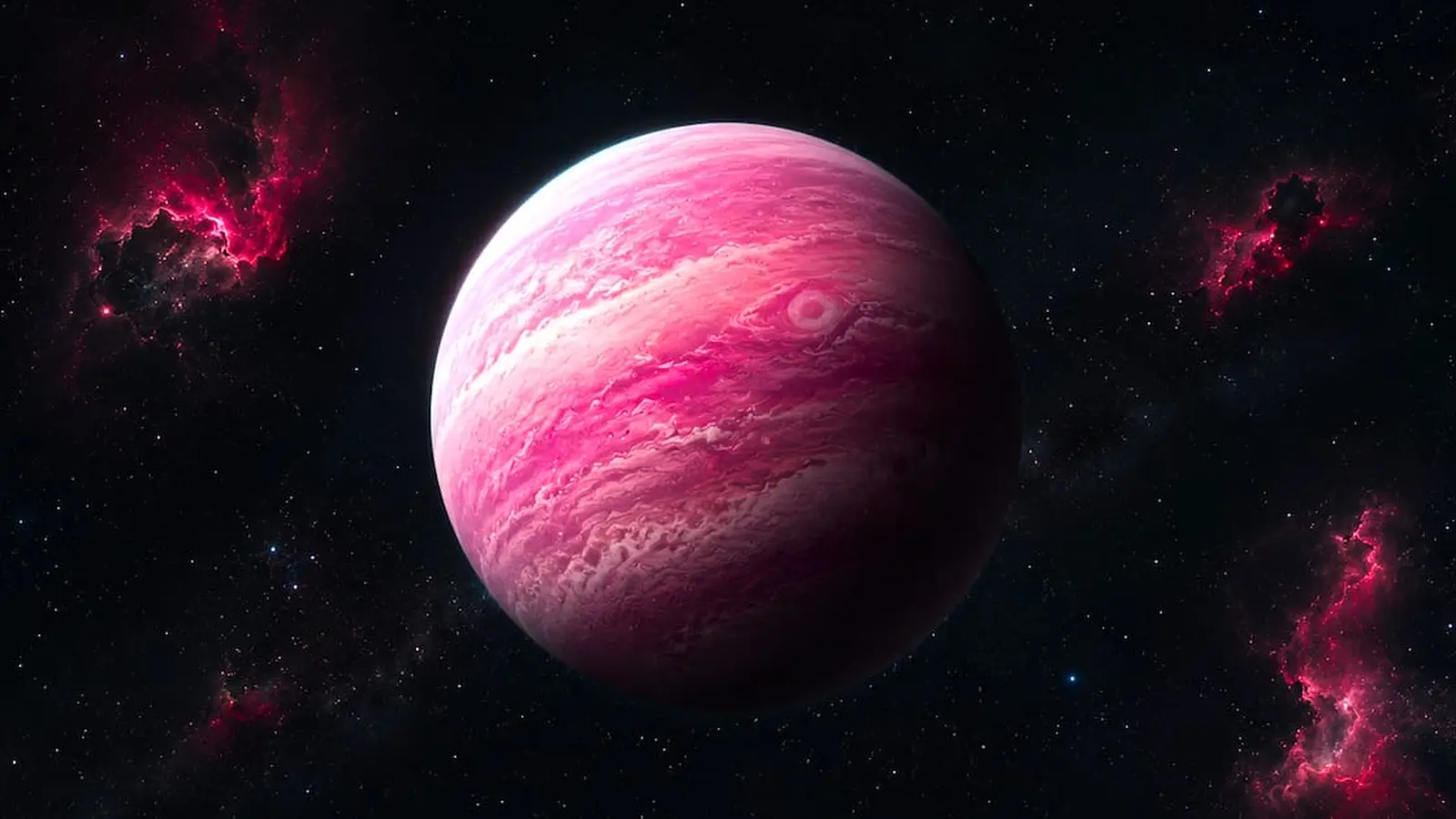
Clouds of salt. Not on an ocean beach, but high in the thin, cold air of a distant world nicknamed the Pink Planet. That image upends how astronomers thought ultra-cool, planetary-mass companions behave and opens a new window on atmospheres previously invisible to ground telescopes.

This artistic illustration shows the Pink Planet, or GJ 504 b, orbiting its host star. Astronomers think the object is pink because it’s incredibly old (between 2.5 billion and 4 billion years old) and cold.
How Webb cut through the glare to read a faint spectrum
GJ 504 b was discovered in 2013 and has been a puzzle ever since. Sitting about 57 light-years away and orbiting a sun-like star, the object is unusually dim and cool for a directly imaged companion. Temperatures on GJ 504 b are roughly 290 degrees Celsius, far cooler than the typical directly imaged exoplanet. Its mass, near 25 times Jupiter's, places it at the fuzzy border between giant planets and brown dwarfs, so scientists often call it a planetary-mass companion.
Why has it been so hard to study? Two reasons. First, the companion’s light is faint compared with its much brighter host star. Second, its spectrum—light split into constituent wavelengths that act like chemical fingerprints—was simply too weak for even the largest ground-based telescopes to capture cleanly. Teams spent nights trying to pry a spectrum from the glare and often came up empty.
Enter the James Webb Space Telescope. Using Webb’s infrared sensitivity and careful data processing to remove starlight, a group led by Aneesh Baburaj at Northwestern University isolated the companion’s spectrum in roughly two hours of observing time. The quick success surprised many; previous ground-based attempts sometimes failed even after a full night.
The spectrum Webb returned was detailed enough to detect several molecules: water vapor, methane, carbon dioxide, ammonia and other species. But when researchers tried to match the observed spectrum with standard atmospheric models, the pieces did not add up. The observable molecular signals were muted in ways that suggested something unusual was blocking the deeper, warmer layers of the atmosphere.
Salt clouds provide the missing puzzle piece
Simulations that included various cloud compositions finally produced good matches to the spectrum. The best fit came from clouds composed of salt condensates. These are not ocean salts evaporating into air but mineral salts that can form solid particles in cold planetary atmospheres. When such particles form high in the atmosphere, they scatter and absorb light, masking spectral features that would otherwise reveal deeper chemical abundances.
Salt clouds explain multiple oddities at once. They suppress some molecular signatures while allowing others, they alter the planet’s apparent color, and they are consistent with a cooler atmosphere where salt species can condense. According to the research team, models containing salt clouds were the only physically plausible way to reconcile the full spectrum with realistic temperature and composition profiles.
The detection marks one of the first clear lines of evidence for salt-based cloud decks on a cold, directly imaged, planetary-mass object. It also shows that Webb can probe atmospheric physics on worlds that were previously beyond reach.
Another surprising finding is that GJ 504 b appears enriched in heavy elements relative to its host star, a trait astronomers describe as high metallicity. That enrichment bears on how the object formed. Did it build up by gradually accreting gas and solids like a giant planet? Or did it condense more like a small failed star? The metallicity and the cloud chemistry provide new constraints, but they do not yet settle the debate.
Why this discovery matters for exoplanet science
Planets and brown dwarfs cool over time, and as they do, different chemical species condense into clouds. Our solar system’s Jupiter shows the principle: ammonia and water form cloud layers at different depths. Detecting salt clouds on a very cool, faint companion extends our understanding of cloud microphysics into regimes rarely observed outside the solar system.
That extension matters in two ways. First, it forces modelers to include mineral condensates such as salts when they try to interpret spectra of other cold objects. Omit those clouds and inferred compositions and temperatures can be biased. Second, it tells observers where to look next; certain wavelengths and spectral features are more sensitive to scattering by salt particles, and Webb is well suited to make those measurements.
More broadly, the study demonstrates a technique: combine Webb’s infrared sensitivity with careful star-subtraction methods to isolate faint companions. With those tools, astronomers can begin surveying a population of cold, faint worlds and testing whether salt clouds are rare curiosities or a common atmospheric outcome for old, massive companions.
Expert Insight
"Finding salt clouds reshapes our expectations for cold atmospheres," says Dr. Elena Morales, a planetary atmospheres researcher at the European Space Agency. "It’s not just a color curiosity. Clouds alter the energy balance, chemistry, and the spectral fingerprints we rely on to infer composition. Webb gives us the leverage to spot these subtle effects for the first time, and that opens up a new class of planets to comparative study."
Her point captures the wider significance. With salt cloud physics now on the table, teams will revisit spectra of other faint companions and re-evaluate earlier abundance estimates. The outcome promises a more nuanced picture of how massive, planet-like objects evolve over billions of years.
Looking ahead, astronomers will combine Webb observations with ground-based high-contrast imaging and future missions to map how cloud composition varies with temperature, age, and mass. Each new spectrum will act like a small weather report from an alien sky, telling us whether that atmosphere hosts ammonias, water ice, or, intriguingly, mineral salts.
The Pink Planet is no longer just a catchy nickname. It has become a natural laboratory for testing atmospheric chemistry at low temperatures and a reminder that the diversity of planetary atmospheres goes far beyond familiar solar system examples.

“The cosmos has always fascinated me. I write about space missions, astronomy, and the technologies pushing humanity beyond Earth.”

Discussion
Leave a Comment
Comments (3)
Feels a bit overhyped, tbh. Salt condensates match the spectra but until we see a survey, hard to say if this is common or just a weird outlier
Is this even true? Salt clouds masking deeper layers sounds plausible but could model degeneracies be fooling us, or is more obs coming..
wow salt clouds? never expected mineral salts to tint a whole planet pink... mind blown. Webb turned nights of failure into 2 hours, wild