
A faint pulse of X-rays. A race across continents to point telescopes. A star’s death laid bare in the moment it first flashed into light. That is what astronomers captured on March 21, 2026, when the Einstein Probe registered a fleeting soft X-ray signal from a galaxy roughly 500 million light-years away. The alert, cataloged as EP260321a, lasted only briefly, but it marked one of the rarest observational prizes in supernova astronomy: a shock breakout, the opening flash when a stellar explosion tears through its surface.
How a few seconds of X-rays rewrote a supernova story
Most supernovae announce themselves days to weeks after the core collapse, once the optical light curve has climbed and spectroscopic signatures are obvious. Catching the shock breakout is exceptional because it requires both luck and speed: the emission can last from a few seconds to a few hours, and only space-borne X-ray monitors or ultra-fast optical surveys are likely to see it. EP260321a was the opening note of a drama that telescopes around the world quickly joined.
Within an hour of the Einstein Probe alert, ground facilities were on the target. The transient rapidly brightened in optical bands, and follow-up spectroscopy established the explosion as SN 2026gzf, a broad-lined Type Ic supernova, abbreviated Ic-BL. That classification tells us two quick facts: the progenitor had been stripped of its hydrogen and helium layers before collapse, and the ejected material was expanding at very high velocities, producing wide spectral lines.
What made SN 2026gzf puzzling is the mismatch between the signs of raw, fast energy and the absence of an expected signature: no gamma-ray burst, no relativistic jet, and no long-lived high-energy afterglow. In other words, the explosion looked like those connected to jets and gamma rays, yet it lacked those telltale outcomes.

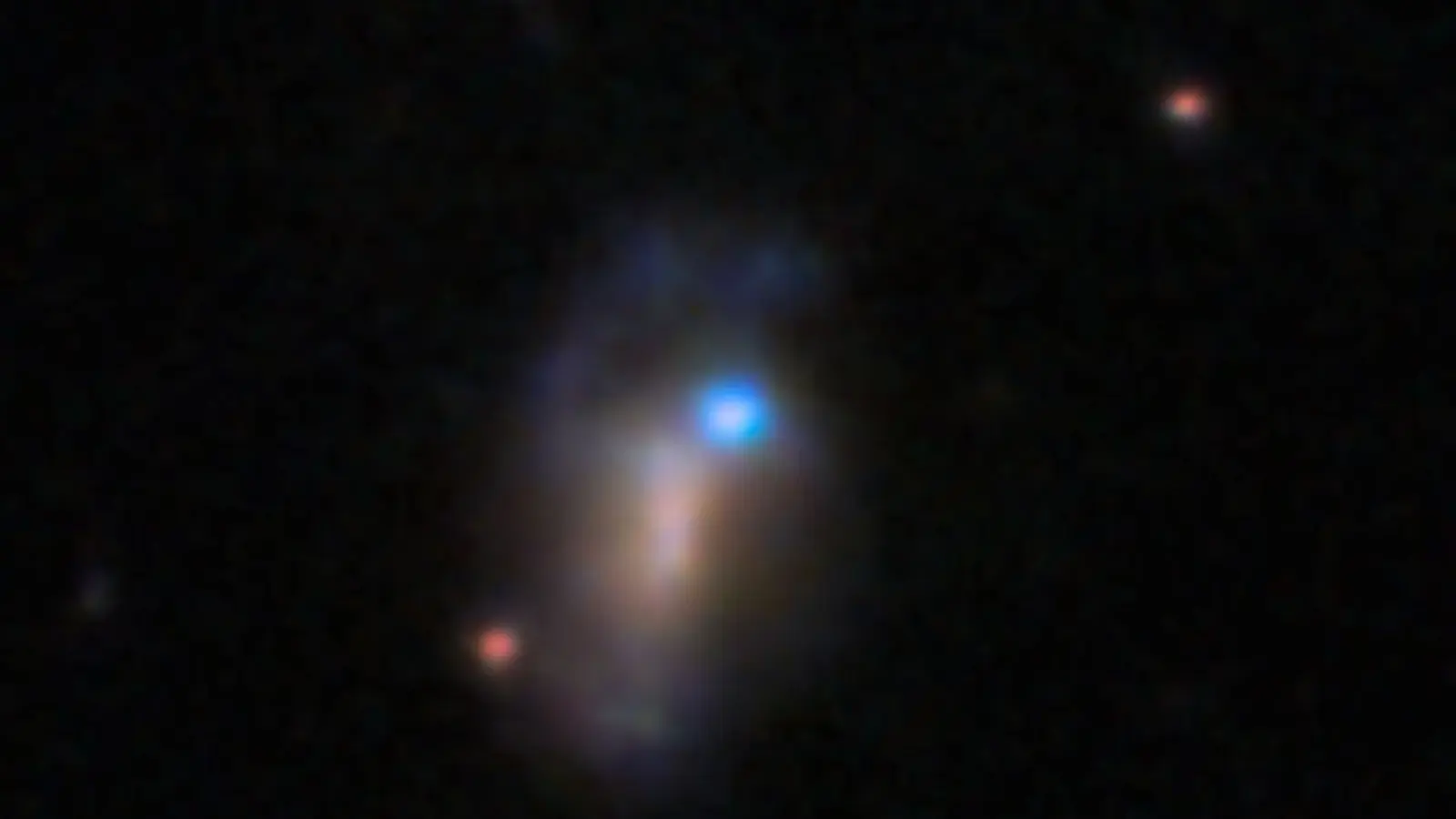
This image shows the field around the progenitor to supernova SN 2026gzf, detected by the Einstein Probe on March 21, 2026. The supernova progenitor appears as a bright blue dot within the galaxy located in the middle of the upper third at the center of this image.

Shock breakout explained and why X-rays matter
When a massive star’s core collapses, the inward fall rebounds and produces an outward-moving shock wave. As the shock propagates through the envelope, it heats material and traps radiation. Only when the shock reaches the star's outermost layers can photons escape freely, producing a sharp, luminous flash called a shock breakout. The emission is often hard to detect because it is brief and can be dominated by X-rays or extreme ultraviolet, wavelengths that are absorbed by Earth’s atmosphere.
Detecting EP260321a as a shock breakout provided a rare peek at the explosion’s first light. Historically, only a handful of X-ray shock breakouts have been recorded with confidence. What made this case more valuable was the ability to follow the same system across the electromagnetic spectrum from X-rays to radio as the supernova evolved. This created a cohesive timeline: the opening flash, the subsequent optical brightening, and the later interaction with material previously shed by the star.
Shock breakout observations constrain the density and distribution of material near the stellar surface, the shock energy, and the progenitor’s radius. For SN 2026gzf, the X-ray flash was surprisingly faint for an Ic-BL event, which itself is a clue that the explosion dynamics near the surface or in the surrounding medium were atypical.

These images show the evolution of supernova SN 2026gzf, which was first detected by the Einstein Probe on March 21, 2026. Images taken on March 25 and April 3, 2026, show the supernova brightening. An archival image of the host galaxy from March 9, 2016, reveals a bright blue source at the location of the supernova, which scientists say likely represents a compact, extreme star-forming region in the host galaxy, combined with pre-explosion activity of the progenitor star before its death.
When a jet is expected but not found

Broad-lined Type Ic supernovae are of special interest because some of them coincide with long-duration gamma-ray bursts. Those GRBs are thought to arise when the collapsing core launches narrow, relativistic jets that escape the star and beam gamma rays toward Earth. Observationally, a GRB produces a bright initial flash and a multiwavelength afterglow as the jet interacts with circumstellar and interstellar material.
SN 2026gzf displayed the spectral breadth and kinetic energy the field associates with jet-producing explosions, yet deep searches across X-ray, optical, and radio bands turned up no jet signature. Brendan O’Connor, lead author of one of the two independent teams that studied the event, described the paradox: "SN 2026gzf looks remarkably similar to other energetic supernovae that have been previously linked to gamma-ray bursts. Yet multi-wavelength follow-up observations using the most sensitive facilities found no evidence for a relativistic jet or an afterglow, which are typically seen in those events."
One plausible explanation is that a jet did attempt to form but was choked before it could escape the stellar envelope or the dense circumstellar shells. A choked jet deposits its energy inside the star or the immediate environment, contributing to the supernova’s kinetic output without launching a detectable gamma-ray signal. That scenario naturally explains a strong optical explosion accompanied by a weak or absent high-energy signature.
What the star did before it died
Supernovae do not occur in isolation. The material a star sheds in the centuries, decades, or even months before collapse builds up an environment that shapes the observable explosion. For SN 2026gzf, archival and follow-up observations revealed a complex pre-explosion neighborhood. Images taken with the Dark Energy Camera, a high-resolution, 570-megapixel instrument deployed at Cerro Tololo Inter-American Observatory, showed a persistent blue source at the same position about a decade before the event. That blue source likely tracked either an extreme compact star-forming region or direct pre-explosion activity tied to the progenitor.
Rastinejad’s team interpreted the progenitor as a Wolf-Rayet star that began life at roughly 20 solar masses. Wolf-Rayet stars are hot, luminous, and notorious for heavy mass loss through winds and eruptive episodes. In this case, the evidence points to at least two distinct shells of material around the star: a compact, relatively low-mass shell close in, and a larger, asymmetric shell farther out. The inner shell produced the initial X-ray signal as the breakout struck it, while interaction with the outer structure shaped portions of the optical light curve as the explosion plowed outward.
Mapping these shells is akin to reading a fossil record. Material shed years to centuries before core collapse retains information about the progenitor’s instability and mass-loss behavior. "Our observations allowed us to study the physics of three pieces of this explosion: the X-ray shock breakout, the accompanying supernova, and the interaction of the supernova with material previously cast out by the dying star," said Jillian Rastinejad, lead on the second independent analysis. "With this information we were able to map out the structure of the material surrounding the star and understand the star’s violent lifestyle before it collapsed."
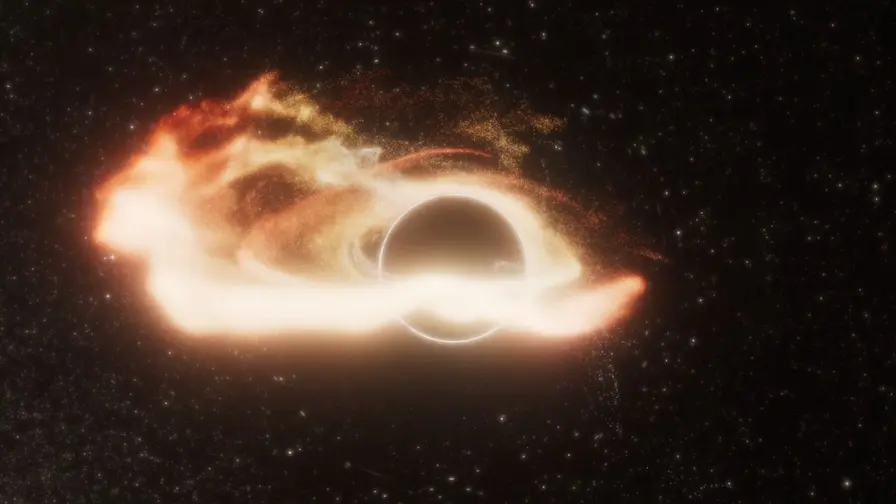
This is the first time such a detailed reconstruction has been achieved for a star stripped of hydrogen and helium. It raises questions about whether episodic mass loss is common among stripped-envelope progenitors and how this behavior affects the odds of launching successful relativistic jets.
How a global telescope network traced the event
No single facility captured the full story. Instead, a rapid chain of alerts and a global set of instruments stitched together the timeline. The NSF-Vera C. Rubin Observatory happened to have the transient within one of its Deep Drilling Fields, enabling repeated, sensitive imaging. Public commissioning data delivered via an alert broker provided early photometric measurements across several bands. The Rubin observations also showed signs that the progenitor system had been active shortly before the explosion, adding another layer to the pre-explosion narrative.
Spectroscopy played a central role too. The Dark Energy Spectroscopic Instrument, normally tasked with mapping the cosmos using thousands of optical fibers, operated a spare-fiber transient program to obtain repeated spectra of SN 2026gzf. Those data tracked spectral evolution, confirmed the Ic-BL classification, and measured the velocity structure of the ejected material. "DESI’s spare-fiber program gave us the opportunity to return to SN 2026gzf repeatedly and follow how its spectrum changed as the explosion evolved," said Xander Hall, a graduate student and member of O’Connor’s team. "This sequence of observations demonstrates the power of using DESI’s spare fibers for rapid transient follow-up and classification as Rubin continues to ramp up its transient alert stream over the next decade."
Other contributors included NASA’s Chandra X-ray Observatory, the Very Large Array, Gemini North and South, SOAR, Palomar, the Hobby-Eberly Telescope, SALT, and observatories at CTIO. Together they provided coverage from X-rays to radio frequencies, allowing researchers to rule out a relativistic jet with high confidence and to model the shock interaction with circumstellar material.
Expert Insight
"What makes SN 2026gzf so instructive is not only the rare detection of the shock breakout but the ability to connect that detection to the complex envelope the star built around itself before collapse," said Dr. Elena Moreno, an astrophysicist not on the primary teams but who studies massive star evolution. "If jets are being choked by dense shells, then the progenitor’s late-stage mass loss directly determines whether a GRB is visible. That link forces us to revisit models where jet success depends only on core properties. Environment matters."

Dr. Moreno added that expanding rapid-response networks will increase the sample of shock breakouts in the coming decade. "We will soon know whether SN 2026gzf is an oddball or part of a broader class of energetic explosions where jets fail at the last moment. Each well-observed event teaches us how massive stars live and die."
Implications for theory and future observations
SN 2026gzf acts as a bridge between ordinary shock breakouts and the more extreme deaths that produce GRBs. Its faint X-ray breakout and absent relativistic outflow suggest a continuum of outcomes rather than a strict dichotomy between jet-producing and non-jet-producing explosions. In practical terms, models of core collapse must account for how mass-loss history sculpts the outer layers and how those layers influence jet propagation and breakout.
From an observational standpoint, the event underscores the need for continuous, multiwavelength monitoring and for alert systems that can marshal resources within minutes. The combination of wide-field X-ray monitors, fast optical surveys, and flexible spectroscopic resources like DESI’s spare-fiber program proved decisive. As Rubin begins full operations and as new X-ray monitors come online, astronomers will capture more shock breakouts and build a statistically meaningful sample that links progenitor properties to explosion outcomes.
There are also technical lessons. Rapid coordination across facilities and the integration of archival data proved essential. Archival imaging with DECam provided a decade-long baseline that revealed the pre-explosion blue source. Such historical context is invaluable because it provides constraints on progenitor activity that are otherwise inaccessible for stars hundreds of millions of light-years away.
Conclusion
SN 2026gzf is a rare and illuminating case. A faint X-ray opening flash announced an explosion that resembled the energetic supernovae associated with gamma-ray bursts, yet produced no detectable relativistic jet. Detailed follow-up revealed a stripped Wolf-Rayet progenitor surrounded by multiple shells of previously ejected material, suggesting a violent final phase of mass loss that may have altered the explosion’s high-energy outcome.

Beyond the specific findings, the event highlights how modern astronomy is orchestrated: a space telescope spots a transient that can last minutes, automated alerts fan out across networks, and telescopes in different time zones gather complementary data that together reveal a coherent physical narrative. SN 2026gzf will be a touchstone for future work on how mass loss, progenitor structure, and jet physics combine to determine the observable fates of massive stars.

“My work centers on sustainability, energy, and environmental science — examining how innovation can lead to a greener future.”

Discussion
Leave a Comment
Comments (5)
Feels a bit overhyped, like one exceptional case and they generalize a lot. Still, shock breakout detection is neat, but sample size matters.
I work with radio arrays, and ruling out a jet to high confidence is tough, takes time and depth, but this team pulled it off, impresive
Is this even true? A faint X-ray then no GRB sounds odd, could selection bias or detection limits be fooling us, right?
Makes sense tbh: choked jet + dense shells explains missing GRB. Still curious about mass loss timeline, years vs months?
wow that opening X-ray flash gave me chills, like watching a star gasp its last breath... insanely fast response by telescopes, bravo but also kinda eerie