
When astronomers peered back through archived telescope images, they expected to chart familiar territory. Instead, they found a shy giant that had been peeking out from the glare for more than a decade. Beta Pictoris d, a faint gas giant orbiting a young star only 63 light-years away, had been hiding in plain sight inside one of astronomy's most scrutinized systems.

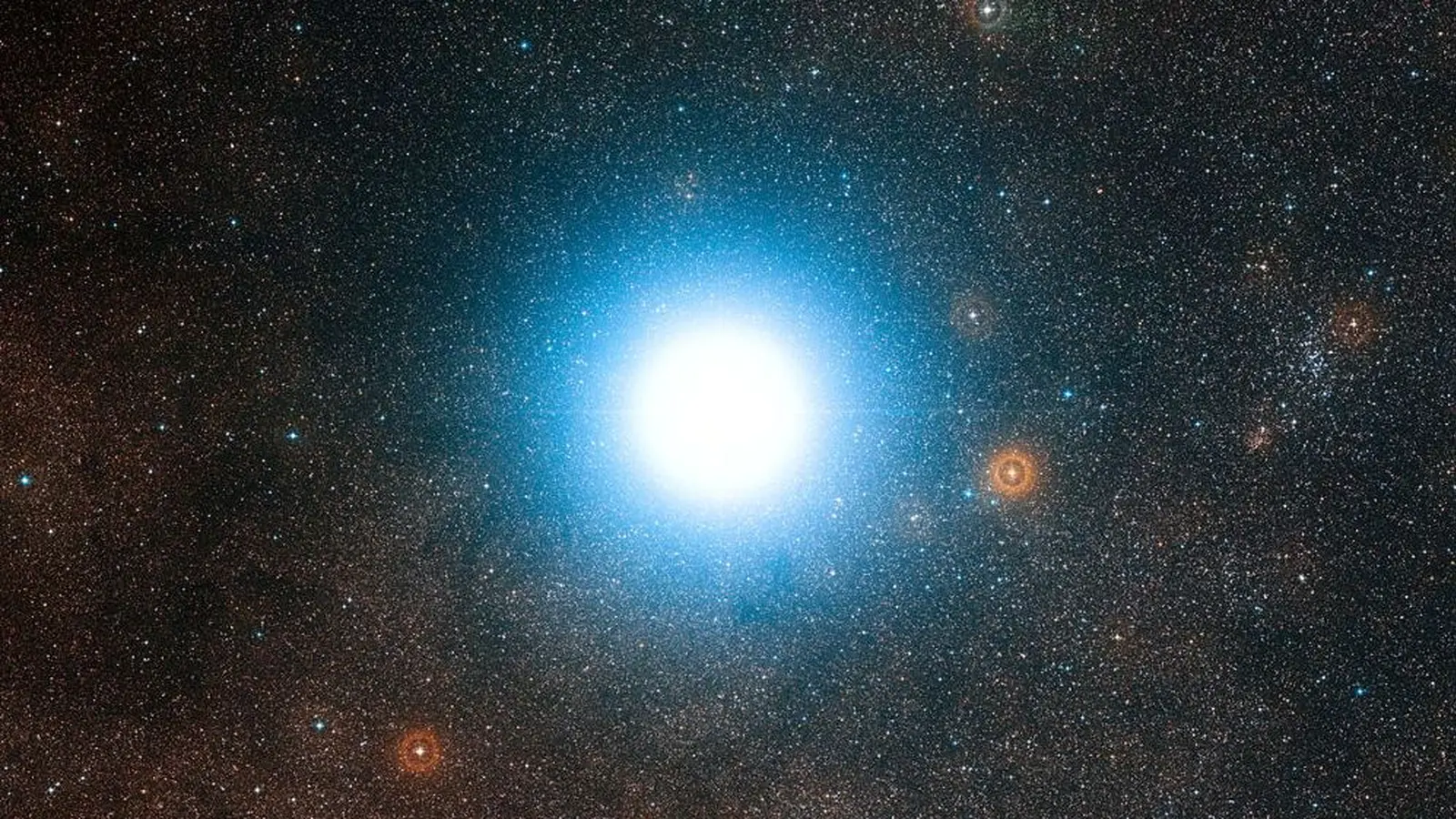
Beta Pictoris is located about 60 light-years away toward the constellation of Pictor (the Painter’s Easel) and is one of the best-known examples of a star surrounded by a dusty debris disc. This image, based on data from the Digitized Sky Survey 2, shows a region of approximately 1.7 x 2.3 degrees around Beta Pictoris.
How a planet slipped between the cracks
Direct imaging of exoplanets is a game of contrasts. Stars can outshine their planets by factors of millions, so researchers rely on sophisticated instruments to suppress starlight and tease out the dim glow of a companion. Even then, dust in the system, instrumental artifacts, and subtle processing choices can make or break a detection. That is exactly how Beta Pictoris d went unnoticed for years: faint, close to brighter companions, and partially camouflaged by an edge-on debris disc that scatters starlight into patterns that mimic planetary signatures.
The surprise discovery began when teams using the European Southern Observatory's Very Large Telescope, specifically the ERIS instrument, revisited observations of the well-known planet Beta Pictoris b. Instead of only tracking the familiar giant, researchers noticed an unexpected point of light appearing apart from the brighter companion. Colleagues leaned in. Questions were asked. Measurements were rechecked. The object persisted.

The position of the star Beta Pictoris is marked with a circle on this chart of the constellation Pictor (The Painter’s Easel). As indicated by its name, this is the second brightest star in its constellation. Together with most of the stars marked on this chart, it can be seen in a dark sky with the unaided eye.
What sealed the case was archival archaeology. The team dug through more than a decade of VLT data and found the same faint source in earlier SPHERE images. When they tracked its motion across multiple epochs, the object moved consistently with the Beta Pictoris system rather than remaining fixed like a background star. That orbital motion was the smoking gun. In parallel, an independent group using the James Webb Space Telescope identified the same world through spectral fingerprints, providing a robust, complementary confirmation.
What the observations reveal
Beta Pictoris d is a gas giant, but it is notably lighter and cooler than its siblings. Where Beta Pictoris b and c tip the scales at about ten times Jupiter’s mass each, measurements and model comparisons place planet d at roughly 2.4 Jupiter masses, with plausible values ranging between two and four Jupiter masses. Its lower temperature yields far less thermal infrared emission, which explains why it is about 100 times fainter than the famously bright Beta Pictoris b in direct images from the ground.
Tracking suggests that Beta Pictoris d orbits at an average distance of about 26 astronomical units. For context, one astronomical unit equals the mean Earth-Sun separation. At that distance, the planet may take roughly 91 years to complete a single orbit, although the precise orbital shape is still subject to refinement as more epochs accumulate.

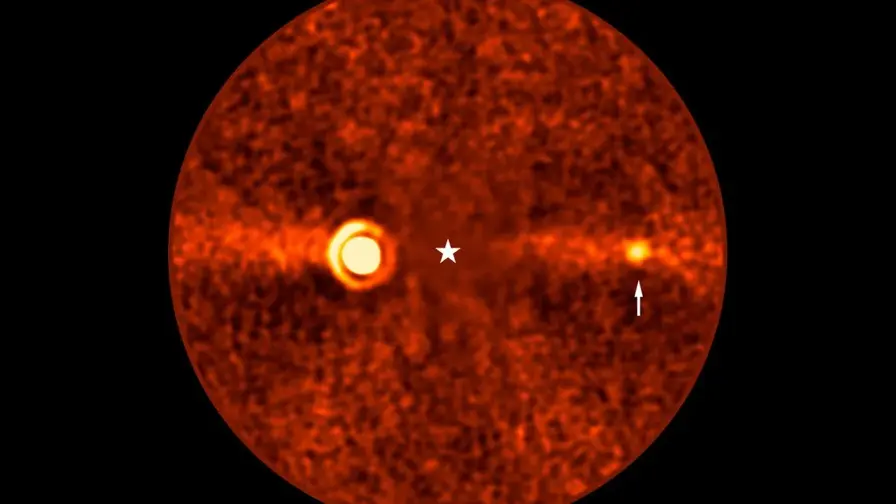
These images trace Beta Pictoris d over more than a decade, from its discovery with ESO’s VLT to earlier detections in archival VLT and JWST data. The arrow marks the faint planet, while the brighter Beta Pictoris b appears in the upper images; the diagonal band is the system’s edge-on debris disc.
What makes the JWST confirmation especially valuable is method complementarity. Ground-based detection relied mainly on high-contrast imaging techniques and precise subtraction of starlight. JWST, using NIRSpec and MIRI, detected atmospheric molecular signatures including methane, carbon monoxide, and water vapor. Spectral lines are harder to fake than a faint blob of light, because scattered dust typically lacks the molecular fingerprints that a planetary atmosphere imprints on the spectrum. Combining imaging and spectroscopy tightened the identification into a clear discovery.
Why this system matters
Beta Pictoris is remarkably young, about 20 million years old, compared with our Sun's 4.6 billion years. That youth makes the system a living laboratory of planetary formation and early evolution. Giant planets are still radiating their formation heat; debris discs brim with colliding asteroids and comets; and smaller rocky worlds may still be accreting from leftover material. Observing multiple planets in the same youthful environment lets astronomers compare siblings that formed from the same protoplanetary disk, reducing some variables that complicate cross-system comparisons.
Systems with more than two directly imaged planets are rare. Prior to this, HR 8799 was the clearest example. Having a third confirmed directly imaged planet in Beta Pictoris opens new opportunities to study planet-planet interactions, migration histories, and how giant companions sculpt surrounding dust. In fact, Beta Pictoris d appears to sit at the right distance and possess the appropriate mass to explain certain features of the system's debris disc, such as a sharply defined inner edge. Its gravitational influence may be the missing piece of a puzzle long observed but underexplained.
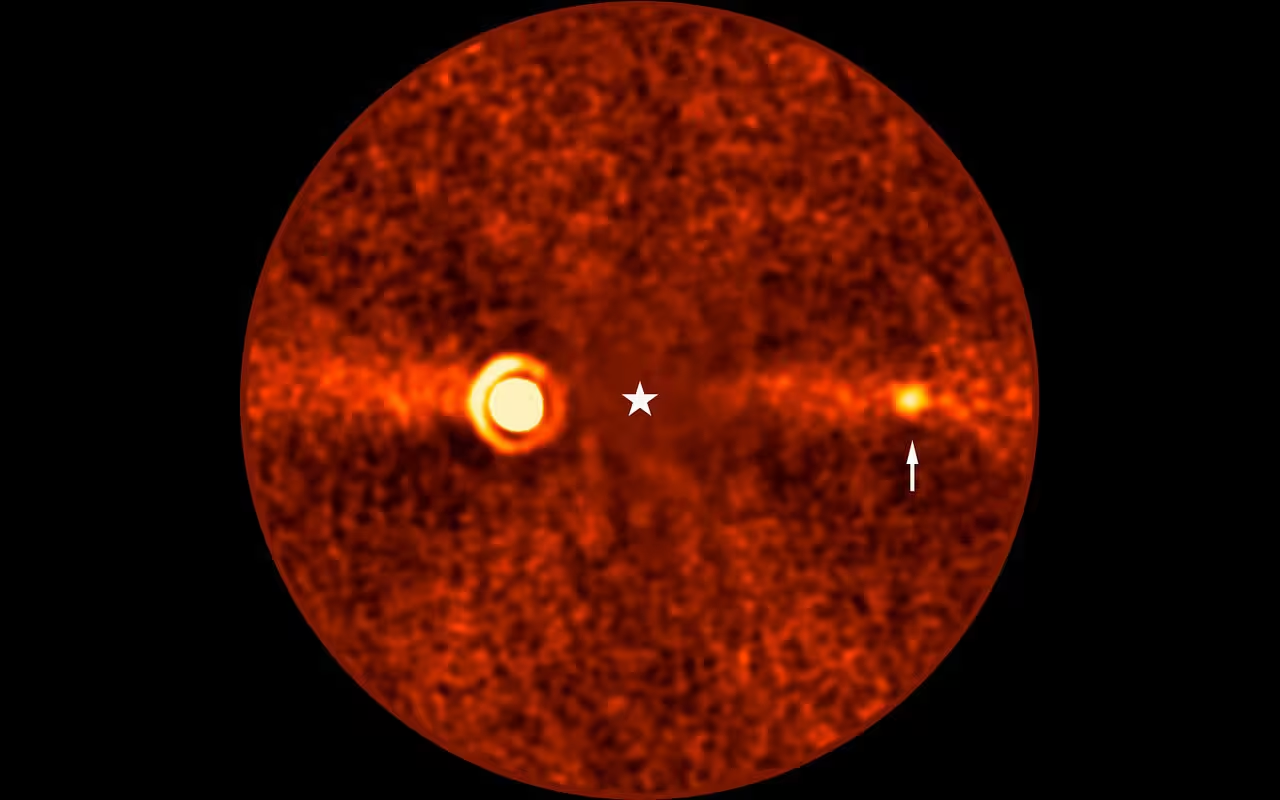
This VLT image shows Beta Pictoris d, the third known planet around Beta Pictoris. Marked by an arrow, the gas giant is about 2.4 times Jupiter’s mass; the horizontal band is the system’s edge-on debris disc.

Beyond interpretations of this single system, the find has methodological implications. It underscores the value of reprocessing archival data with fresh eyes and updated algorithms. Instruments such as SPHERE and ERIS have archived treasure troves of data in which lower-mass or fainter companions may be lurking. Archival discovery is cost-effective and accelerates science by letting teams combine historical baselines with new, more sensitive observations.
Expert Insight
"Finding Beta Pictoris d is a reminder that the universe keeps surprises in its attic," says Dr. Elena Martínez, an observational exoplanet scientist at the Institute for Planetary Sciences. "When you pair improved processing techniques with complementary observatories like the VLT and JWST, you increase your chances of teasing out subtle signals. Each additional planet in a system is another data point on how planetary systems assemble and evolve."
Dr. Martínez adds that the combination of direct imaging and spectroscopy yields richer diagnostics, because images give orbital context while spectra reveal composition and temperature. "Together, they inform formation scenarios. Did these giants form in place, or did they migrate? How much gas remained when they formed? Those are the questions we can start answering with multi-planet systems."
Technologies and the road ahead
The discovery highlights both the power and the limitations of current facilities. Ground-based observatories equipped with adaptive optics and coronagraphs can suppress stellar glare and resolve companions, yet they remain susceptible to atmospheric turbulence and thermal backgrounds. JWST bypasses the atmosphere, providing cleaner infrared spectra, but its observing time is precious and its instruments have different sensitivities and spatial resolutions. The future belongs to facilities that combine large apertures with advanced wavefront control and coronagraphy.
ESO's Extremely Large Telescope is one such facility. Once operational, its enormous mirror and next-generation instruments should push direct imaging deeper into lower-mass, cooler regimes. Researchers expect the ELT to reveal planets that are closer to their stars and fainter than what we can currently image. That capability will test models of planet formation across a wider parameter space, and it may uncover sibling worlds that remain hidden in today’s datasets.
Moreover, the discovery encourages systematic re-examination of other famous directly imaged systems. If Beta Pictoris harbored an overlooked planet, similar faint companions could exist in other systems where bright giants dominated initial analyses. Detecting those companions will refine our statistical understanding of giant-planet multiplicity and offer comparative laboratories for atmospheric chemistry, thermal evolution, and dynamical histories.
Conclusion
Beta Pictoris d is more than a new entry in an exoplanet catalog. It is a demonstration that discovery can be incremental and collaborative, and that archival data still have storylines to reveal. The planet's faintness teaches a practical lesson about observational bias: bright, massive planets attract attention, but less luminous siblings hold crucial clues about formation and sculpting processes. With coordinated ground and space observations, and the next generation of telescopes on the horizon, the hidden corners of nearby planetary systems will continue to yield surprises.

“The cosmos has always fascinated me. I write about space missions, astronomy, and the technologies pushing humanity beyond Earth.”

Discussion
Leave a Comment
Comments
No comments yet. Be the first.