
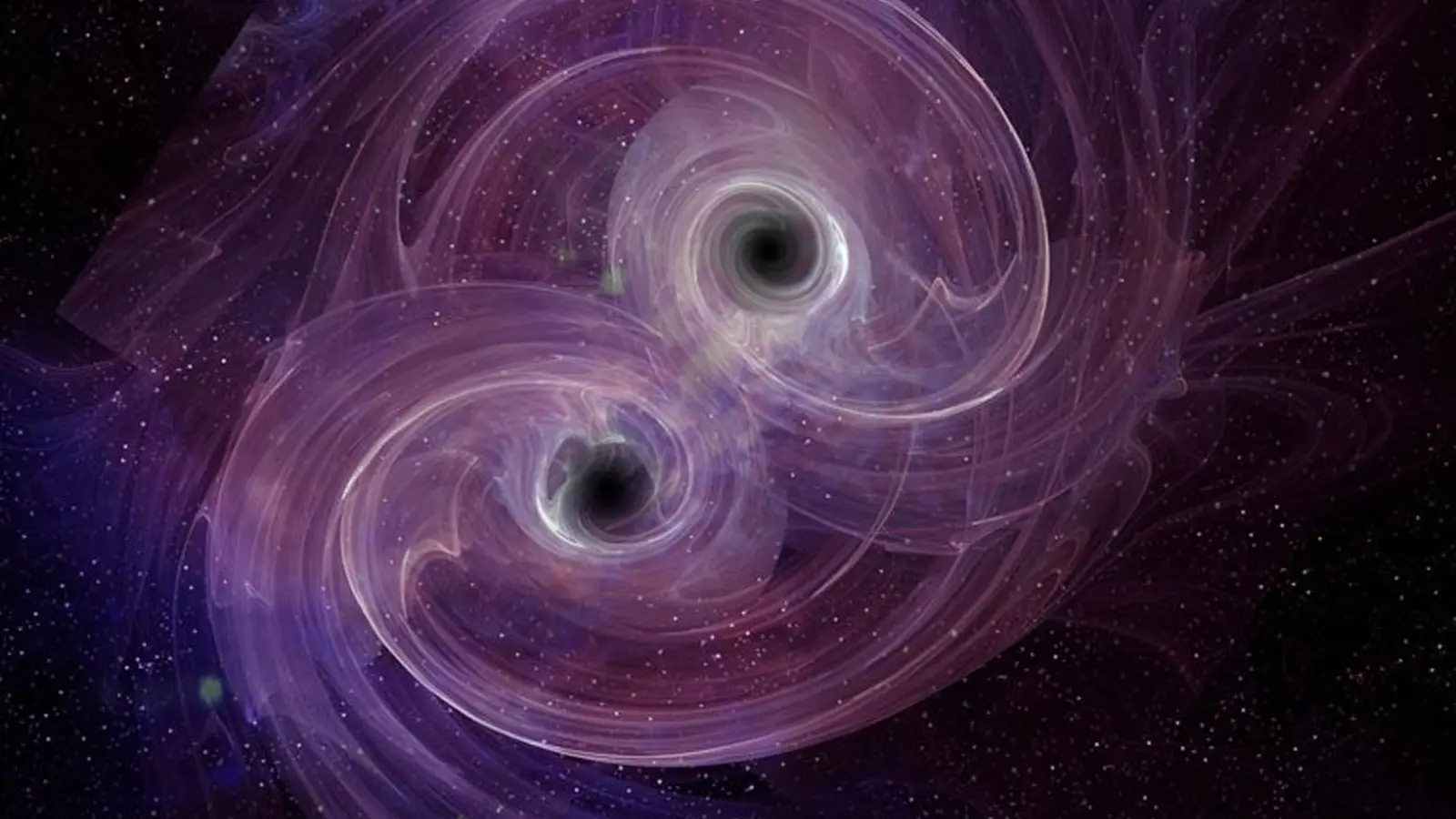
Picture two black holes locked in a death spiral, circling each other until spacetime itself shudders and a single, larger object remains. What seems like chaotic violence might obey a surprisingly simple rule from thermodynamics.

Artist’s impression of orbiting black holes about to merge. New research, led by Penn State physicists, shows that the size of the resulting merged black hole can be predicted using simple thermodynamics.
When gravity sings
Gravitational waves register the universe’s loudest collisions. They arrive as tiny ripples in detectors like LIGO and Virgo, carrying signatures of mass, spin, and the orbital dance that preceded the crash. Analysts invert those waveforms to reconstruct the merger and to estimate the properties of the remnant black hole that emerges after the ringdown phase.
Usually, predicting the final mass and angular momentum of that remnant requires heavy-duty numerical relativity. Those simulations solve Einstein’s field equations on supercomputers and reproduce the full nonlinear choreography of spacetime. They work. But they are expensive. They also tend to hide simple organizing principles behind layers of computation.
A team led by researchers at Penn State has put forward a different, more economical approach. Their idea: use a thermodynamic principle to anticipate the mass and spin of the final black hole. The proposal, published in Physical Review Letters and highlighted as an editor’s suggestion, argues that black hole mergers may settle into the state with the highest allowed entropy once energy and angular momentum carried away by gravitational waves are accounted for.
Entropy as a compass
Entropy often shows up in conversations about disorder. A quick way to think about it is as the count of distinct microscopic configurations consistent with the same macroscopic state. A messy desk has many arrangements. A tidy desk has few. For familiar systems, maximizing entropy under constraints predicts equilibrium states.
Applying this logic to black holes is bold but not new. Since the 1970s, physicists have recognized deep parallels between black hole mechanics and thermodynamics, especially after Hawking’s discovery that black holes radiate. That link opened the door to treating quantities like horizon area as analogs of entropy.
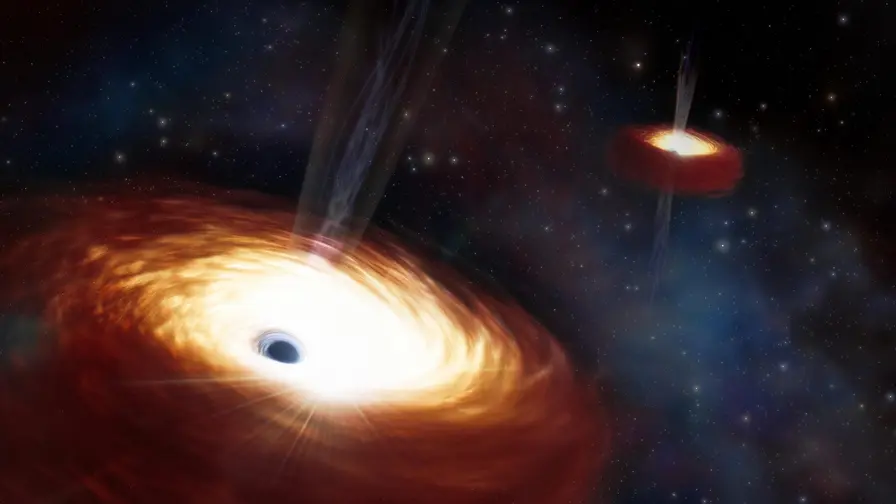
The Penn State group extended that analogy to binary black hole mergers. They examined how the combined mass and angular momentum of the inspiraling pair map onto a family of hypothetical rotating black hole remnants. Scanning that family, they identified the configuration with maximal entropy consistent with the conserved quantities minus the quantities lost as gravitational radiation.
What they found is striking. The entropy-maximum point lies very close to the remnant predicted independently by numerical relativity. The agreement is not marginal. It sits within a few percent for a wide range of initial configurations. In effect, a simple thermodynamic extremum traces the endpoint of a profoundly nonlinear gravitational process.
Why this matters
The result matters for several reasons. First, it offers an intuitive, physics-based shortcut for estimating remnant properties without running a full simulation. That can speed up phenomenological models used to interpret gravitational-wave events and to build waveform templates.
Second, the finding suggests that entropy maximization might be more than an analogy. It could be a principle woven into the dynamics of gravitating systems when radiation drains energy and angular momentum. If so, that would bridge thermodynamics and general relativity in a practical way, not just a conceptual one.
Finally, the approach may clarify what the final black hole ‘remembers’ about the merger. After the violent merger, the remnant’s exterior is described by only a couple of parameters: mass and spin. Other details of the progenitor pair appear lost. Casting this erasure in thermodynamic terms helps explain why only those coarse-grained quantities survive.
How they tested it
The team’s method begins with the evolving mass and angular momentum extracted from a binary system as it emits gravitational waves. These quantities trace a path through the space of possible parameters. For each point along that path, one can ask: if the system were to settle into a single rotating black hole with these conserved values, what would its entropy be?
Mapping entropy across that sequence produces a curve with a peak. That peak marks the entropy-maximizing candidate remnant. The researchers compared those predictions to independent outputs of numerical relativity simulations of mergers that include full general relativistic dynamics. The proximity of the predictions to the simulated remnants was the central empirical result.
Different mass ratios and spin alignments were tested. In many realistic cases the entropy-based estimate tracked the simulated final mass and spin to within a few percent, though the match varies depending on how much energy and angular momentum the system radiates before settling.
Limits and open questions
No single rule is expected to cover every possible scenario. Extreme configurations, such as very unequal mass ratios or highly precessing spins, may push the entropy approach to its limits. Dissipation through gravitational waves is complex and can carry off significant angular momentum in ways that challenge simple accounting.
There are also deeper theoretical questions. Why should entropy, a statistical concept rooted in microscopic counting, so neatly select the remnant of a deterministic geometric process governed by Einstein’s equations? Is this selection an emergent property of the nonlinear dynamics, or does it point to missing microphysics linking gravity and quantum degrees of freedom?
Expert Insight
"This is the kind of result that invites both pragmatism and wonder," said Dr. Lena Ortiz, an observational astrophysicist not involved in the study. "On one hand, you can use it to approximate remnant properties fast. On the other, it nudges us to ask what microphysical bookkeeping underlies horizon entropy. Future gravitational-wave catalogs will tell us whether this is a recurring pattern or a helpful coincidence."
Dr. Ortiz highlighted the practical payoff: rapid estimates can help with low-latency analyses during gravitational-wave detections, when time is critical for electromagnetic follow-up campaigns. At the same time, she encouraged caution: "We need to map where the thermodynamic estimate breaks down so modelers know when to trust it."
Broader implications and future prospects
The thermodynamic conjecture could influence how waveform models are built and how parameter estimation pipelines prioritize computational resources. If entropy maximization becomes a validated tool, it may augment surrogate models and analytical approximations used across data analysis, population studies, and astrophysical inference.
Observationally, the growing catalog of gravitational-wave events provides a testing ground. Each detected merger offers a data point: how closely does the entropy prediction match the inferred remnant? Statistical studies across many events will reveal systematic trends and exceptions.
On the theoretical front, the result encourages new work at the intersection of gravity and statistical physics. Researchers might explore whether entropy-based variational principles arise naturally from averaging procedures applied to Einstein’s equations, or whether they hint at microscopic degrees of freedom yet to be described by a quantum theory of gravity.
Conclusion
Black hole mergers are violent, complex, and deeply nonlinear. Yet nature often hides simplicity beneath complexity. The maximum entropy conjecture for black hole mergers is an elegant example of that pattern: a thermodynamic criterion that tracks the outcome of extreme gravitational dynamics. It does not replace full simulations, but it offers a powerful intuition and a practical tool for the era of gravitational-wave astronomy. As detectors improve and the sample of observed mergers grows, the conjecture will face rigorous empirical tests. If it holds, it may point toward a unifying principle linking entropy and spacetime in a way that deepens our understanding of both.

“The cosmos has always fascinated me. I write about space missions, astronomy, and the technologies pushing humanity beyond Earth.”

Discussion
Leave a Comment
Comments (3)
Feels a bit overhyped but still cool. Simple rules hiding in messy GR — classic. Need a big stats run across many detections, not just a few cases
Seems neat, but is entropy really doing the selecting or just mirroring the numerics? What about extreme mass ratios or crazy spin precession, tho?
Wow, that entropy shortcut is wild - physics keeps surprising me. If it reliably predicts remnants, waveform analysis could be way faster. But curious where it breaks...