
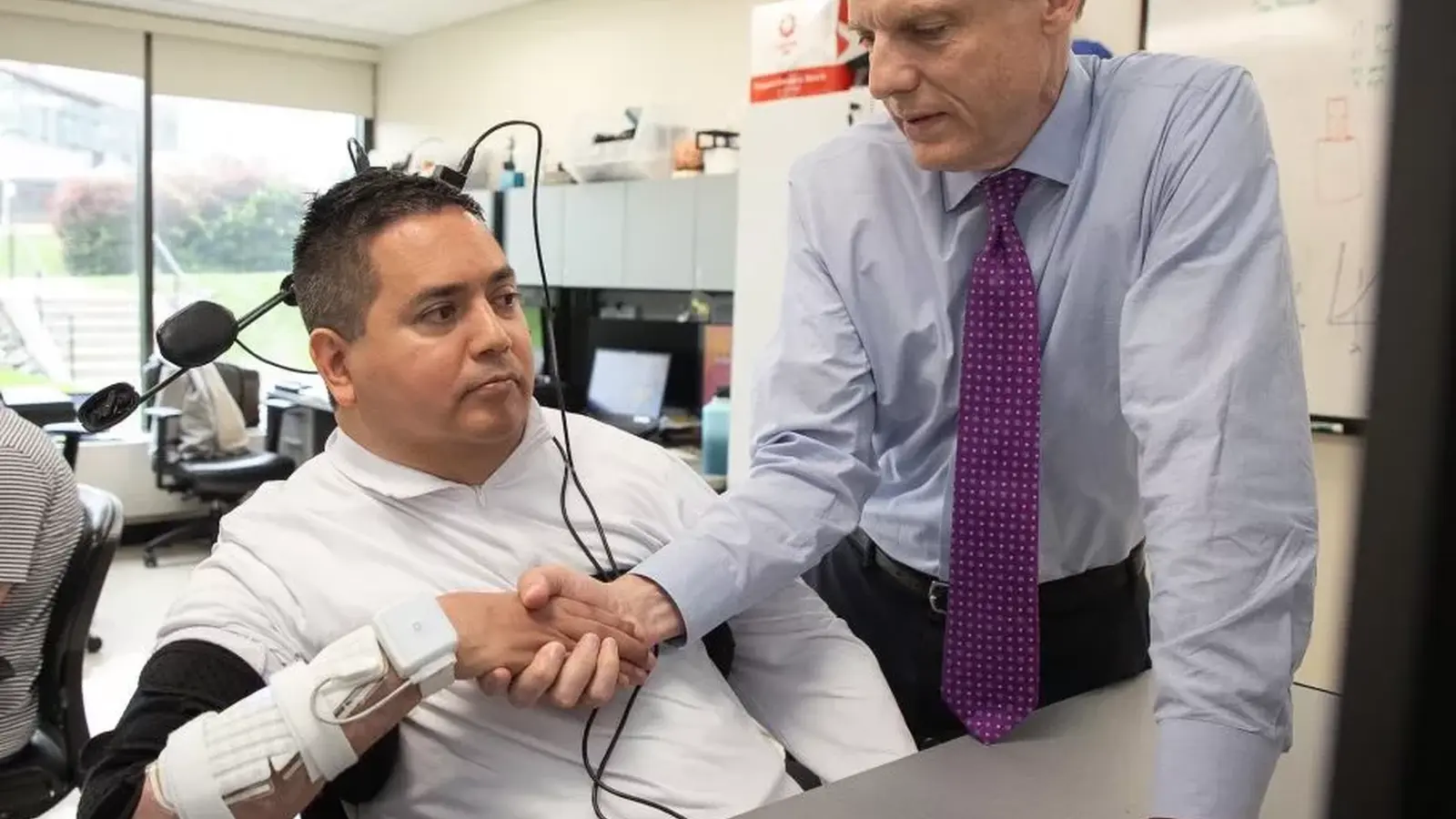
He lifted a cup. He felt its warmth. After six years of paralysis, those two simple acts carried the weight of a small miracle.
In 2020, 42-year-old Kit Thomas dove into a backyard pool and suffered a catastrophic neck injury that left him completely paralyzed from the chest down. For years he relied on caregivers for the most basic tasks. Last month, after participating in an experimental clinical trial, he could feed himself, bring a drink to his lips and sense the heat of his sister's hand for the first time since the accident.
How the double neural bypass restored touch and movement
The breakthrough comes from a team at the Feinstein Institutes for Medical Research and hinges on a system the researchers call the double neural bypass. Two parallel channels rewire the broken communication between brain and body. Tiny electrodes are implanted into both motor and sensory regions of the cerebral cortex. Those implants detect the patient’s intention to move and translate those neural patterns into commands that actuate muscles in the arm and hand.
At the limb itself, highly sensitive pressure sensors sit on the fingertips. When those sensors register contact, they send signals back to the brain implants so the patient can experience a sense of touch. The result is a closed-loop brain-computer interface that does more than move a limb; it restores a two-way flow of information.

Artificial intelligence plays a supporting role. Machine-learning decoders map specific brainwave patterns to particular actions and to tactile sensations. In a striking side experiment, the team also used AI to reconstruct a melody from cortical activity, demonstrating how much information is contained in those signals.
Clinical results were rapid and measurable. After 35 weeks of training and repeated use of the system, Kit’s right arm strength improved by 86 percent and his left arm by 62 percent. Tasks that once required assistance are now within his control: scratching his nose, wiping his face, picking up fragile objects such as thin eggshells without breaking them.

Perhaps most intriguing, some regained abilities persisted even when the external system was switched off. That observation points to neuroplasticity at work. Repeated activation of the circuits appears to encourage the nervous system to form new pathways, partially restoring function beyond the immediate assistance of electrodes and software.
To amplify sensory recovery, researchers combined cortical stimulation with targeted peripheral and spinal electrical stimulation. First they recorded Kit’s brain responses while he imagined a touch. Then they replayed matching stimulation patterns to his sensory cortex while simultaneously delivering mild electrical pulses to the skin and spinal cord. After roughly 25 weeks focused on his right wrist, previously numb areas regained measurable tactile perception.
The findings are published in Nature Medicine and mark a significant advance in the fields of neuroprosthetics and brain-computer interfaces. They also raise practical and ethical questions as these systems move toward broader clinical use.
Expert Insight
"This work demonstrates a practical path from laboratory decoding to meaningful daily function," says Dr. Elena Park, a fictional neuroscientist and neural-engineering specialist. "The combination of cortical implants, peripheral sensors and adaptive algorithms creates synergy. Each element alone is limited, but together they restore a loop the body depends on. Long-term studies will tell us how durable the changes are and how to scale this safely for more patients."
There are hurdles ahead. Implant longevity, infection risk, device calibration and the labor-intensive training required for each patient remain real barriers. Regulatory pathways and the cost of complex therapies will also determine how quickly this approach can reach larger populations of people living with spinal cord injury.
Still, the implications are broad. Beyond restoring basic motor control and touch, closed-loop BCIs may enhance rehabilitation strategies, reduce caregiver burden and improve quality of life. They also sharpen scientific understanding of how intentionality and sensation are encoded in the brain.
For patients like Kit Thomas the change is deeply personal. "I can pick up a cup and drink it myself," he told reporters. "Feeling my sister's hand again was something I never stopped hoping for." That hope now has a scientific pathway behind it, one that blends electrodes, adaptive software and the brain's own capacity to rewire itself.

“My work centers on sustainability, energy, and environmental science — examining how innovation can lead to a greener future.”

Discussion
Leave a Comment
Comments (2)
Is this even real? seems like a miracle headline but what about infection risk, implant life, who pays? if that’s real then… wow but cautious
wow. gave me chills, imagining that first sip. tech + human, kinda beautiful and scary. hope it scales, fast pls