
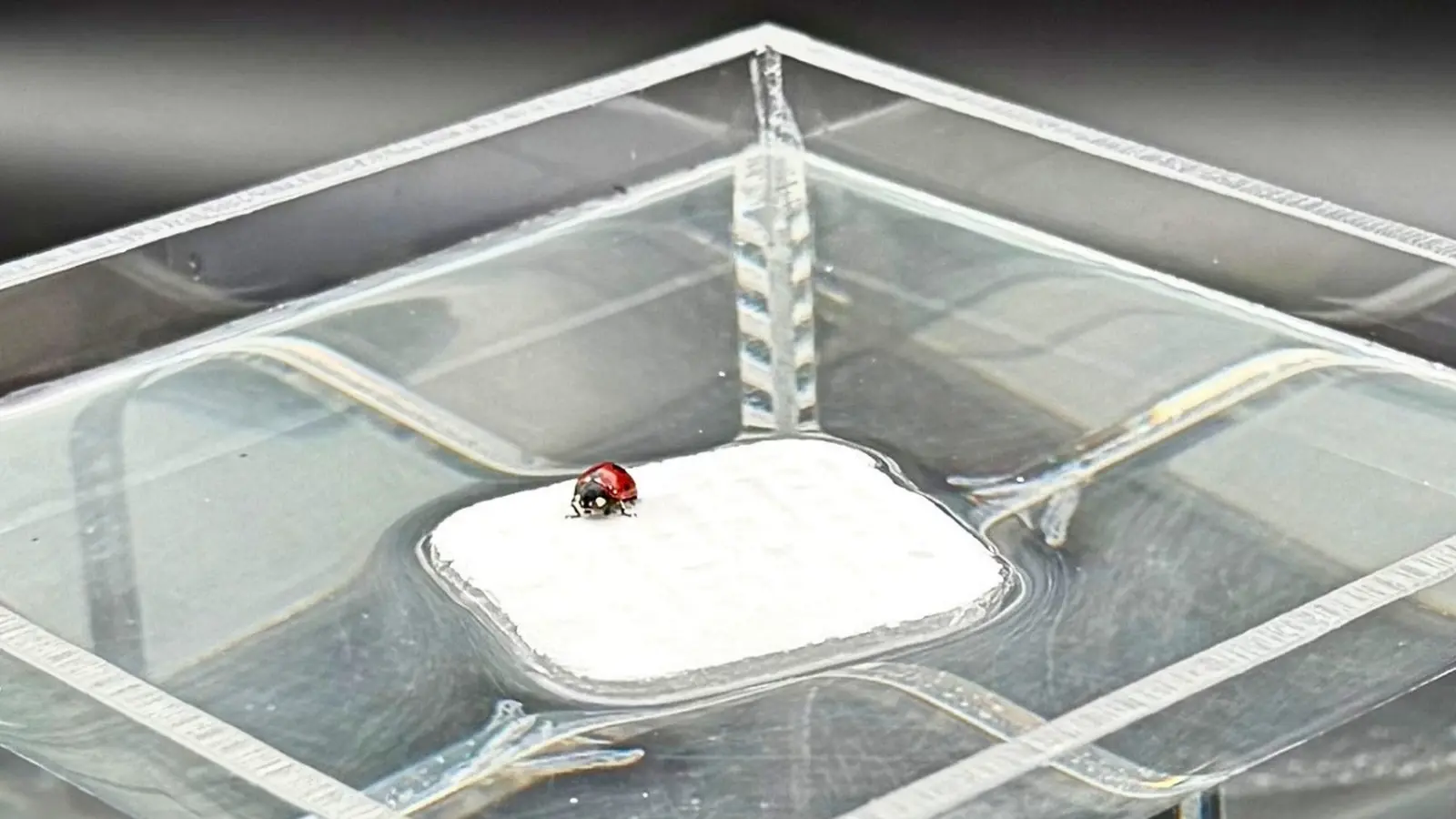
A tiny ladybug, unbothered, rests on a floating patch of material. It is a small image, but it points to a big idea: what if skin-mounted devices could let heat and moisture escape the way lungs move air?
Wearable health sensors, adhesive wound dressings, and long-duration medical patches have a recurring problem. They need to stay in contact with living skin for hours or days. But most soft interfaces used today are water-rich hydrogels that trap heat and sweat. The result: irritated skin, degraded sensor accuracy, and unhappy users. A team led by engineers at the Massachusetts Institute of Technology has taken a different path, designing a bulk hydrogel that carries air through a microscopic network of stable channels while keeping the material 70 percent water.
A lung in a gel
The new material borrows an architectural trick from human lungs. Instead of relying on a super-thin film to move gas, the researchers embedded tiny, water-repelling silica aerogel particles into a conventional hydrogel formula. Think of those particles as permanent, solid-form air bubbles. They keep tiny cavities from collapsing or flooding with water, and in doing so they self-assemble into a thin, interconnected lattice of air pathways during fabrication.
That network allows oxygen and water vapor to traverse the gel without sacrificing the softness and hydration that make hydrogels comfortable against skin. In lab tests the material reached oxygen permeability values up to 185 barrer, meaning gas moved through the bulk gel much more easily than through a standard hydrogel. Put bluntly: it was about ten times more permeable than conventional materials used today.
Keeping skin cool and dry
Why does permeability matter? Because trapped heat and sweat are the main causes of irritation and broken sensor signals. The MIT team compared their breathable hydrogel to common silicone and polyurethane patches. Water vapor transmission through the new gel was ten to one hundred times higher than the more occlusive patches. Skin stayed closer to normal.
In simple comfort tests, volunteers exercised while wearing patches. Infrared scans showed that, after a 20-minute workout, skin temperature beneath a commercial silicone patch rose by 6.5 degrees Celsius. Under the breathable hydrogel, skin temperature dropped by roughly one degree. Sweat pooling underneath the traditional patch was obvious. The hydrogel-covered skin looked and behaved much like uncovered skin.
Durability matters too. The researchers stretched the gel repeatedly. After ten thousand cycles, it retained about 95 percent of its air permeability. That resilience suggests the channels are mechanically stable and not a fragile laboratory curiosity.

A ladybug rests on the new air-permeable hydrogel, floating on water.
From electrodes to long monitoring
The team showed a real-world application by turning the gel into a skin electrode for electrocardiogram recordings. Conventional hydrogel electrodes often lose signal quality as sweat accumulates and contact impedance changes. The breathable electrodes gave clearer ECG traces during and after bicycle exercise, and in an extended test they recorded usable heart signals continuously for ten days while volunteers ate, slept, walked, and worked.

Those results are promising but preliminary. The human tests were small. Up to ten volunteers assessed exercise comfort, only two took part in detailed skin physiology measurements, and three participants were involved in the ECG exercise comparison. The researchers are transparent about that limitation and caution that larger, more diverse studies will be required.
Practical gaps and next steps
“These technologies often require prolonged contact with the skin, but conventional hydrogels trap heat and moisture because they do not allow sufficient oxygen and water vapor to pass through,” said Xuanhe Zhao, the paper's senior author and a mechanical engineer at MIT. “Our material overcomes this limitation while maintaining the high water content and softness that make hydrogels comfortable and biocompatible.”

Yet the material is not ready for clinical use. Important development milestones remain. The team lists long-term biocompatibility, testing on larger animals, sterilization methods, scalable manufacturing, shelf life assessment, and regulatory safety as work that must be completed. Another practical detail: the gel itself is not inherently adhesive, so any real device will need a backing or attachment scheme.
Different product types will demand different tweaks. A wound dressing must control infection risk and promote healing. An implanted device must survive sterilization and integration challenges. A wearable cardiac monitor needs reliable adhesion and consistent electrical contact. The underlying breathable architecture will need adaptation for each case.
Expert Insight
"The idea of embedding permanent, air-holding particles inside a hydrated matrix is elegant because it separates two competing needs: oxygen transport and tissue-friendly hydration," said Dr. Maya Hart, a biomedical materials researcher at Stanford University. "For wearable monitoring this could reduce false readings and skin reactions. For implantable tissues the concept points toward better oxygen delivery, but the regulatory and biological hurdles are much higher."
Broader implications
Beyond wearables, the breathable architecture invites thought. Tissue engineering and many implantable constructs fail because cells in the interior do not receive enough oxygen. A material that preserves a hydrated environment while letting gas pass could improve engineered tissue survival and function. But again, implantable use will require extensive safety testing and likely years of development.
There is also a materials science lesson here. Instead of designing ever-thinner films to solve permeability problems, you can create pathways inside a bulk material. That shift opens design space for sensors, dressings, and potentially even active devices that exchange gas as well as fluids.
Conclusion
The MIT lung-inspired hydrogel is not a finished product, but it is a clear example of bioinspired engineering that addresses a real challenge for skin-mounted devices. It balances hydration, softness, gas transport, and mechanical resilience in a single material. The road to clinical adoption is long. Yet for patients, athletes, and anyone who wears a device for a long time, the idea of a patch that truly lets skin breathe is immediately compelling.

The findings are reported in Nature.

“My work centers on sustainability, energy, and environmental science — examining how innovation can lead to a greener future.”

Discussion
Leave a Comment
Comments (3)
Looks promising, but 10 volunteers? cmon. I want to see 100s, varied skin types, long wear in heat. still, clever trick with aerogel.
Is this even scalable? lab demos look slick but sterilization, shelf life, adhesion, thats a lot. curious about cost tho.
wow, little ladybug pic sold me. Tech that actually lets skin breathe? hopeful but also wow, this could fix so many itchy sensors!