
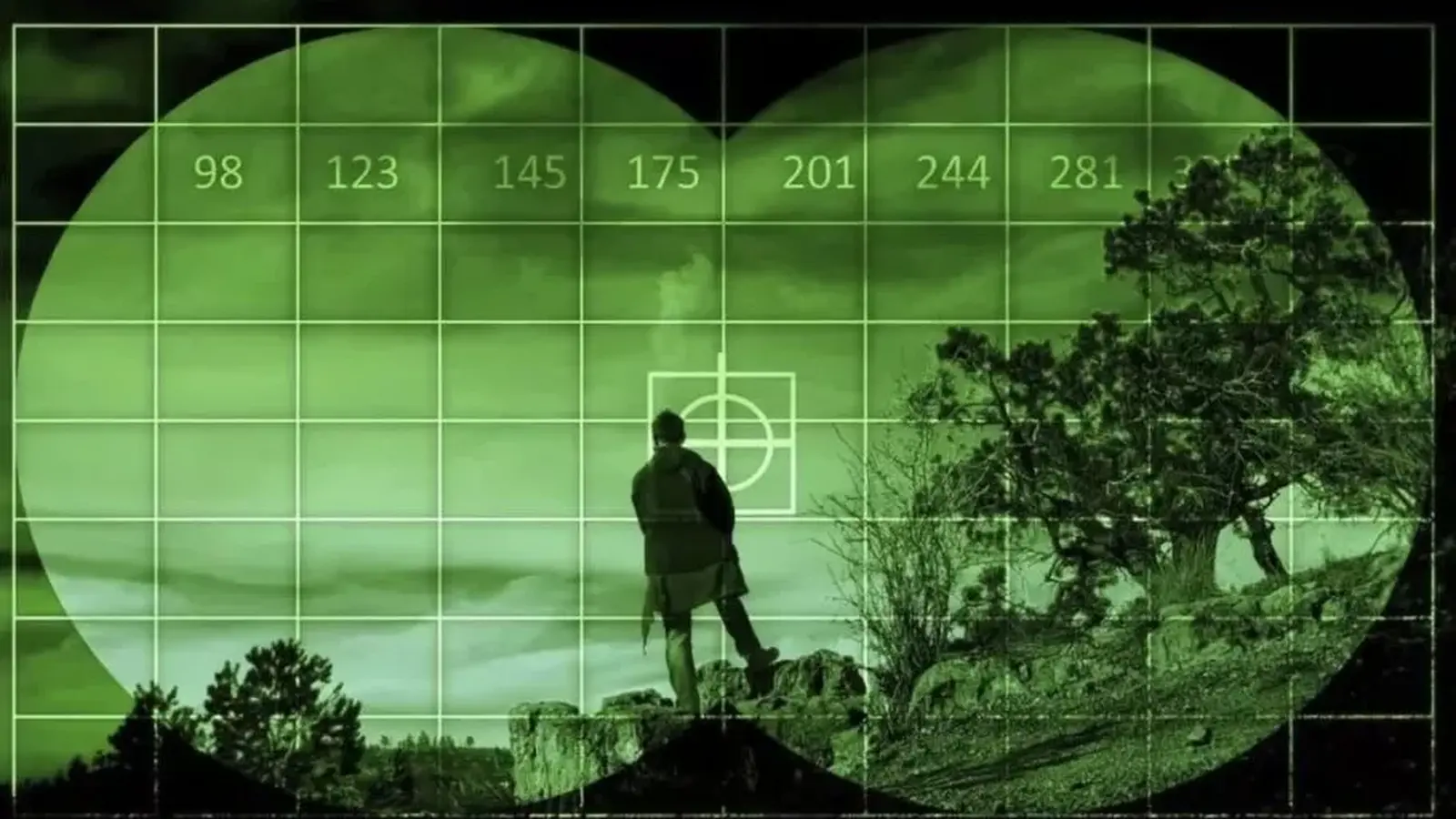
Imagine walking through a dim city street and seeing the world not as a flat green wash, but in subtle, usable color. That’s what a small team at China’s Institute of Technology has demonstrated with a featherlight prototype that translates infrared into full-color images.
A different way to see the dark
Traditional night-vision tools compress a wide band of infrared into a single brightness channel. The result is useful but blunt: mostly shades of one color, typically green. Human vision, however, excels at reading color contrasts. Why settle for brightness alone when color can reveal much more?
Researchers answered that question by combining mercury telluride quantum dots with a two-layer organic OLED display. The quantum dots, each only a few nanometers across, act like tiny tuned antennas. They respond differently depending on the incoming infrared wavelength and intensity. Instead of collapsing everything into one grayscale value, these nanoscale sensors produce signals that the OLED stack translates into distinct visible hues.
How the hardware maps infrared to color
At the heart of the system are quantum dots made from mercury telluride, often written as HgTe. Their discrete energy states let them react selectively to different infrared bands. Those reactions feed an OLED structure with two emissive layers: one that produces red light and another that emits cyan. An energy barrier placed between the layers governs how much electric charge can pass through. Weak infrared inputs shift the balance toward faint red. Stronger signals, or those at shorter infrared wavelengths, push more charge across the barrier and activate the cyan layer. The visible output is a blend, producing richer color and greater contrast than single-color night vision.

For a real-world test, the team built a minimal wearable: semi-transparent glasses weighing just 23 grams. Users can see normal, unaided vision alongside the infrared-enhanced overlay. The device demonstrates the potential of colorized night imaging for navigation, surveillance, search-and-rescue, and even medical applications such as visual prosthetics.
“Our prototype shows that spectral detail in infrared need not be thrown away,” said the project lead, summarizing the approach. “Color mapping opens up new ways to interpret scenes at night.”
The system does have practical limits. The OLED requires an external power source, which adds weight and design constraints for portable gear. More importantly, mercury telluride contains toxic mercury; the researchers note that direct exposure risks have not yet been fully assessed. Any path to consumer devices or implants would need rigorous safety testing and containment strategies.
Beyond immediate devices, this work intersects with broader advances in sensor miniaturization and low-power displays. Color-capable infrared imaging could improve automated scene analysis by feeding richer visual inputs to computer vision systems. It could also inform the next generation of visual prostheses, where spectral nuance might restore more natural perception to people with severe vision loss.
There are hurdles to clear, from material safety to battery life. Still, the concept pushes night-vision toward a more human-friendly design: one that respects our ability to read color and extract meaning from subtle visual cues. If the engineering and toxicology lines up, night might finally be seen in full color.


“My work centers on sustainability, energy, and environmental science — examining how innovation can lead to a greener future.”

Discussion
Leave a Comment
Comments
No comments yet. Be the first.