
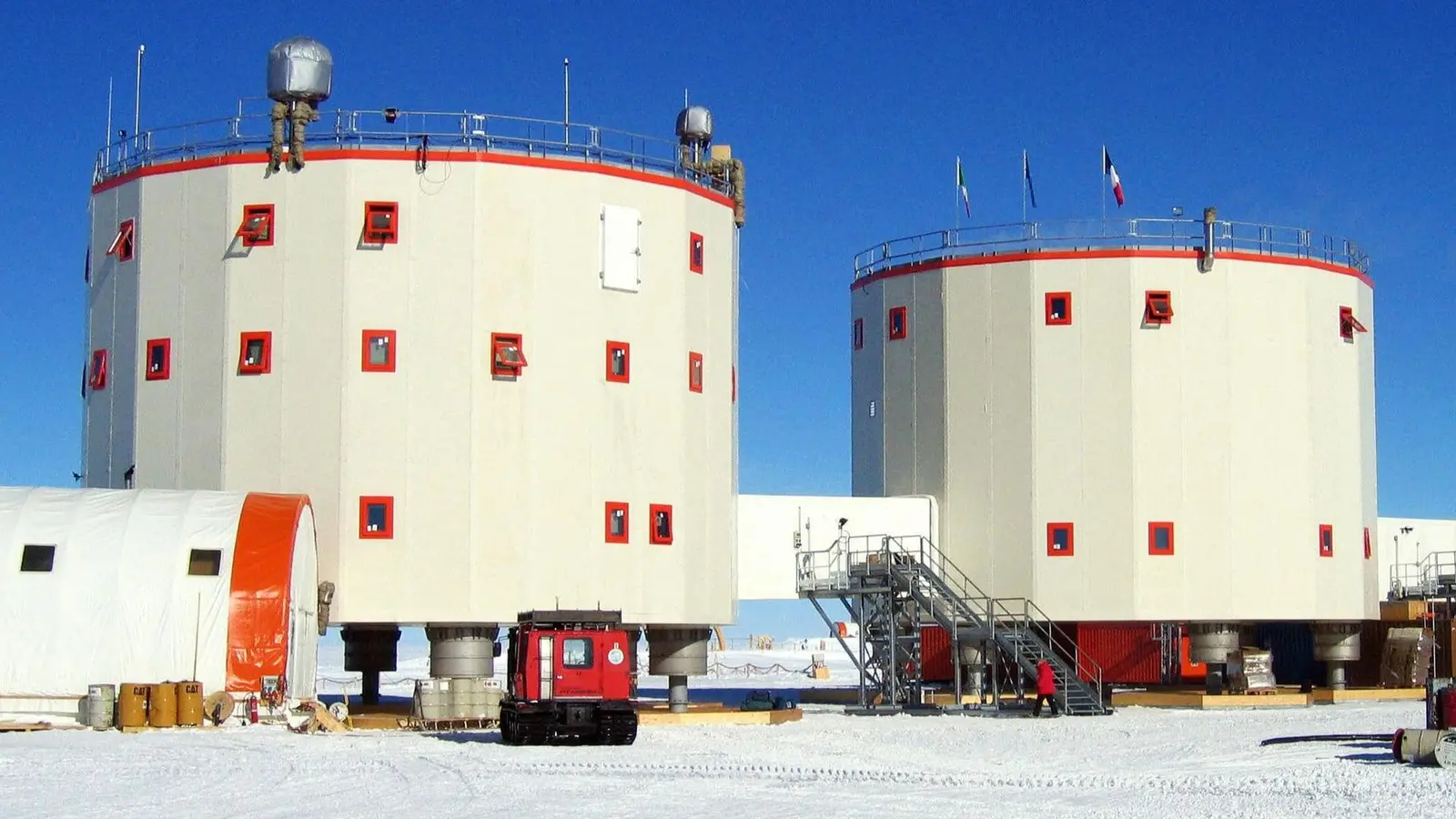
On a winter morning deep in East Antarctica, thermometers at Concordia Station plunged to minus 84.1 degrees Celsius. It was a moment that felt at once ordinary for one of the planet's coldest outposts and striking against the backdrop of record-breaking heat elsewhere on Earth.
An extreme reading from a remote white plain
Concordia, a Franco-Italian research outpost built atop a 3,300 meter ice cap, reported the low on 18 July. The station — jointly run by the French Polar Institute Paul-Emile Victor and Italy's National Antarctic Research Program — logged the temperature twice on that morning, in two closely spaced measurements. For residents and researchers there, subminus-80 values are not unusual. Still, readings beneath minus 84 degrees stand out.
Gabriele Carugati, head of Concordia on behalf of PNRA, put it plainly: even in a place engineered for cold, values this low are noteworthy. The immediate takeaway is not a contradiction of long-term warming. Rather, it is a reminder of how variable Earth's atmosphere can be, and how polar climates host extremes in both directions.
Why Concordia gets so cold
Several factors conspire to push temperatures to such depths at Concordia. First, its elevation and distance inland mean the station sits over a thick, high ice plateau. Second, the polar night — months without sunlight — removes any daytime warming. Third, the atmosphere there is extremely dry and stable in winter, so heat that reaches the surface radiates directly into space through clear skies. With no clouds to trap warmth, the surface cools relentlessly.

Those conditions also make Concordia useful for more than meteorology. The outpost supports seismology, astronomy, paleoclimate studies and long-term atmospheric observations. Researchers use its silent nights and dry air to probe signals that would be masked closer to populated or wetter regions.
Records, satellites and the coldest corners of Earth
Historically, Concordia has flirted with the planet's lowest recorded temperatures. The station's all-time low stands slightly colder than the recent event: a reading of minus 84.7 degrees Celsius observed in winter 2010. The overall terrestrial record, however, belongs to Russia's Vostok Station, where ground measurements from July 1983 reached minus 89.2 degrees Celsius.

Beyond surface stations, satellites have mapped even colder skin temperatures across East Antarctica under particular conditions. A 2018 study using satellite data suggested that the frostbound surface temperature can fall toward minus 98 degrees Celsius in isolated hollows during optimal radiative cooling events. Those satellite-derived minima occur over small spatial scales and require very specific atmospheric setups, but they indicate the theoretical range the continental ice sheet can attain.
Cold extremes and a warming planet: reconciling the paradox
It may seem paradoxical that Concordia can register such frigid lows while people in other parts of the world swelter through heat waves and wildfires. The explanation lies in scale. Climate change describes long-term shifts in global energy balance driven by greenhouse gas increases. Weather, by contrast, is local and transient. A warming planet raises the average. It does not eliminate the mechanisms that generate extreme cold in polar regions.
When scientists talk about climate variability, they are describing precisely this duality: the statistical upward trend in global temperatures coexists with episodes of intense cold or anomalous warmth in particular places. Concordia's low is a data point within a complex system, useful for understanding atmospheric behavior in one of Earth's most extreme climates.
Why researchers still watch these cold snaps
Every observation from remote polar stations helps refine models. Concordia's measurements feed into weather forecasting, climate model validation and studies of polar processes that influence sea level and global circulation. Extreme lows test models' ability to capture boundary-layer physics, radiative transfer under clear skies and the interaction between surface ice and the overlying air.
Practical research at Concordia extends to human factors as well. The station is so isolated during the harshest months that flights are impossible and the nearest research outpost sits roughly 600 kilometers away. That degree of remoteness makes Concordia a natural analogue for long-duration space missions. An ESA biomedical specialist at the station studies how isolation, confinement and extreme cold affect crew health and group dynamics. The crew have picked up the nickname "ice astronauts."
Recent warming episodes in the neighborhood
East Antarctica's cold plateaus are not immune to warming events. In March 2024, an unprecedented winter warming pulse raised temperatures near Concordia to minus 9.4 degrees Celsius — about 18 degrees warmer than the previous March maxima for the area. Studies linked that event to broader atmospheric circulation changes and found that the fingerprint of global warming amplified its intensity.
Meanwhile, the western Antarctic Peninsula shows the fastest regional warming on the continent. Marine-terminating glaciers and local sea ice have responded rapidly to atmospheric and oceanic heat, threatening ice shelves and the ecosystems dependent on them. Decisions about greenhouse gas emissions today will shape the trajectory of those changes for centuries to come.
Context: El Nino and near-term temperature prospects
The planet recently moved into an El Nino phase, a natural climate oscillation that tends to boost global average temperatures. When you add a strong El Nino signal to the background of human-driven warming, you increase the chance of record-setting global years. Forecasts and expert commentary have suggested that 2026 could be among the warmest years on record, and that the odds of surpassing previous temperature highs rise if El Nino strengthens into 2027.
That background of long-term warming does not negate the scientific value of extreme cold observations. On the contrary, such data help disentangle local atmospheric dynamics from global trends, improving the fidelity of projections used to inform climate policy and adaptation planning.
Operational and scientific tools used at Concordia
Concordia combines routine meteorological stations with targeted instruments: radiosondes, automated weather stations, and ground-based radiometers monitor the thermal structure and humidity of the lower atmosphere. Seismic sensors record subsurface and glacial signals. Astronomers exploit the stable atmosphere for optical and infrared observations. Ice cores and firn studies supply long-term climate archives.
These instruments form a network that yields dense, high-quality datasets. Scientists can compare surface records with satellite observations, test boundary-layer schemes in atmospheric models and refine estimates of polar contributions to sea-level rise.
Expert Insight
Dr. Marcus Liu, a climate modeler at the Polar Research Institute who studies polar boundary-layer processes, commented: "Cold extremes like Concordia's recent reading are not curiosities to shelve. They provide crucial stress tests for models. If a model cannot reproduce how heat escapes the surface under clear, dry winter conditions, its projections for polar amplification and ice-sheet response will be less reliable. Observations and models must be pushed together for us to reduce uncertainty."
His point is practical. Better models lead to better policy decisions and more targeted mitigation strategies. The data are the bridge between raw observation and actionable science.
Where this leaves us

Concordia's minus 84.1 degrees Celsius reading is a clear demonstration that extremes persist even as the global mean temperature rises. It is not a refutation of climate change. It is an invitation to probe the mechanisms that produce extremes at both ends of the thermometer. Polar stations like Concordia remain essential: they keep meticulous watch over the coldest corners of our planet while the rest of the globe grapples with unprecedented warmth.
In short, cold and heat are both actors on a changing stage. Understanding how they interact is central to forecasting our planet's future.

“The cosmos has always fascinated me. I write about space missions, astronomy, and the technologies pushing humanity beyond Earth.”

Discussion
Leave a Comment
Comments
No comments yet. Be the first.