
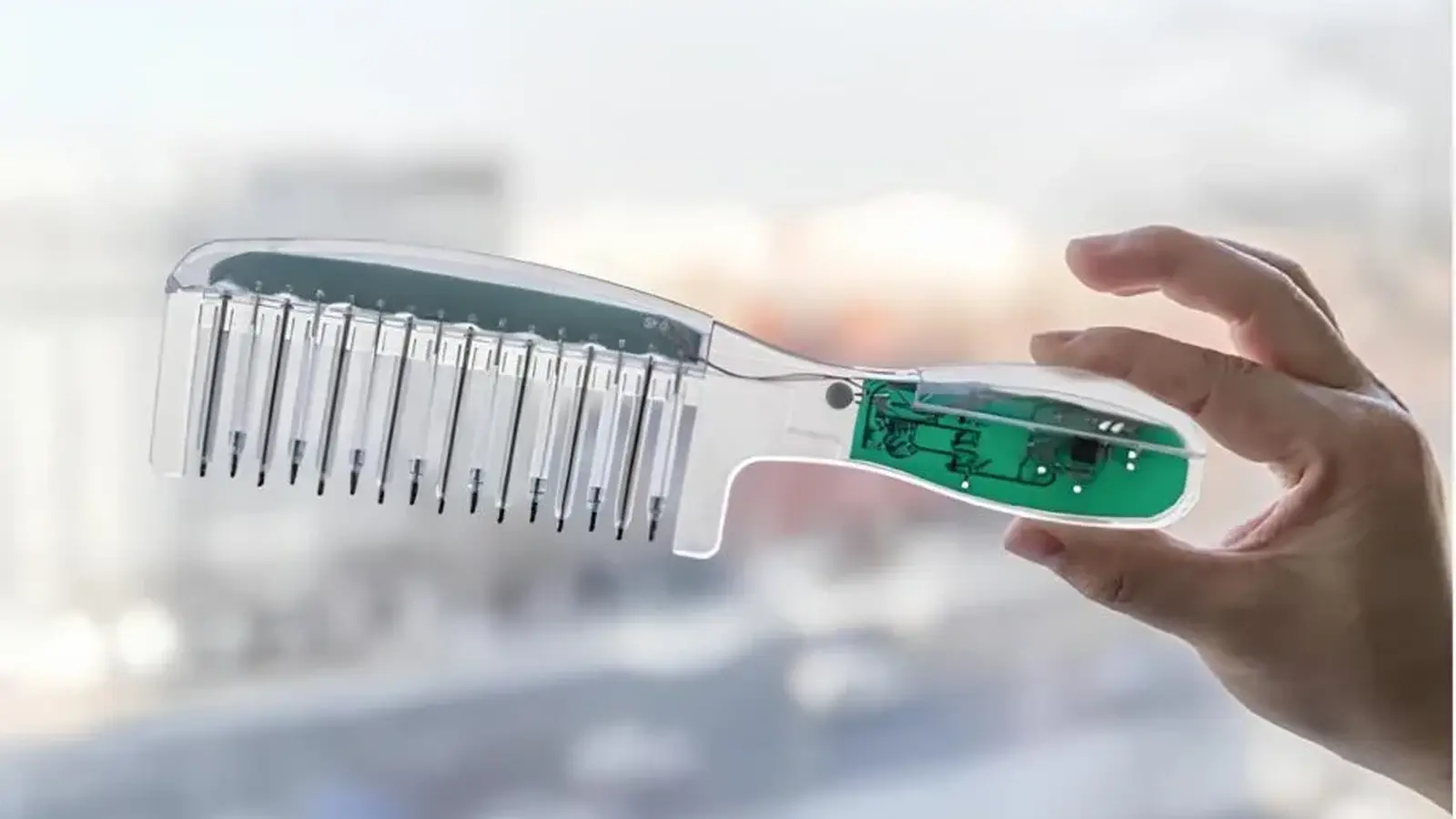
Imagine a toothbrush for your scalp that can push medicine deeper than any cream. Scientists in Beijing have built something like that. It looks like a comb, but under the plastic teeth there are tiny electronic electrodes and pockets to carry therapeutic molecules. The device, nicknamed Detangle, was engineered to coax dormant follicles back to life in a mouse model of male-pattern hair loss.
How the comb actually works
Detangle does two things at once. Short pulses of electricity stimulate hair follicles directly. At the same time, the staggered-length teeth act as channels for transdermal delivery, using electroporation to make cell membranes briefly more permeable and let larger molecules slip in. The researchers report that arranging the teeth at different heights amplifies the pulsed electric field. According to their measurements, this geometry produces a field about 2.63 times stronger than a comb whose teeth are all the same length.
Why does that matter? Because a stronger, focused field can push therapeutic agents deeper. The team estimates the combined effect drives the electric influence nearly nine times deeper into skin compared with conventional topical application. That depth reaches the hair follicle niche where growth is regulated.
Evidence from mice and what was tested
The work, published in Nature Communications, tested Detangle on mice with testosterone-induced hair thinning, a common lab model for androgenetic alopecia. The researchers compared several approaches: electrical stimulation alone; two genetic therapies delivered via the device; and standard drugs used in clinics.
Two genetic interventions were explored. One used a plasmid carrying VEGFA to encourage growth of blood vessels around follicles, improving their nourishment. The other delivered SRD5A2 siRNA to silence an enzyme that contributes to follicle miniaturization. For clinical context, the team also ran comparison arms with finasteride and minoxidil applied in typical fashion.

Results over a 28 day period were striking. Untreated mice regained only about 1 percent of shaved-area hair. Electrical stimulation alone produced roughly 40 percent regrowth. Finasteride and minoxidil yielded about 50 percent and 70 percent recovery respectively. Combining electrical stimulation with SRD5A2 siRNA reached near 85 percent. Pairing the device with the VEGFA plasmid gave about 90 percent. The best outcome came when both genetic therapies were delivered together while the comb pulsed: approximately 97.85 percent regrowth.
How those numbers translate
- Untreated control: ~1 percent regrowth
- Electric stimulation only: ~40 percent
- Finasteride and minoxidil comparators: ~50 and ~70 percent
- Electric plus both genetic therapies: ~97.85 percent
Those percentages describe hair density recovery in a controlled animal experiment. They do not mean the same results will follow in humans, and the authors emphasize safety and efficacy must be established in clinical trials.
Implications and next steps
The study is an elegant demonstration of marrying bioelectronics with targeted molecular therapy. Electroporation as a delivery technique is not new, but packaging it into a consumer-friendly comb that also provides local stimulation is novel. The approach opens avenues for noninvasive gene or RNA therapies for skin and follicle disorders, and it may nudge future clinical research toward devices that augment, rather than replace, pharmacology.
Researchers at Beihang University and collaborators conclude that Detangle could one day complement existing hair-loss treatments, especially where deeper delivery is required. Human trials will be the crucial next chapter. Until then, the device remains a promising prototype that demonstrates how clever engineering can reshape drug delivery at the scale of a hair follicle.


“The cosmos has always fascinated me. I write about space missions, astronomy, and the technologies pushing humanity beyond Earth.”

Discussion
Leave a Comment
Comments (1)
Is this even real? Amazing results in mice but human skin, immune responses, safety... feels way farther off than they say. curious tho