
They turned up in a remote fold of the Mackenzie Mountains: strange, soft-bodied impressions in ancient rock, the kind of fossils that rewrite timelines. Some of the specimens date to about 567 million years ago, and together they suggest that movement, sexual reproduction, and other hallmarks of animal life were established sooner than scientists thought.
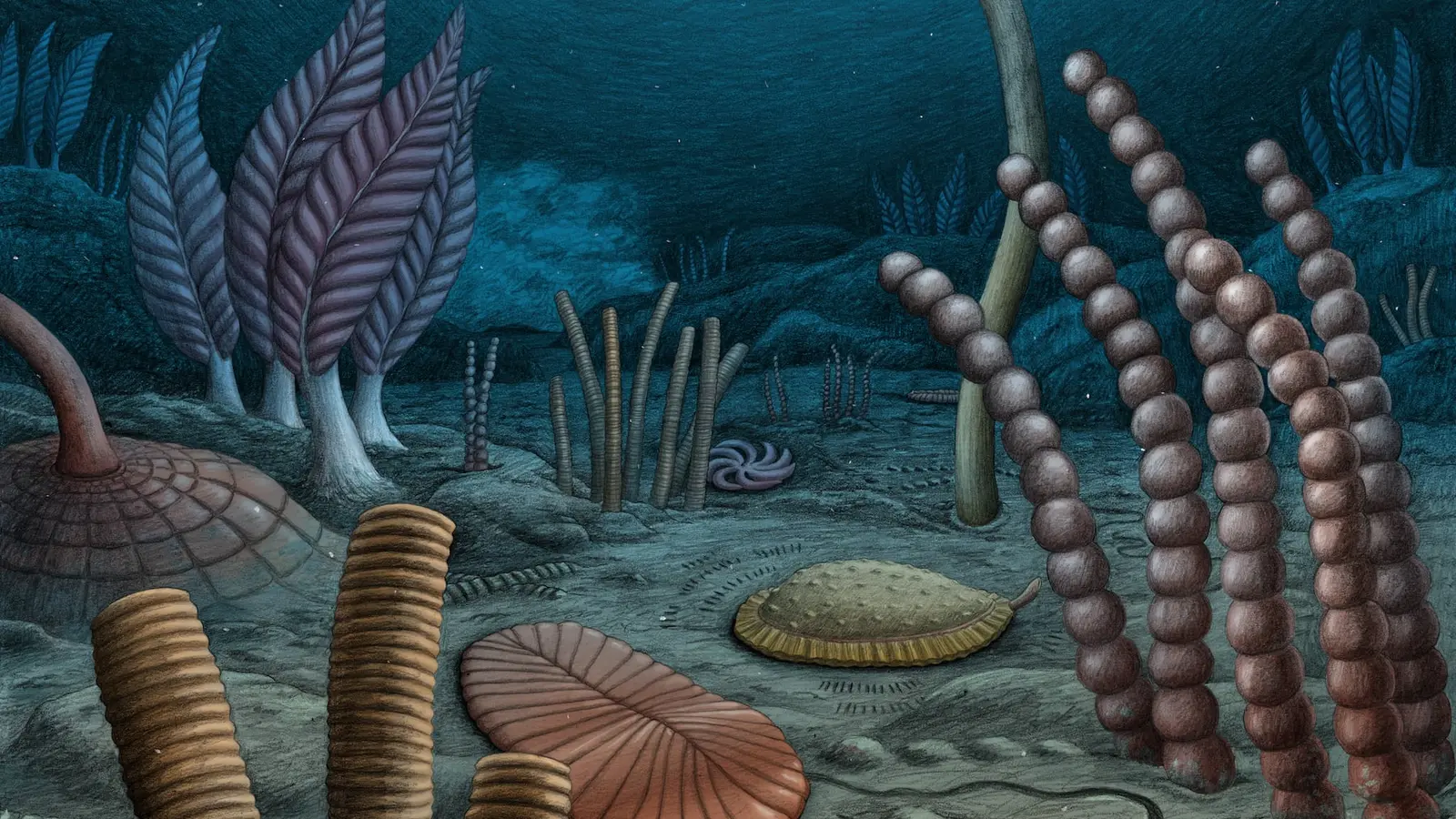
Reconstruction of a hypothetical deep-water paleocommunity from the new fossil site in Canada’s Northwest Territories, based on fossils recovered by the researchers.
The find that complicates a tidy story
For much of Earth’s early history, microbial life ruled. Then, in a geologic blink, organisms visible to the naked eye appear in the record. Paleontologists call much of that strange fauna Ediacaran. The new Canadian site, discovered by teams from the American Museum of Natural History and Dartmouth and described in Science Advances, contains more than 100 fossils and several species not previously recorded in North America.
What makes this site notable is not just the count but the context. The assemblage belongs to what researchers recognize as the White Sea community, a set of organisms previously known from Europe, Asia, and Australia. Those fossils were dated to roughly 559 to 550 million years ago. The Canadian material pushes some White Sea-type fossils back by 5 to 10 million years, and places them partly within the older Avalon timeframe. Chronology gets messy in the best way; it forces rethinking about when complex animal traits emerged and how they spread across ancient oceans.
What the fossils show about early animal life
Some Ediacaran organisms are bewildering. Flat disks. Leaf-like fronds. Ribbed ovals. Many lack the hard parts that make typical fossils, so their preservation requires special conditions. Yet within these impressions we can see behavior and body plans.
.avif)
A fossil of Dickinsonia, a flat organism that moved around on the sea floor, lacking a mouth and instead absorbing bacteria and algae through its entire bottom surface.
At the Canadian site researchers documented several key taxa that illuminate early animal biology. Among them:
- Dickinsonia: a flat, segmented organism that appears to have moved across the seafloor and fed by absorbing microbial mats across its underside. Think of it as an ancient, mobile mat-eater.
- Funisia: a clustered, tubular organism whose population structure points toward sexual reproduction, likely synchronized spawning that resembles the broadcast spawning seen in many modern marine invertebrates.
- Kimberella: an animal with a muscular foot used for scraping the substrate, commonly interpreted as an early relative of mollusks and a candidate for the oldest known bilaterian body plan, with distinct front and back orientations and left-right symmetry.
- Eoandromeda: possibly a comb jelly relative, bearing a set of spiral arms that hint at early experiments in predation and locomotion.
.avif)
A fossil of Eoandromeda, a possible comb jelly with eight spiral arms.
These fossils are not idle curiosities. Movement and sexual reproduction are complex behaviors that require integrated physiological systems. If Dickinsonia really moved and Funisia really spawned, then major elements of animal life were in place earlier than the established White Sea timeline had implied.
Why deeper waters matter
One striking aspect of the Mackenzie assemblage is its inferred environment. Sedimentology and associated fossils indicate these organisms lived in relatively deep, offshore settings rather than the shallow coastal shelves where many fossil assemblages form. That points to a model in which evolutionary innovation first took root in more stable, deeper marine habitats before those forms migrated shoreward.
Deep water is not synonymous with lifeless. It can be more buffered against short-term fluctuations in temperature and oxygen levels. Over millions of years, such stability could provide the ecological breathing room for new body plans and reproductive strategies to emerge and persist. Once established, those designs could then spread into more variable shallow environments where subsequent diversification and competition intensified.
.avif)
In this study, the researchers found clear evidence of the White Sea assemblage in ancient rocks of Canada’s Mackenzie Mountains in the Northwest Territories, on the traditional lands of the Sahtú Dene and Métis, who provided the research team with guidance and permission to access the site.
Scientific context and implications
Scientists divide Ediacaran life into three broad assemblages that reflect shifts across roughly 575 to 538 million years ago. The Avalon assemblage occupies the older interval, the White Sea assemblage comes next, and the Nama assemblage follows. Each grouping captures changes in diversity, morphology, and ecological interactions.
Finding White Sea taxa in North America narrows a geographic gap in the record. It also complicates simple, linear models of how animal traits evolved. The Canadian fossils occupy a stratigraphic position below hundreds of feet of younger rock that may preserve additional material. In other words, the discovery might be the first visible tip of a much larger archive.
Justin Strauss, who has worked in the region for about 15 years, noted that the find opens new avenues for reconstructing Ediacaran environments and timelines. The combination of detailed regional geology and unusually rich fossil material gives researchers a rare chance to test hypotheses about where and when animal-level complexity first consolidated.
Expert Insight
"When you find organisms that show coordinated reproduction or active movement this ancient, it forces us to recalibrate models of early animal evolution," says Dr. Lena Moretti, a paleobiologist who studies pre-Cambrian ecosystems. "Deep marine settings can act like evolutionary incubators. They are stable, buffered, and allow fragile life histories to develop without the same environmental volatility found closer to shore. It is plausible that many key innovations began offshore and only later invaded shallow habitats."
Dr. Moretti’s observation echoes a growing sentiment in paleontology: context matters as much as morphology. Timetables derived from scattered sites are fragile until we build a denser, global network of well-dated localities.
What comes next
The immediate next steps are methodological and logistical. Teams will return to the Mackenzie exposures to map stratigraphy in greater detail, sample more horizons for geochronology, and expand systematic excavation. High-resolution dating will be crucial. A robust absolute age framework can pin down whether these fossils truly predate other White Sea localities or whether regional tectonics and burial altered the apparent sequence.
Researchers will also compare morphology and population structures with other classic Ediacaran sites. Do these Canadian Dickinsonia individuals show the same growth patterns as those from Australia? Does the inferred reproductive ecology of Funisia match population structures elsewhere? Cross-site comparisons can reveal whether we are seeing convergent evolution, range expansions, or a broadly connected, cosmopolitan fauna.
.avif)
The site in Canada’s Northwest Territories where researchers have uncovered a wide diversity of fossils representing Ediacaran biota.
Conclusion
The Mackenzie Mountain fossils are a reminder that the fossil record is not static. It is a patchwork that occasionally yields a new patch so vivid it forces us to redraw maps and timelines. If the Canadian assemblage holds up under further scrutiny, it will shift key markers in the story of animal origins: not only when complex behaviors appeared but where they first found a foothold. For paleontologists, that is an invitation to look deeper into the record and to expect the unexpected.

“My work centers on sustainability, energy, and environmental science — examining how innovation can lead to a greener future.”

Discussion
Leave a Comment
Comments (3)
Feels a bit overhyped, not gonna lie. fossils are fascinating but until high-res dates land i'll hold off on rewriting evolution maps. quick comment, rushed but hopeful
is this solid? 5-10 million year shifts are huge. maybe tectonics or burial fooled the order, or misIDs? curious how robust the radiometric dates are
wow, actual animal movement 567M yrs ago? that's wild. Deep water incubator idea makes sense, but i want more dates and layers... this could actually rewrite textbooks