

By the time many toddlers say their first words, a small screen is already part of the background. That omnipresence is so ordinary it can be easy to forget we are observing a new environmental pressure on a brain that is still wiring itself.
What the long view reveals
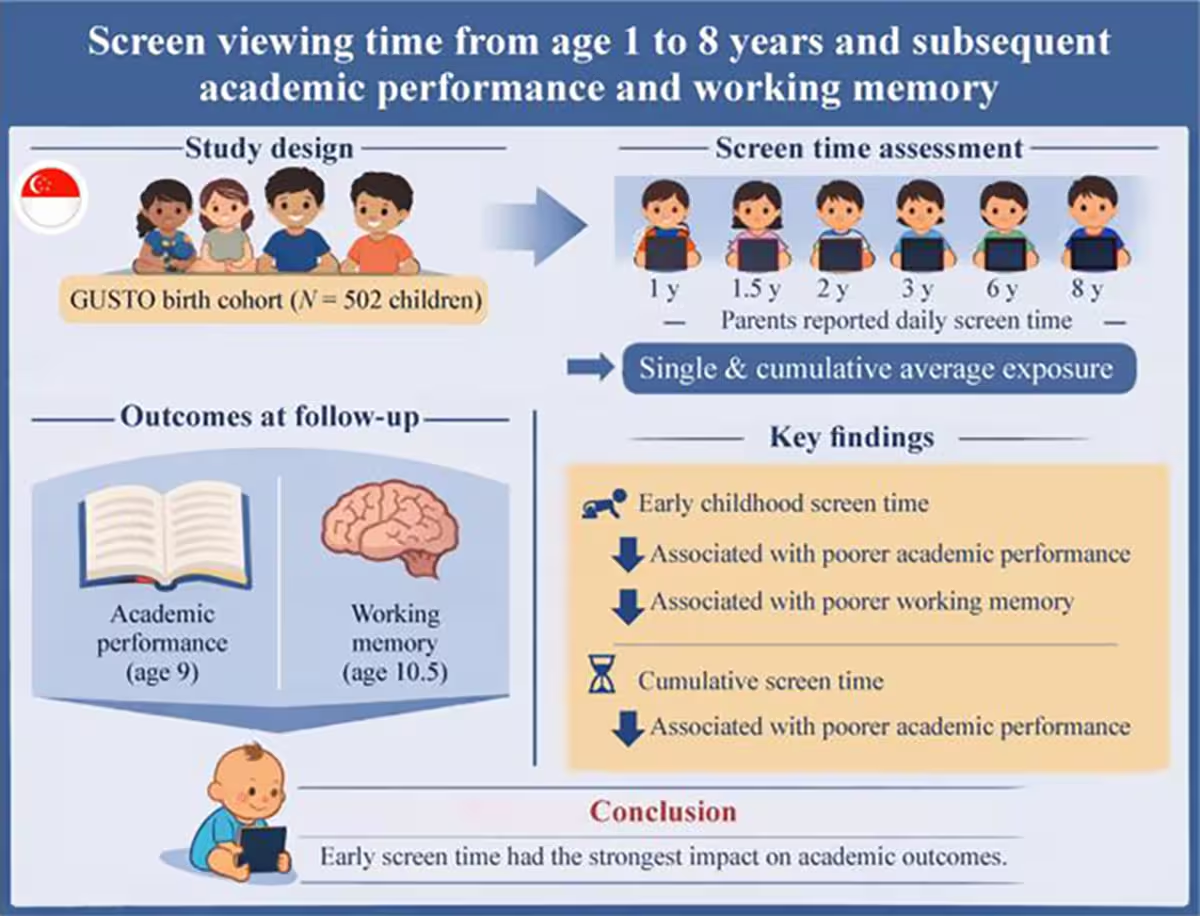
Researchers who followed children from infancy into middle childhood found patterns that suggest timing matters as much as quantity. The study tracked 502 children enrolled in the Growing Up in Singapore Towards healthy Outcomes cohort and recorded parent-reported screen viewing at six separate ages. Years later, when academic tests and working memory assessments were administered, subtle but consistent differences showed up.
Not every age was equal. Greater screen exposure during infancy — roughly around age one — correlated most strongly with lower academic achievement measured at age nine. A second peak in association appeared near school entry, around age six, when screen use again aligned with weaker working memory scores assessed at about age ten and a half. Viewing at ages two and three did not show a clear link in this dataset, producing a pattern that looks like two sensitive windows rather than a steady decline tied to any single year.
The investigators, from Inserm and the National University of Singapore, reported their results in the World Journal of Pediatrics. Their message: both the developmental timing of screen exposure and the total exposure accumulated across childhood may influence later learning and memory. Small effects at the individual level can still matter at scale; a modest shift in average performance can change how many children fall below important academic thresholds.
How this study fits into broader advice and science
Public health guidance already tends toward caution. The World Health Organization and the American Academy of Pediatrics recommend avoiding screens before roughly 18 to 24 months and limiting viewing to under one hour per day between ages two and five. Many families exceed those benchmarks for understandable reasons: work demands, caregiving pressures, and educational apps that promise learning benefits.
Why have previous studies been inconsistent? Part of the answer is method. Cross-sectional snapshots capture a moment in time and can miss developmental dynamics. Repeated measurements, as in this longitudinal work, make it possible to detect periods of heightened sensitivity while controlling for family environment and other variables. The GUSTO analysis offers that temporal resolution: it separates infancy from later preschool years and shows that the relationship with later cognition is not uniform.

Importantly, duration is not the whole story. Content quality, device type, and the social context of viewing—whether a parent watches and adds language or whether the child is alone—likely shape outcomes. A passive video that displaces caregiver interaction presents a different developmental challenge than a short, interactive session shared with an adult who explains new words and ideas.
Small shifts, large consequences
- Effect sizes were modest, but consistent.
- Infancy showed the strongest associations.
- School entry was the other notable window of sensitivity.
When public-health recommendations say "less is better," they reflect this kind of population-level thinking: even modest reductions in average screen time could translate to fewer children experiencing measurable academic or cognitive disadvantage.
Expert Insight
"The developing brain is shaped by patterns of interaction more than by isolated minutes of exposure," says Dr. Leila Morgan, a fictional pediatric neurodevelopment specialist. "Screens are not inherently harmful, but they can replace vital back-and-forth experiences—joint attention, responsive language, and play—that build memory systems and academic readiness. Parents and educators should focus on timing, content, and co-viewing rather than only counting minutes."
Dr. Morgan adds that future research needs to parse which types of media might be neutral or even supportive when used in specific ways, and which are most likely to displace learning interactions. That includes looking at touchscreen apps versus passive videos, interactive video calls with relatives, and contexts where caregivers narrate what the child is seeing.
Conclusion
This longitudinal snapshot does not condemn screens outright. It does, however, sharpen a practical point: when exposure occurs appears to matter. Reducing screen time in infancy and reinforcing limits as children approach school entry may protect opportunities for interaction that underpin learning and memory. Attention to content and shared viewing increases the chance that media serve development rather than supplant it.


“The cosmos has always fascinated me. I write about space missions, astronomy, and the technologies pushing humanity beyond Earth.”

Discussion
Leave a Comment
Comments (2)
Seen this first hand in my sister's daycare. Kids on tablets non stop, fewer real chats, attention jumps. Doable limits, but hard for parents! ugh
is this even true? article says infancy screens link to lower scores, but could be other factors, parenting, sleep, SES... curious how they controlled, seems complex.