
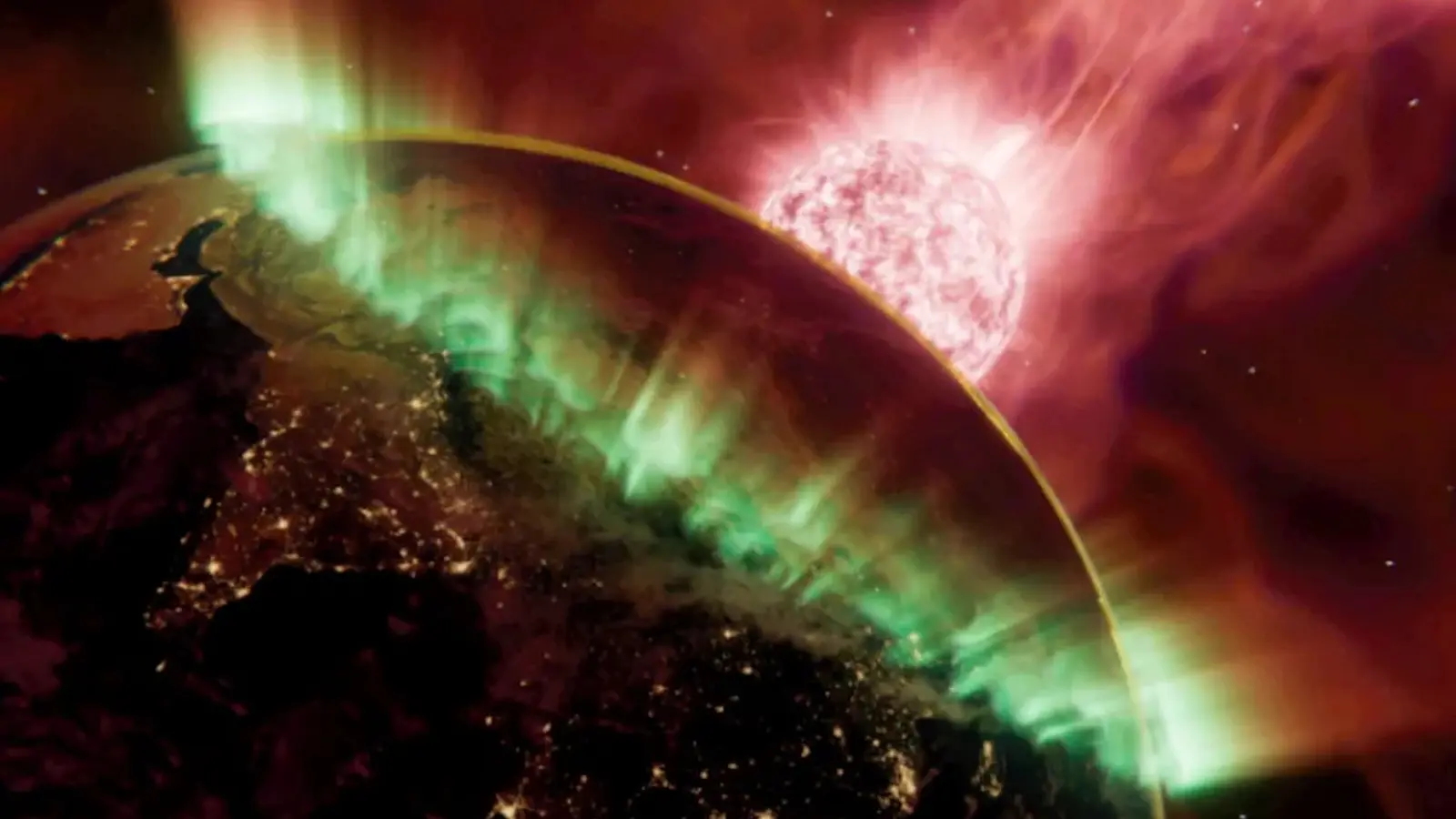
The Sun has always been a source of light and life. It can also be a source of sudden, violent disruption. New analysis indicates that our planet's magnetic defenses may not cap the worst effects of solar storms the way many models have assumed. If correct, the practical fallout for satellites, power grids, and navigation systems could be far larger than currently planned for.

Illustration of solar wind streaming from a fuming sun drives auroras bright enough to be seen far from the poles, a dazzling signature of an extreme geomagnetic storm.
For decades, researchers noticed a curious pattern. As the solar wind intensifies, so do currents in Earths upper atmosphere, but only up to a point. Beyond that, the relationship seemed to flatten. Scientists described that flattening as a saturation or ceiling in Earths geomagnetic response. The idea was reassuring. It implied a natural safety valve that limits damage when the Sun throws everything at us.
What the new study changes
A paper led by a NASA Goddard scientist and coauthored by a researcher at Lancaster University reexamines that assumed ceiling and finds it may be an illusion. The team combined more than a million near-Earth observations and applied statistical corrections for measurement uncertainty. Their conclusion: when you account for how data degrade between upstream monitors and Earths magnetosphere, the apparent saturation largely disappears.
Put plainly, extreme readings measured a million miles sunward do not always match the storm that actually strikes the magnetosphere minutes later. Small timing and intensity errors preferentially affect rare, extreme measurements. When those imprecise high-value readings are paired with real but lower responses at Earth, the aggregate data can look flattened. That statistical bias is known as regression to the mean, and it can masquerade as a physical limit when none exists.
Why measurements at L1 matter
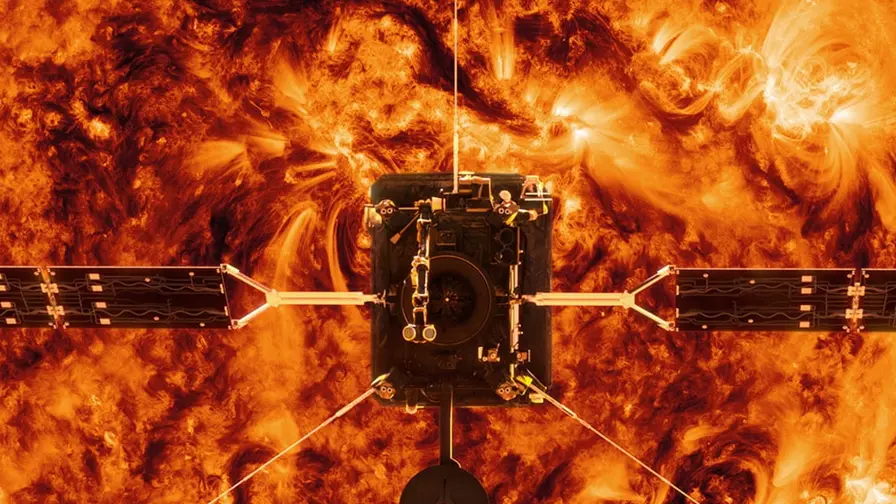
Space weather warnings depend on spacecraft positioned near the first Lagrange point, L1. Those observatories provide the only practical early alert of incoming solar wind, giving operators a precious lead time to protect instruments and grid assets. But L1 is about 1 million miles sunward of Earth. The solar wind evolves between L1 and the magnetosphere. A sharp spike at L1 can smear out, shift, or contract before it arrives.
That drift in timing and amplitude matters most for the rarest events. A handful of extreme L1 readings, each carrying larger uncertainty, can skew a statistical relationship if the errors are not explicitly modeled. The new analysis used closer-in spacecraft measurements and statistical techniques that compensate for the timing mismatch. The result: the geomagnetic response remains proportional to solar wind strength across the observed range, not capped at a safe maximum.
Implications for technology and risk planning
We rely on satellites for communications, weather, and many forms of navigation. Flight routes over polar regions use satellite links and GPS. Power grids spanning continents are vulnerable to currents induced in long conductors. If the biggest storms can drive geomagnetic effects roughly twice as large as some models expect, then the probability of severe disruptions grows.
That does not mean a catastrophe is imminent. The most extreme solar events are rare, perhaps once in a few hundred to a few thousand years. But rarity is not the same as impossibility. Infrastructure planning and emergency exercises depend on credible worst-case scenarios. If models understate the top end of geomagnetic effects, planners may be preparing for something less severe than the real worst case.
What could be affected
- Satellites: increased drag on low Earth orbit spacecraft, anomalies in electronics, and degraded sensor performance.
- Navigation and communications: GPS errors, HF radio blackouts, and loss of satellite-based links on polar routes.
- Power systems: geomagnetically induced currents that stress transformers and can lead to wide-area blackouts.
- Human exposure: higher radiation doses for astronauts and crew on high-altitude polar flights.
Engineers already build resilience into critical systems, but design margins reflect assumptions about how bad space weather can be. If those assumptions change, so must the margins.
Scientific context and remaining unknowns
The study strengthens the argument that the Earths magnetosphere does not impose a simple, universal cap on energy transfer from the solar wind. Yet it stops short of declaring an infinite response. There are plausible physical limits under some conditions, and the observational record simply does not contain many truly extreme storms. When events are this rare, statistical inference carries unavoidable uncertainty.
That uncertainty has two consequences. First, models used for operational forecasting should include wider uncertainty bounds for extreme scenarios. Second, continued investment in both upstream monitoring and in-situ near-Earth measurements is essential. More data reduces the blind spots that make rare-event assessment so difficult.
Expert Insight
Dr. Elena Moretti, a space physicist at a university research center, says: 'This study is a useful reminder that the way we measure storms is part of the story. The Sun does not care about our statistical conveniences. If the data upstream are noisy in just the right way, we can misread how the magnetosphere will respond. Practical planning requires we treat the highest-impact tail of the distribution with extra caution.'
Her point is practical. Forecasting agencies and grid operators cannot wait for scientific certainty. They must weigh the cost of added resilience against the chance of a once-in-a-thousand-year storm. That tradeoff is not scientific alone. It is social and economic.
What comes next for research and preparedness
Researchers can build on this work in several ways. First, expanding the network of near-Earth monitors would shrink timing uncertainty. Second, coordinated multi-point observations would let scientists trace how individual solar disturbances evolve en route to Earth. Third, modeling efforts should incorporate measurement error explicitly when mapping upstream conditions to ground-level effects.
On the practical side, satellite operators can run stress tests against stronger geomagnetic forcing. Grid operators can revisit assumptions used in transformer design and contingency planning. Aviation stakeholders should review polar flight protocols and consider additional mitigations for navigation loss and increased radiation exposure.
Conclusion
Reinterpreting long-standing data does not mean we are suddenly at the mercy of the Sun. It does mean our picture of risk has changed subtly but importantly. If the planet's response to extreme solar wind is not limited by a convenient ceiling, then the upper range of space weather impacts may be larger than once thought. Planning for those extremes, even if rare, is a prudent step for a world that depends on space-based services and widespread electrical networks.

“My work centers on sustainability, energy, and environmental science — examining how innovation can lead to a greener future.”

Discussion
Leave a Comment
Comments (3)
Feels a bit overhyped but ok, good nudge to prep. If that's real then utilities gotta revisit worst case plans, esp transformers and polar flights
Is this even solid? L1 timing errors make sense, but are we sure not overcorrecting? sounds like stats trickery..
wow, didn't expect the magnetosphere to have no real ceiling... kinda scary tbh. If true, airports and grids need to wake up now