

They lurk at the tumor edge. Quiet cells that, until now, were invisible to researchers, yet they change the battlefield between cancer and the immune system.
A newly discovered group of fibroblasts may help lung tumors evade immune surveillance through a specific signaling pathway.
How an overlooked cell type rewires the tumor neighborhood
When scientists profile tumors, they often expect to find immune cells, cancer cells, and supportive connective tissue. What Olivia Ringham and colleagues at Columbia University found instead were fibroblasts wearing an unexpected molecular signature: CHL1. These cells do not normally appear in healthy lung tissue. In mouse models, the CHL1-expressing fibroblasts assembled at tumor borders and drew in regulatory T cells, a class of immune cells that suppress inflammatory responses. The result: a protective ring that shields the tumor from attack.

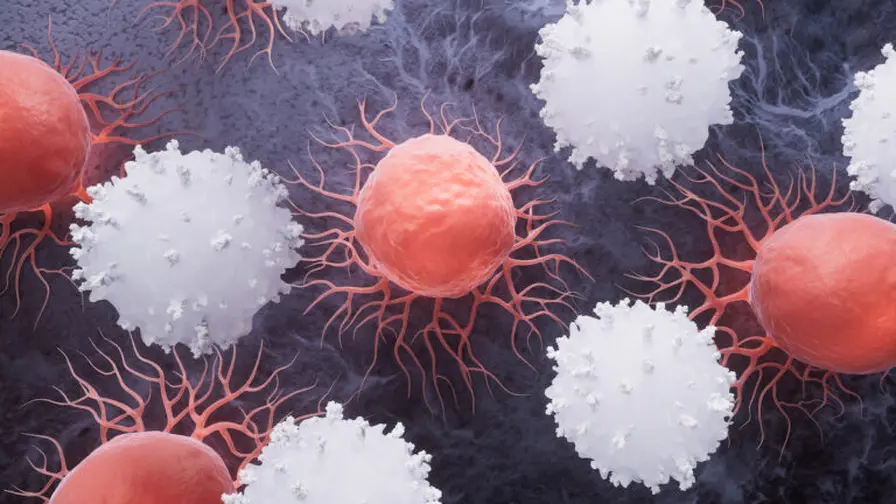
Fibroblasts (pink) recruit regulatory T cells (green) to lung tumors, preventing the immune system from attacking the tumors.
Single-cell transcriptomics made the discovery possible. By reading gene activity one cell at a time, the team detected a distinct population that bulk methods would blur into the background. "Single-cell transcriptomics has really had a huge development on the field over the last decade," Ringham says. "It’s a great way to find hidden cell types and understand what those cells do." The technique revealed CHL1-positive fibroblasts as a discrete actor in the tumor microenvironment.
Recruitment, signaling, and a weakened immune response
The functional story unfolded in follow-up experiments. CHL1 fibroblasts produce signals that lure regulatory T cells, commonly known as Tregs, to the tumor perimeter. In the lungs, Tregs serve a protective role. They keep inflammation in check so every breath does not provoke a damaging immune reaction. But cancer can exploit that restraint. When Tregs cluster at tumor margins, they blunt effector immune cells and reduce the chance that the tumor will be eliminated.
Tracing the molecular trail, the researchers identified CXCL9 as a key signaling protein in this process. When genetic manipulation or pharmacological blockade interrupted the CXCL9 pathway in mice, fewer regulatory T cells accumulated around the tumors. The immune brakes loosened and anti-tumor responses increased. In short, removing the signposts that CHL1 fibroblasts erect lets the immune system see and attack the cancer.

Evidence in humans and clinical implications
Mouse work can point the way, but the team also looked at human samples. CHL1-positive fibroblasts were present in patient tumors. Tumors that contained more of these cells showed weaker immune infiltration and were linked to shorter progression-free survival. That correlation does not prove causation, but it aligns with the experimental results and suggests a clinically relevant mechanism.
Nicholas Arpaia, the senior author, frames the therapeutic possibilities directly: target the recruited regulatory T cells to restore immune function or develop strategies that neutralize the CHL1 fibroblasts themselves. The latter is appealing because CHL1 fibroblasts are absent from healthy lungs, implying that a targeted therapy might spare normal tissue. Yet many questions remain. Where do these fibroblasts come from? What triggers their formation? If therapies could block that transformation, patients might derive a significant benefit.
Expert Insight
"This study highlights how non-cancer cells remodel the immune landscape in ways we did not fully appreciate before," says Dr. Elena Vargas, a tumor immunologist not involved in the work. "Targeted disruption of the chemokine cues could amplify existing immunotherapies, especially for lung cancers that are currently resistant." Her point is practical: combining approaches that modulate the tumor niche with checkpoint inhibitors could shift outcomes.
Broader context and next steps
The discovery joins a growing body of research that recasts fibroblasts as active partners in cancer progression rather than inert scaffolding. Past studies emphasized cancer-associated fibroblasts in pancreatic tumors. This work extends that paradigm to lung cancer and to an entirely new fibroblast subtype defined by CHL1 expression. It also highlights CXCL9 as a molecule of interest in the tug-of-war between immune suppression and activation.
Technically, the study relied on high-resolution single-cell profiling, mouse genetic models, and analysis of human tumor banks. That combination strengthens confidence in the findings and guides practical translation. Still, translating these insights into therapies will require understanding the developmental origin of CHL1 fibroblasts and designing safe methods to disrupt their immunosuppressive signaling.
Conclusion
The work from Columbia and collaborators maps a previously hidden route by which lung tumors evade immune surveillance. By recruiting regulatory T cells through a CHL1 and CXCL9-dependent axis, a special class of fibroblasts builds a protective moat. Blocking that pathway restored immune activity in mice and correlates with more favorable immune profiles in humans. The discovery opens two avenues: targeting the recruited Tregs or neutralizing the CHL1 fibroblasts themselves. Either route could enhance the effectiveness of existing immunotherapies and offer new hope for patients with lung cancer.

“The cosmos has always fascinated me. I write about space missions, astronomy, and the technologies pushing humanity beyond Earth.”

Discussion
Leave a Comment
Comments (2)
Interesting, but is CXCL9 blockade actually safe? Mouse data ok, human link is just correlation, isnt causation. where do CHL1 fibroblasts come from?
wow that’s wild... fibroblasts building a Treg moat at the tumor edge? If this holds up, could flip immunotherapy. fingers crossed, but yikes