

A dense jewel box floats on the outskirts of our galaxy: more than half a million stars packed into a glittering sphere that looks at once fragile and eternal. That is Messier 3, revealed in a fresh Hubble image released for the United States’ 250th anniversary, dressed in tones of blue, white, and red.
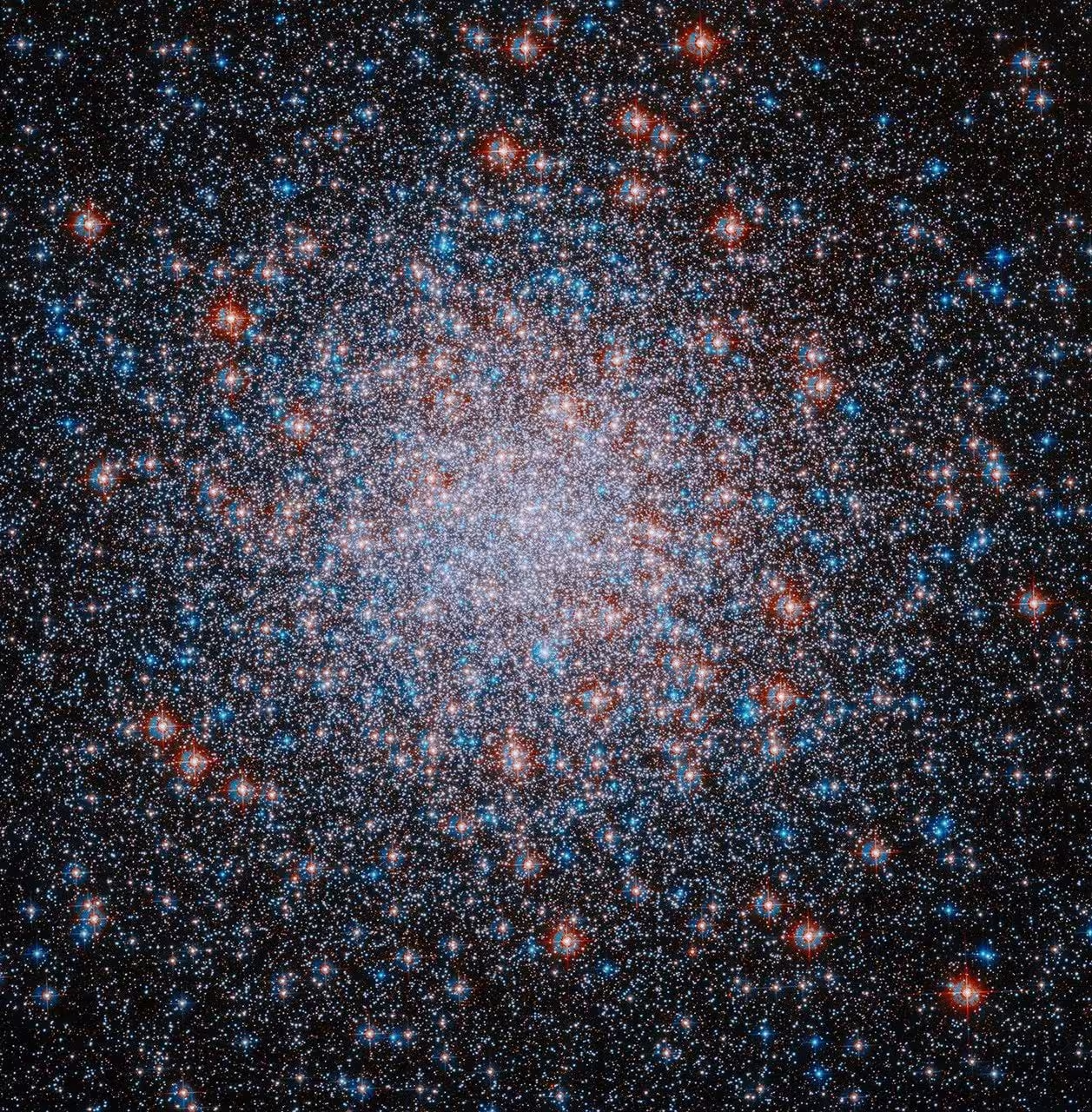
This image from NASA’s Hubble Space Telescope shows Messier 3, a densely packed cluster of stars whose origins may be a merger between globular clusters in the early universe.
Globular clusters like M3 are among the galaxy’s oldest stellar families. They are gravitationally bound spheres of stars that formed roughly at the same time from a single cloud of gas. Astronomers catalog about 150 such clusters orbiting in the Milky Way’s halo, and M3 ranks among the most populous and scientifically revealing.
A cluster of records and rare stars
M3 stands out for a simple reason: scale and variety. It is one of the largest globular clusters in our galaxy and contains an unusually high number of RR Lyrae variable stars—over 240 confirmed—more than any other Milky Way globular cluster. These pulsating stars are astrophysical yardsticks. Their rhythms encode intrinsic brightness, and from that astronomers derive precise distances. Picture a procession of identical lanterns; if you know how bright each lantern truly is, you can judge how far away each one sits by how dim it looks.
Then there are the blue stragglers. M3 hosts around 70 candidate blue straggler stars, a curious minority that shine bluer and hotter than the dominant, redder population. They appear younger, an oddity in an otherwise ancient system. The favored explanation is mass transfer or collisions: a star steals material from a companion or merges with another, gaining mass and reigniting hydrogen fusion in a way that makes it look renewed.
Signs of an ancient collision
Beyond individual curiosities, M3’s stellar demographics hint at a dramatic past. Observations reveal two distinct stellar populations, which suggests Messier 3 may be the remnant of a merger between two globular clusters. Those progenitor clusters are likely to have once belonged to the same dwarf galaxy that later fell into the Milky Way, stripped apart by tidal forces. In that sense, M3 is a fossil record: a compact archive of larger galactic assembly processes.
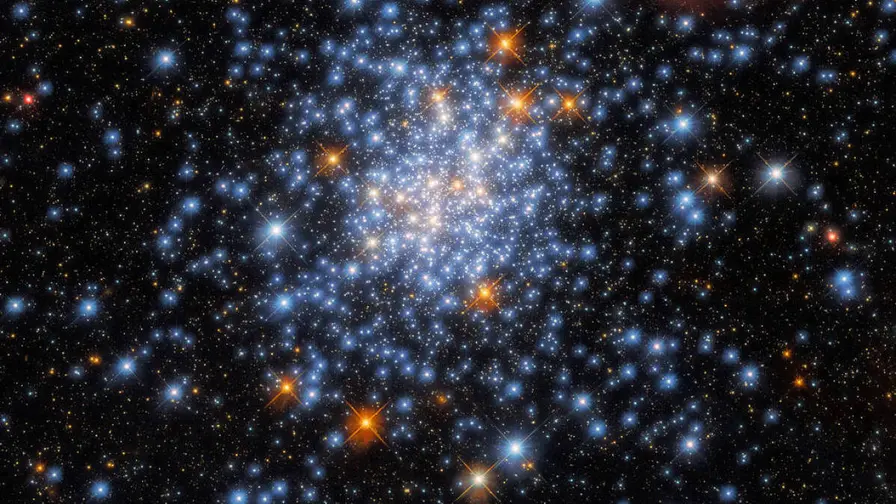
Hubble has revisited M3 multiple times across its decades-long mission, allowing astronomers to trace motions, map populations, and refine models of cluster evolution. The current image is part of a Hubble Treasury program aimed at observing roughly half of the Milky Way’s known globular clusters. The goal is to compile a coherent timeline of formation and change across these ancient systems, an effort that ties local stellar archaeology to the galaxy’s global history.
Color in the image is not decoration alone. Blue tones represent shorter visible wavelengths, while red captures longer wavelengths and some near-infrared light. Hubble assigns colors to the filters it uses so that temperature and composition become readable: bluer stars are hotter, redder stars cooler. This color coding helps researchers separate stellar types and assess evolutionary stages at a glance.
Why Messier 3 still matters
Studying clusters like M3 has practical payoffs. RR Lyrae stars refine distance ladders, crucial for calibrating cosmic scales. Blue stragglers teach us how stellar encounters alter evolutionary paths. And the cluster’s overall structure—its density profile, core dynamics, and binary fraction—informs models of how gravity sculpts stellar communities over billions of years.
Hubble does not work in isolation. Its data complement observations from the James Webb Space Telescope and will be paired with future surveys from the Nancy Grace Roman Space Telescope. Each mission brings different strengths: Webb’s infrared sensitivity probes cooler and dust-enshrouded regions, Roman will enable wide-field mapping, and Hubble continues to provide high-resolution optical snapshots that anchor multiwavelength studies.
Expert Insight
"Messier 3 is a microcosm of galactic archaeology," says Dr. Elena Márquez, an observational astrophysicist who studies stellar populations. "Its mix of RR Lyrae stars and blue stragglers, combined with the signs of a past merger, gives us an unusually clear laboratory to test how clusters evolve when they interact. Hubble’s long-term observations let us watch slow processes as if we were reading tree rings."
That kind of perspective matters because the Milky Way itself is a product of countless such interactions. Each captured dwarf galaxy, each merged cluster, has left fingerprints in the halo. By decoding those fingerprints in richly observed systems like M3, astronomers assemble a chronology of growth—when stars formed, when structures accreted, and how dynamics redistributed mass over cosmic time.
There is still work to do. Precise proper motions from Gaia, deeper spectroscopy to tease out chemical variations, and high-resolution infrared imaging will all sharpen the picture. Hubble’s portrait of Messier 3 is more than an image; it is a map that points to follow-up observations and new questions. The cluster keeps its secrets well, but with each dataset we pry a little more loose.
In the end, Messier 3 is both spectacle and source material: a dense, storied object that continues to teach us about stars, collisions, and the Milky Way’s long adolescence.

“The cosmos has always fascinated me. I write about space missions, astronomy, and the technologies pushing humanity beyond Earth.”

Discussion
Leave a Comment
Comments (2)
Is the merger story solid tho? Two pops could be chemistry, or clumpy formation, or just bias. wait for Gaia proper motions
wow, that Hubble shot is stunning, a dense jewel box indeed. feels ancient but alive, gives me chills, its unreal