
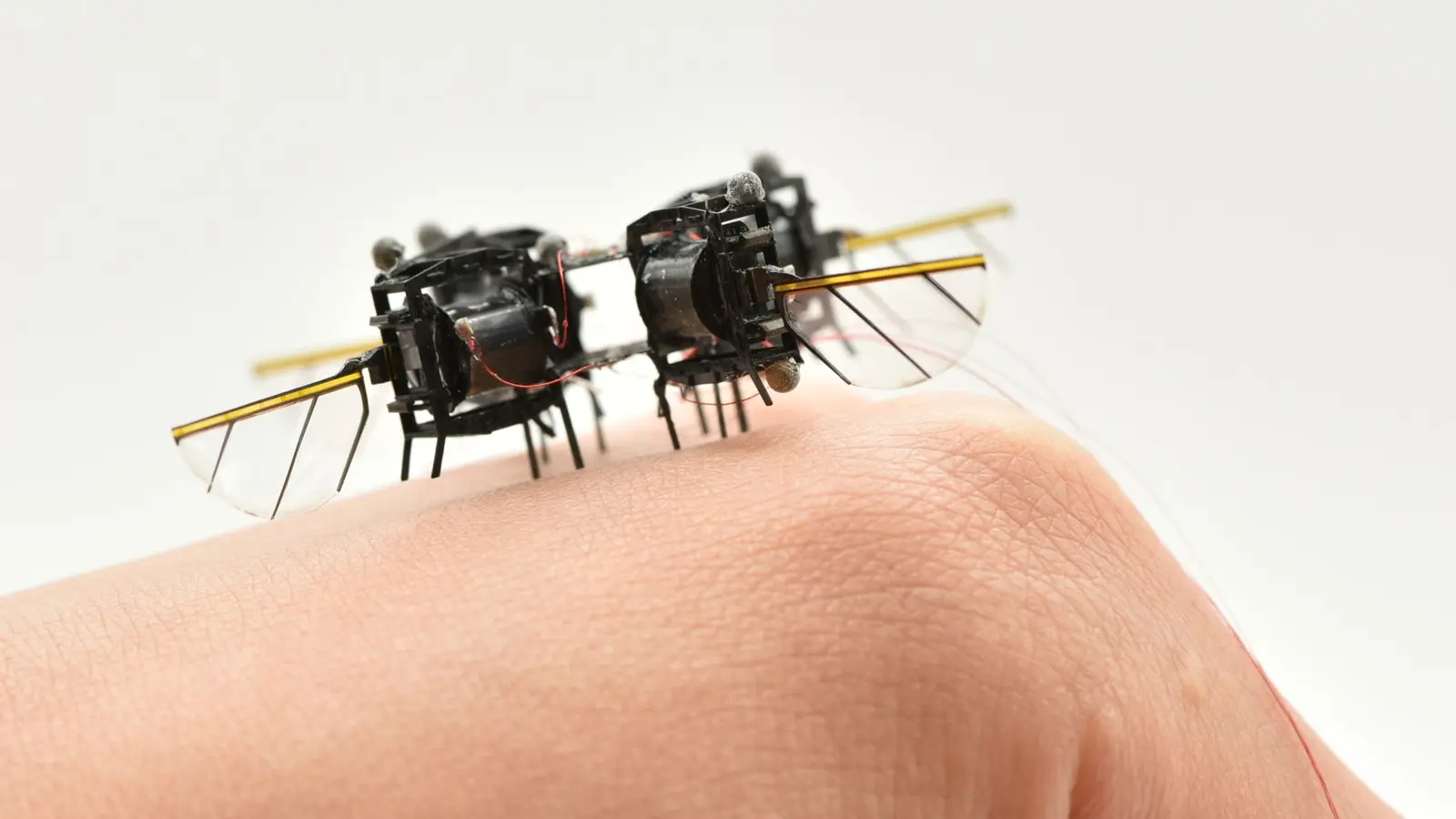
Imagine a machine the size of a microcassette slipping through a collapsed corridor, tilting sharply, accelerating toward a gap, then flipping end over end to thread through without touching a single beam. Short, fierce bursts of motion. Precision that looks like instinct. Chen’s group has been building robotic insects for more than five years.
Small wings, big leaps in control
For years, researchers have built tiny flying robots that could hover or trace gentle paths. But they struggled to match the speed, acceleration, and abrupt attitude changes that real insects use to dart through cluttered environments. That restriction kept microrobots from one of their most promising applications: getting into places too cramped or unstable for full-size drones or ground robots after earthquakes or industrial accidents.
Now, teams at MIT have closed much of that gap. Combining hardware improvements with a novel two-step control strategy, the researchers taught an insect-scale flyer to execute aggressive aerial maneuvers, including repeated somersaults, while resisting wind disturbances and remaining on course.

A time-lapse photo shows a flying microrobot performing a flip.
The physical platform is small and stubbornly simple in appearance: soft artificial muscles drive larger, more resilient flapping wings that beat at high frequency. Those changes to the frame and actuators gave the vehicle the raw capacity for rapid thrust and rotation. The missing piece was the brain: a flight controller that could make split-second decisions under uncertainty without requiring a supercomputer on board.
Two minds at work: planner and policy
The teams solved that trade-off with a hybrid approach. First came an expert planner: a model-predictive controller that uses a mathematical model of the robot to predict future motion and to compute the safest, most effective sequence of control inputs for aggressive trajectories. This planner can design maneuvers that look difficult to imagine, like a chain of ten precise flips where each landing sets up the next rotation.
The catch is that the planner is computationally heavy. Running it live on a tiny platform is not feasible. So the researchers used imitation learning to convert the planner’s behavior into a fast policy implemented by a deep neural network. In training, the planner plays teacher and the network learns to mimic its decisions. During flight, the network reads the robot’s current state and emits control commands instantly.
Think of it this way: the planner sketches masterful strategies, and the learned policy executes them at sprinting speed. The result delivers the planner’s sophistication without its latency.

Tests show dramatic gains. Compared with earlier controllers from the same group, the new system increased top speed by about 447 percent and peak acceleration by roughly 255 percent. In one demonstration the microrobot completed 10 consecutive somersaults in 11 seconds while staying within four to five centimeters of the intended path.
“The hardware advances pushed the controller so there was more we could do on the software side, but at the same time, as the controller developed, there was more they could do with the hardware,” says Jonathan P. How, a co-senior author on the study and a professor in the MIT aeronautics group. The partnership between the soft-robotics team and the control lab made each improvement multiply the other.
What makes repeated flips so demanding?
A single somersault is already a precision act. You must generate the right torques to rotate, then arrest that rotation at the exact angle and rate required to begin the next flip. Tiny errors accumulate. Try to string ten flips together and the smallest drift becomes catastrophic: the machine tumbles off course and crashes.
The planner explicitly reasons about these constraints. It factors in limits on forces, torques, and wing motion and searches for control sequences that keep the robot inside safe envelopes. The learned policy internalizes those safe trajectories during training so the onboard controller can act decisively and in real time.
Beyond somersaults, the system reproduces insect-like saccades: a sharp tilt, a burst of acceleration toward a point, then a pitch in the opposite direction to stop. Insects use such maneuvers to stabilize vision and to reset their sensorimotor state quickly. For a microrobot carrying cameras or range sensors, that behavior could be essential for rapid perception in clutter.

“Now, with our bioinspired control framework, the flight performance of our robot is comparable to insects in terms of speed, acceleration, and the pitching angle,” Kevin Chen, head of the Soft and Micro Robotics Laboratory and co-senior author, notes. The statement captures the paper’s core advance: combining soft hardware with controls that exploit dynamic capabilities rather than constraining them.
From motion-capture rooms to independent navigation
Current experiments still depend on an external motion-capture system to tell the robot where it is. That allows precise measurement and control during development. The obvious next step is to move sensing on board: tiny cameras, inertial measurement units, and lightweight range sensors that enable the robot to navigate outdoors and inside rubble without external trackers.
Adding onboard perception raises new challenges. Processing vision data is computationally costly and noisy in dusty, low-light conditions. The team plans to investigate whether compact perception pipelines paired with the learned control policy can keep agility high while maintaining reliability. Another research direction is swarm coordination: could groups of insect-scale flyers coordinate aggressive maneuvers and avoid collisions using only onboard sensing?
There are also practical concerns to confront before these robots join rescue toolkits. Battery energy and flight duration remain limited at this scale. Payload capacity is small, which constrains sensor suites and communications hardware. Durability has improved, but real-world rescue scenarios can be brutally harsh: sharp metal, shifting debris, water. Still, progress in actuation, materials, and control algorithms narrows the gap between lab prototype and field-ready platform.
Expert Insight
“This work represents a pragmatic marriage between theoretical control and practical robotics,” says Dr. Elena Vargas, a robotics engineer with experience on planetary and disaster-response robots. “What matters in the field is not the elegance of a model but whether the system can repeat fast, aggressive behaviors reliably under uncertainty. Their two-step architecture is an elegant way to capture complex strategies offline and then deploy them online at low latency. As we miniaturize sensors and improve power efficiency, I expect these designs will be central to new exploration and rescue tools.”

Even when wind disturbances threatened to push it off course, a speedy robot was agile enough to complete 10 consecutive somersaults in 11 seconds.
Broader implications and related technologies
Microrobotics has long promised capabilities that scale differently from larger drones: the ability to enter confined spaces, to perch and crawl, or to work in swarms that distribute sensing tasks. This study shows that high agility need not be sacrificed for small size. With advanced control, soft actuators and lightweight structures, insect-scale machines can perform rapid, robust maneuvers that were once the exclusive domain of living insects and larger robotic platforms.
Related advances are converging. Lightweight vision pipelines, event cameras that reduce data flow, compact neural inference accelerators, and new battery chemistries all push the practical envelope. On the materials side, more durable soft actuators and foldable structures increase survivability. Integrated, these improvements could produce microrobots capable of autonomous, coordinated deployment in confined or hazardous environments.
In the nearer term, these platforms will accelerate laboratory research into agile flight, bioinspired locomotion, and multimodal robots that can fly, crawl, and squeeze. They are testbeds for control theories that operate under extreme constraints: tight power budgets, delayed sensing, and complex aerodynamics for flapping flight.
Conclusion
Roboticists have long borrowed from biology for efficient movement. What changed here is a control framework that lets tiny machines exploit their hardware instead of being limited by it. The two-step system, with an expert planner teaching a fast policy, unlocks dramatic speed and acceleration without demanding heavy onboard computation.

The microrobot achieved 10 consecutive somersaults in 11 seconds while remaining within four to five centimeters of its intended path.
That capability does not make microrobots ready to replace human teams in search-and-rescue missions tomorrow. But it does shift the conversation. The machines can now perform the kinds of rapid, vision-stabilizing maneuvers that open new operational possibilities. With further integration of sensors, power solutions, and robustness measures, insect-scale flyers could become a practical tool for probing spaces that are otherwise unreachable.

“The cosmos has always fascinated me. I write about space missions, astronomy, and the technologies pushing humanity beyond Earth.”

Discussion
Leave a Comment
Comments (4)
i worked on tiny drones, and the planner->policy trick is clever. Quick q: can the learned policy adapt if a wing gets damaged mid flight? curious, rushed thought
Impressive numbers but feels a bit overhyped. 10 flips in lab is cool, yet real rescue ops are brutal — durability, comms, runtime matter way more
Is this even practical outside mocap rooms? dust, low light, messy rubble, sensors and batteries seem like the real bottleneck. Anyone done outdoor trials?
Wow those tiny flips look insane. Tiny machine doing 10 somersaults? If they add onboard vision this could actually help rescue teams, but battery life worries me