
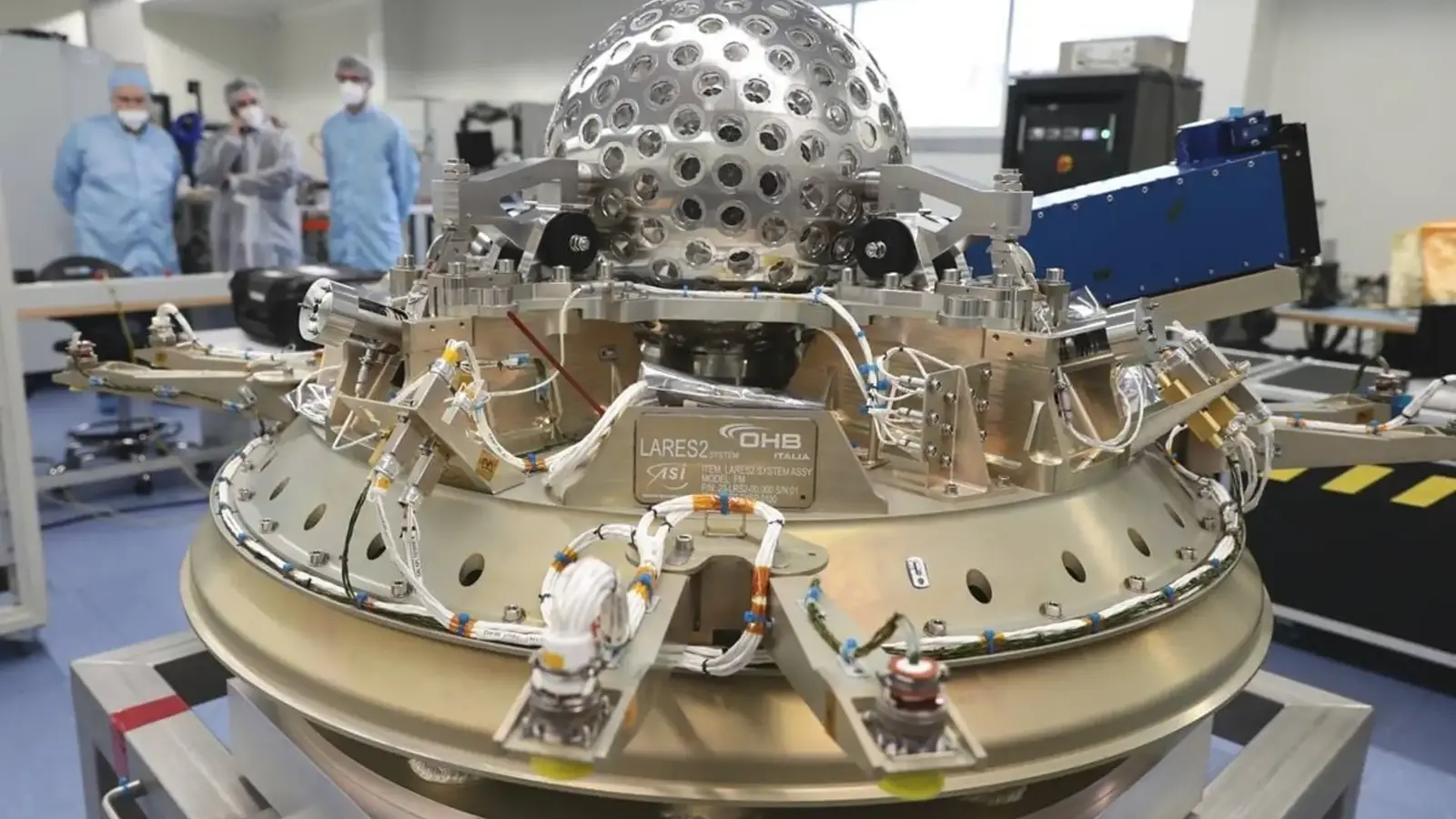
Imagine a shiny metal orb, reflecting sunlight like a miniature disco ball as it sails around Earth. It looks playful. Its purpose is anything but. That polished globe, LARES-2, has helped scientists hear one of nature's faintest whispers: the way a rotating planet drags the fabric of spacetime around it.
The subtle prediction that changed physics
When Albert Einstein published general relativity more than a century ago, he rewrote gravity. Mass tells spacetime how to curve, and curved spacetime tells matter how to move. But there is a less famous, stranger corollary: if a mass spins, it should tug nearby spacetime with it. Think of a spoon stirring honey and pulling the syrup along. Physicists call that frame-dragging or the Lense-Thirring effect.
Around compact objects such as black holes, frame-dragging is dramatic. Near Earth, the effect is vanishingly small. The planet is light compared with a black hole, and it rotates once per day. Detecting the tiny precession of a satellite's orbit induced by that rotation required unprecedented measurement precision and careful subtraction of larger, distracting effects.
How a mirror-covered sphere became a pristine test mass
LARES-2 is simple by design. No cameras, no electronics, no solar panels. It is a dense metal sphere roughly 40 centimeters across, coated in 303 retroreflectors that bounce laser light straight back to its source. The idea is elegant. Make the satellite as compact and heavy as possible so non-gravitational forces such as solar radiation pressure or atmospheric drag have minimal influence. Then the satellite behaves, for practical purposes, like a test particle moving under gravity alone.

Launched in 2022, LARES-2 was tracked with satellite laser ranging. Ground stations across the globe fired short laser pulses at the sphere. Each retroreflector returned the flashes, and the round-trip time gave distances accurate to the millimeter level. Over three years, researchers recorded more than 200,000 laser-ranging observations, building one of the highest-fidelity orbital datasets in history.
Taming the noise: LAGEOS, tides, and geodesy
Measuring frame-dragging around Earth is like trying to detect a whisper beside a roaring engine. The biggest noise source comes from Earth's imperfect shape. The planet is not a perfect sphere; it bulges at the equator and has mass anomalies that produce gravitational effects thousands of times stronger than the frame-dragging signal.
To cancel much of that interference, the team combined LARES-2 data with observations of NASA's LAGEOS, a pair of laser-ranged satellites that have orbited since the 1970s. By choosing orbital planes and combining measurements in a way that systematically cancels Earth-shape effects, the scientists effectively subtracted the loud engine to reveal the whisper underneath.
Another hurdle came from tidal variations. The gravitational pull of the Moon and Sun deforms Earth continuously, shifting mass and altering the gravity field on timescales tied to tidal cycles. One dominant component, the K1 tide, induces orbital changes that could mimic or mask frame-dragging unless properly modeled. The researchers addressed this by analyzing a full 1,050-day cycle, averageing over tidal phases and removing their influence from the residual signals.

Results that tighten the noose on alternative theories
After painstaking modeling of gravity-field coefficients, tidal perturbations, and residual non-gravitational forces, the measured nodal precession of the satellites matched Einstein's prediction with only 0.2 percent uncertainty. That is several times more precise than earlier frame-dragging experiments. In plain terms, Earth's tiny twisting of spacetime behaves exactly as general relativity predicts, to within a few parts in a thousand.
These results do more than validate a century-old prediction. They narrow the parameter space for alternative gravity theories. Some proposed extensions, such as variants of Chern-Simons gravity, predict small deviations from general relativity in frame-dragging signatures. The new LARES-2 constraints rule out many versions of those models or push any allowable deviations to even tinier amplitudes, forcing theorists back to the drawing board as they seek a theory that unites relativity with quantum mechanics.
Practical spin-offs for Earth science
Precision gravity experiments often produce collateral benefits for geoscience. The team’s detailed removal of tidal and gravitational noise yielded improved measurements of Earth’s mass distribution and the temporal evolution of tides. Such datasets feed geodetic models that underpin everything from sea-level research to studies of Earth’s interior structure and tectonic processes. Better gravity maps can even refine models used in earthquake science and oceanography.
Expert Insight
"Detecting frame-dragging at this level is a triumph of measurement technique and of international collaboration," says Dr. Marta Alvarez, a gravitational physicist not involved with the study. "They turned a simple, passive satellite into one of the most precise laboratories in space. The methodology also gives geophysicists cleaner signals to study Earth itself."
She adds, "This is the kind of incremental progress that tightens constraints on new physics. It does not close doors; it helps point us toward the more subtle deviations we need to find to reconcile gravity with quantum theory."
What comes next and why it matters
Precision tests of general relativity remain a cornerstone of modern physics. Each experiment that confirms Einstein on new scales both reaffirms the theory’s robustness and narrows the scope for viable alternatives. Future experiments could push sensitivity further by deploying additional retroreflector-equipped satellites in complementary orbits or by improving laser-ranging networks. Advances in modeling Earth’s gravity field, driven by missions like GRACE and its successors, will also reduce systematic uncertainties.
The long-term prize is a consistent description of gravity that meshes with quantum mechanics. Until then, experiments such as the LARES-2 campaign serve a dual role: they test fundamental physics and sharpen tools that help us understand our own planet with rare precision.
Conclusion
LARES-2’s gleaming surface may catch the eye, but its true achievement lies in subtlety. By measuring how Earth twists spacetime and confirming Einstein’s frame-dragging prediction to 0.2 percent, scientists have produced one of the most precise validations of general relativity to date. The work both constrains alternative gravity theories and delivers higher-fidelity data for geodesy. In the quiet orbit of a reflective sphere, classical theory met meticulous observation, and the match was impressively exact.

“My work centers on sustainability, energy, and environmental science — examining how innovation can lead to a greener future.”

Discussion
Leave a Comment
Comments (3)
Feels a tad overhyped, but the tech is legit. Nice that geodesy benefits too, sea level studies actually need this kinda precision
So 0.2% — impressive, but how robust are the tide/earth-shape models? K1 tide sounds like a sneaky culprit, no? feels like more cross checks needed
wow, that shiny orb looks silly but does real heavy lifting. brilliant idea to make it dumb simple, curious how future sats might improve this…