
A faint whisper of hydrogen, stretched across billions of years, has been picked out of radio noise by MeerKAT. It is the kind of signal that does not announce itself. You need patience, sophisticated analysis, and a telescope willing to listen.
Listening for the Universe’s long, low note
Neutral hydrogen emits radio waves at a characteristic wavelength of about 21 centimeters. As space expands, those waves lengthen and arrive at longer wavelengths. Measure that stretching and you gain a clock. Add the sky position and you can place hydrogen in three dimensions. That simple idea underpins hydrogen intensity mapping, a technique that treats the combined radio glow of many galaxies as a textured backdrop instead of cataloguing each galaxy one by one.
Using South Africa’s MeerKAT radio telescope, an international team has successfully extracted such a faint hydrogen signal from roughly 96 hours of archival observations. The radiation they measured began its journey four to five billion years ago. Detecting neutral hydrogen directly at those distances without pairing radio data with optical galaxy surveys is uncommon. This detection changes that calculus.
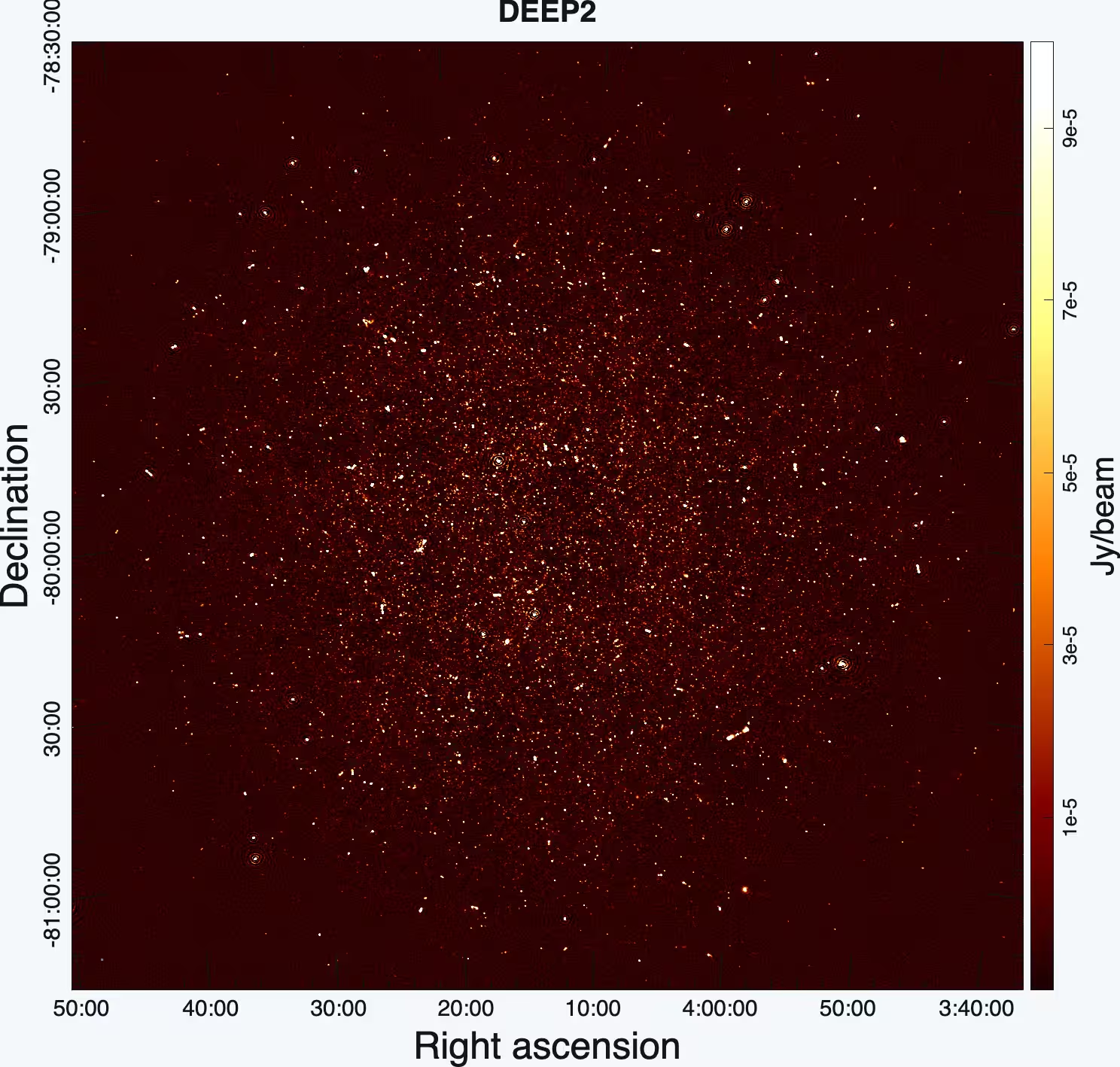
MeerKAT view of the observed sky field. This radio image shows the patch of sky observed with MeerKAT as part of the study. The bright points are radio-emitting galaxies and other compact sources, whose emission is much stronger than the faint hydrogen signal the team set out to measure. One of the major challenges of hydrogen intensity mapping is separating this extremely weak signal from much brighter foreground radio emission and unwanted interference. The hydrogen signal itself is not visible to the eye in this image; it is extracted from the MeerKAT data using careful analysis designed to isolate the cosmic hydrogen emission.
How they pulled a whisper from a storm
There are hurdles. Foreground radio sources, such as bright galaxies and compact emitters, can overwhelm the hydrogen signature by orders of magnitude. Human-made radio-frequency interference contaminates the bands. The instrument itself introduces subtle effects. Separating the cosmic hydrogen from all of that is a data-problem as much as a hardware one. The team combed through the 2018 observations, which predate many of MeerKAT’s later campaigns, and applied careful calibrations and filtering to isolate the cosmological signal.
"Neutral hydrogen is one of the key ingredients for understanding how galaxies form and evolve," said Dr. Zhaoting Chen. "With intensity mapping, we do not need to detect every individual galaxy. Instead, we can measure the collective signal from hydrogen across large cosmic volumes, giving us a new way to study both galaxy evolution and the underlying matter distribution of the Universe."
The measurements trace hydrogen across scales comparable to the separation between the Milky Way and the Andromeda galaxy. That scale is cosmologically useful because it sits at the sizes where dark matter and baryons sculpt large-scale structure, where filaments form and galaxies cluster. Extracting the signal required modeling of foregrounds and instrument behavior, careful excision of terrestrial interference, and an assumption-light statistical treatment to avoid biasing the result.
Why this matters for cosmology
- Survey efficiency: Intensity mapping scans enormous cosmic volumes faster than surveys that resolve each galaxy.
- Structure mapping: It yields three-dimensional maps of hydrogen, which trace the distribution of matter and the cosmic web.
- Galaxy fuel: Neutral hydrogen is the raw material for star formation, so its distribution informs galaxy evolution models.
"This is a very exciting milestone," said Dr. Sourabh Paul, the study's lead author. "Hydrogen intensity mapping has long been seen as a promising way to map the Universe efficiently, but the signal is extremely faint and difficult to isolate from foreground emission, human-made radio-frequency interference, and instrumental effects. Detecting it directly with MeerKAT shows that this technique is becoming a practical tool for cosmology."
The observations used in this analysis were opportunistic. They were taken when MeerKAT was just beginning science operations and were not designed specifically for intensity mapping. That makes the result doubly encouraging: it suggests existing archives contain recoverable cosmological information, and that future, dedicated surveys will improve both sensitivity and scale.
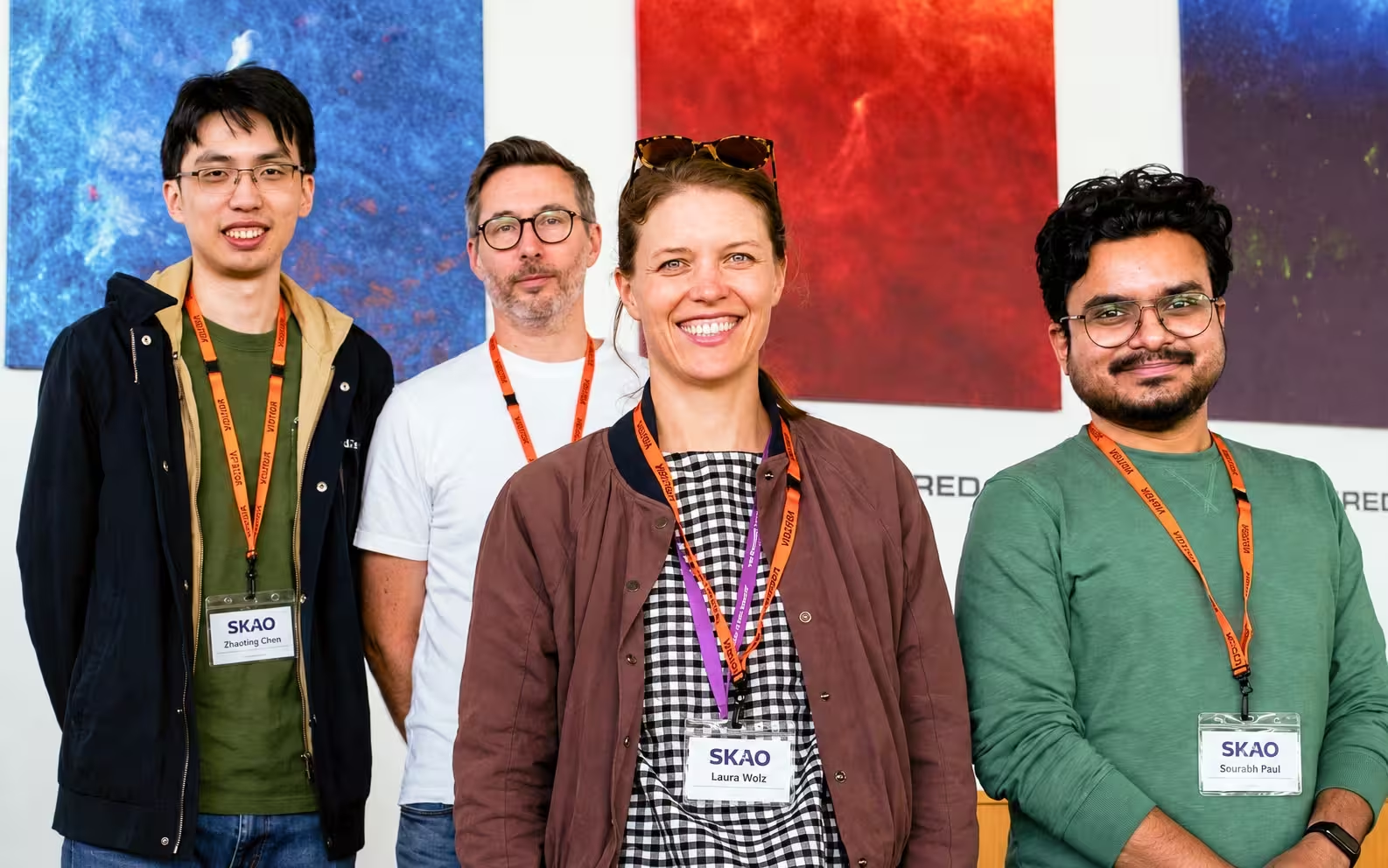
The team behind the detection; from left to right: Dr Zhaoting Chen (Researcher at University of Edinburgh, graduated with PhD from University of Manchester in 2024), Prof Mário Santos (professor at University of Western Cape), Dr Laura Wolz (Reader at University of Manchester), Dr Sourabh Paul (project lead and researcher at University of Manchester and University of Western Cape).
Expert Insight
"What this detection really shows is feasibility," says a fictional senior astrophysicist, Dr. Amina Bhatt, who is not affiliated with the study. "You can treat diffuse hydrogen as a large-scale tracer, and from that you infer the scaffolding of the cosmos. The next step is to combine depth with breadth: longer integrations and wider sky coverage will sharpen features that today are blurred by noise."
Dr. Bhatt adds a practical note: "Instrumental calibration is everything. Small systematics masquerade as cosmological signal if you are not vigilant. Teams that master that will extract the richest science from MeerKAT and from the Square Kilometre Array Observatory in the coming decade."
Implications and what comes next
MeerKAT is a pathfinder for the Square Kilometre Array Observatory, SKAO, where hydrogen intensity mapping is expected to become a core research program. With longer observations and purpose-built survey strategies, astronomers hope to produce denser hydrogen maps that will address several big questions: How did the gas supply that fuels star formation evolve? How does dark matter arrange itself into the cosmic web? Can these maps help constrain cosmological parameters in ways complementary to optical galaxy surveys?
Professor Mário Santos emphasized the challenge and opportunity: "This was a challenging data analysis process, requiring a detailed understanding of the many sources of contamination that can affect such a faint measurement. It is particularly remarkable that the data used in this study were taken in 2018, when MeerKAT had only just started science operations. There is now a rich trove of MeerKAT data waiting to be explored with this method."
Professor Laura Wolz noted the broader value of the discovery. "MeerKAT continues to open new windows for cosmology. The fact that this signal can be extracted from observations that were not originally designed for hydrogen intensity mapping is very encouraging. It shows the enormous scientific value of MeerKAT data and points the way to future observations with SKAO."
Conclusion
This direct detection of distant neutral hydrogen marks a turning point. It moves hydrogen intensity mapping from theoretical promise to demonstrable practice. The path forward will be technical and demanding, but the prize is large: a fuller, three-dimensional view of how matter, gas, and galaxies arranged themselves over billions of years.

“The cosmos has always fascinated me. I write about space missions, astronomy, and the technologies pushing humanity beyond Earth.”

Discussion
Leave a Comment
Comments
No comments yet. Be the first.