
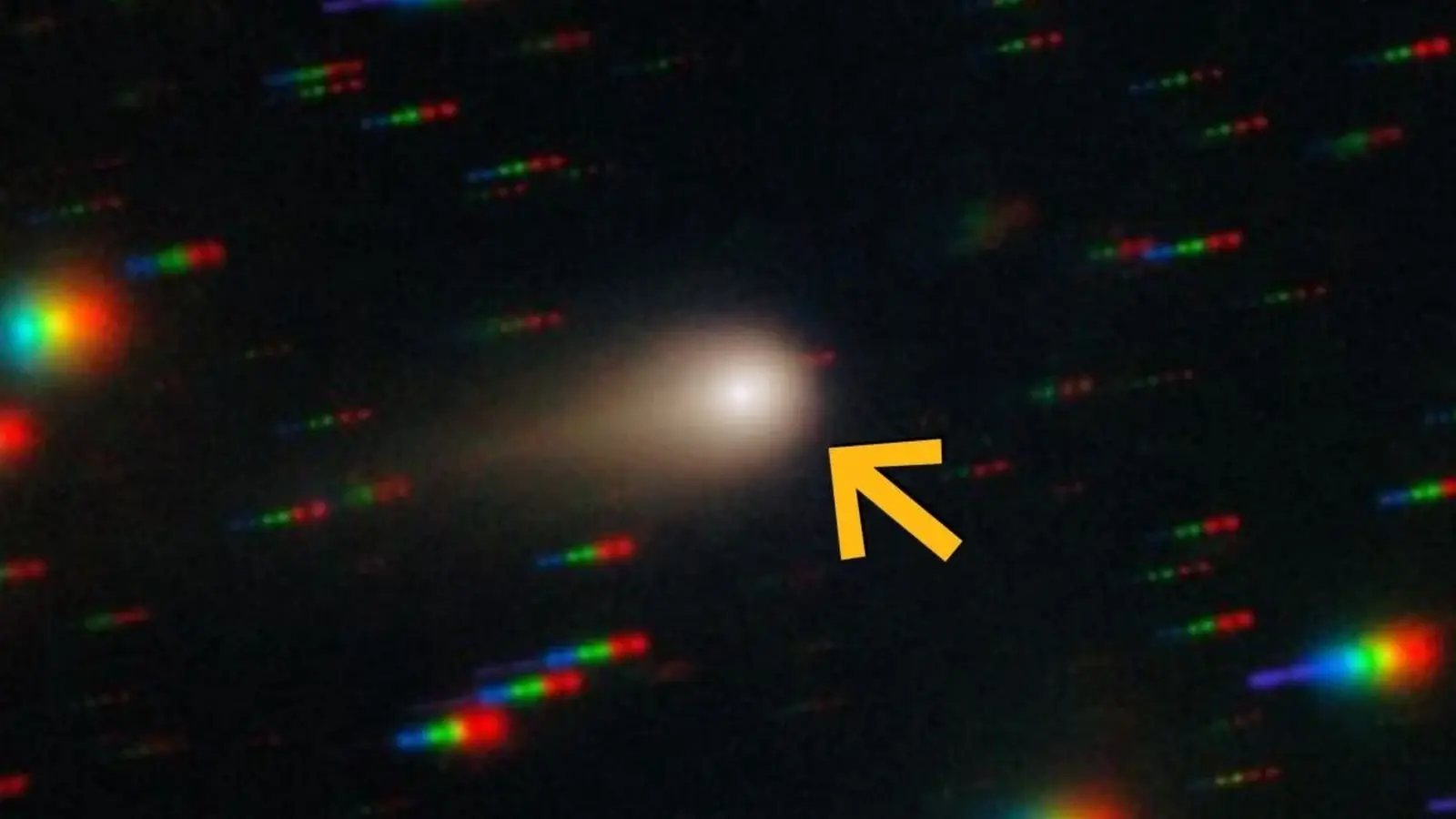
When telescopes around the world turned toward a faint, fast-moving speck in 2025, few expected what the instruments would whisper back. The visitor, catalogued as 3I/ATLAS, arrived like a messenger from a very different past. It looked like a comet, but its chemistry was anything but familiar.
A traveler unlike our own
At first glance 3I/ATLAS behaved like comets we know: a dusty nucleus with a growing coma and a streaming tail as solar heating released trapped gases. But spectral fingerprints — the detailed colors of light returned by instruments — told a stranger story. Observations from the James Webb Space Telescope and the Atacama Large Millimeter/submillimeter Array combined high-resolution infrared and radio views, revealing molecular and isotopic abundances that do not match those of comets formed in the Solar System.
Most comets in our backyard carry isotopic signatures imprinted by the Sun-forming environment some 4.6 billion years ago. This object carried signatures that point to conditions far colder and far more primitive. How primitive? The measurements suggest formation in an environment close to the cosmic deep freeze — tens of kelvin above absolute zero — and possibly as old as the early Milky Way itself.
Isotopic fingerprints: deuterium and carbon tell different tales
Isotopes are nature's archive. Swap an atom for a heavier sibling and you get a subtle but detectable change in the light emitted or absorbed by a molecule. The JWST team measured the deuterium-to-hydrogen ratio in water vapor released from 3I/ATLAS. Deuterium is heavy hydrogen; it accumulates in ices that form in the coldest environments. The result was startling: a D/H ratio of about 0.98 percent in the comet's water — more than ten times the ratios commonly seen in Solar System comets.
Such enrichment implies water condensation at temperatures below roughly 30 kelvin, or around -243 degrees Celsius. At those temperatures chemical pathways favor the capture of deuterium into water, locking a record of the frigid birthplace into the comet's ices. In short: this was not a comet born in a warm protoplanetary disk but one whose waters formed in deep freeze far from starlight.
Carbon isotopes added another twist. The ratio of carbon-12 to carbon-13 in 3I/ATLAS was higher than typical Solar System values, and unlike most nearby star-forming regions and planetary materials we have sampled. Carbon-13 is produced progressively by generations of stars; a lower relative abundance of that isotope points to source material that had not been heavily processed by many prior stellar generations. In other words, the comet appears chemically ancient.
What 'ancient' might mean for origin and age
Combine the heavy hydrogen in water with the carbon isotope pattern and a picture emerges: 3I/ATLAS likely formed in a very cold, chemically pristine region. When researchers compared the carbon ratios with models of the Milky Way's chemical evolution, they estimated a possible formation epoch roughly 11 to 12 billion years ago, when the galaxy was still young and had not yet been enriched by multiple cycles of stellar evolution.

That estimate carries caveats. The comet could alternatively have formed in a remote pocket of interstellar space that remained chemically isolated from the dust and gas shed by dying stars. In that case, its isotopic simplicity would mimic great age without demanding a true 12-billion-year birthdate. Dynamical tracing cannot resolve the uncertainty: stellar motions and gravitational interactions make backtracking a single small body over billions of years effectively impossible. Current orbit reconstructions are reliable for only about 10 million years, far short of what would be needed to pinpoint a birthplace in the ancient galaxy.
Still, whether genuinely ancient or formed in a chemically sheltered region, the object gives us a rare sample of pre-processed material, a fragment of environments rarely sampled by probes or meteorites.
Observations and instruments behind the discovery
These results come from coordinated use of flagship facilities. JWST provided infrared spectra sensitive to vibrational modes of molecules and isotopologues, crucial for detecting deuterium in water. ALMA supplied complementary radio measurements that trace molecular rotational lines and help quantify carbon isotope ratios. Together, they allowed a detailed decomposition of coma chemistry at a fidelity unattainable by either instrument alone.
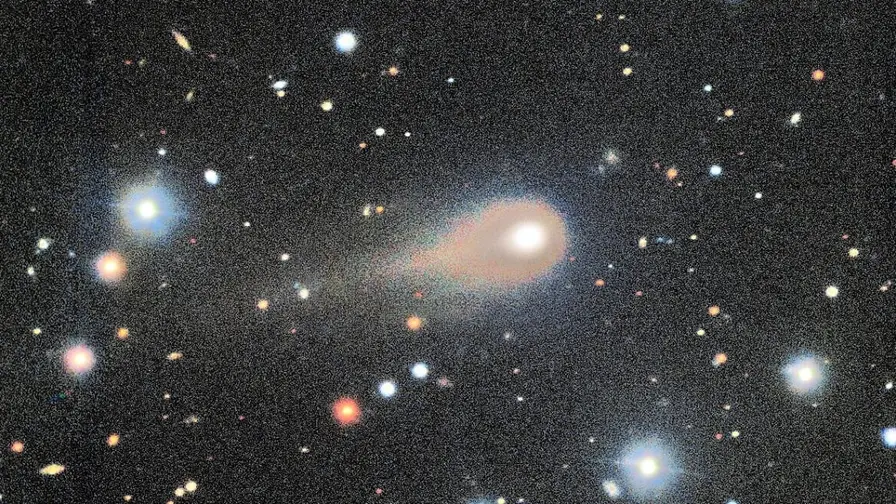
Ground-based optical telescopes played supporting roles, tracking the comet's brightness, activity level, and morphology as it passed through perihelion. High-resolution imaging from Gemini South documented the dust tail and coma structure while spectroscopy revealed the mix of gases released when sunlight warmed the nucleus.

JWST observations of 3I/ATLAS.

Gemini South image of 3I/ATLAS showing its cometary tail.
Why this matters for galactic science
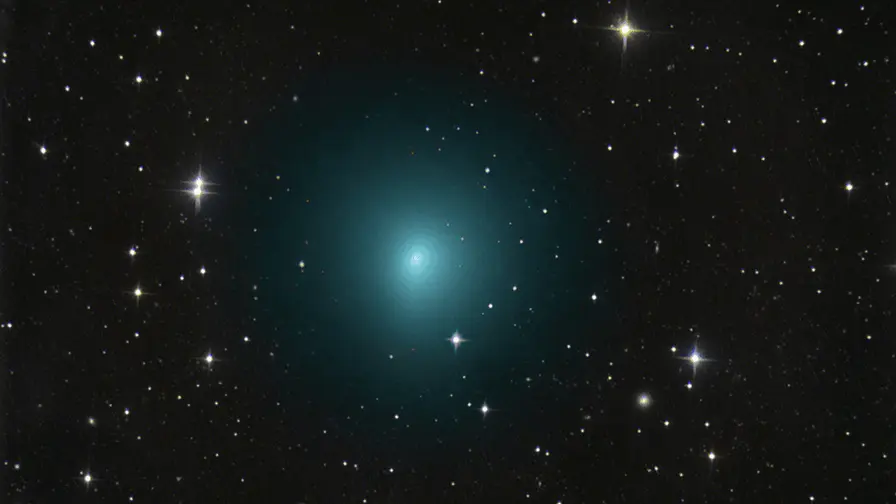
Comets formed in the early Solar System are time capsules for our own protoplanetary disk. An interstellar comet like 3I/ATLAS expands that archive beyond our local neighborhood. It lets scientists sample material from other parts or eras of the galaxy, offering constraints on how and where volatile compounds — like water and organics — formed and survived before being assembled into larger bodies.
If some fraction of interstellar objects condenses their ices at extremely low temperatures and remains chemically unprocessed for billions of years, they serve as direct probes of the interstellar medium's chemical state across cosmic time. That is powerful: it ties small-body chemistry to the broader narrative of galactic chemical evolution and star formation history.
Expert Insight
"The implications are twofold," says Dr. Laila Moreno, an astrophysicist who studies icy bodies. "One, we can capture snapshots of chemical conditions that predate the Solar System. Two, these objects test our models of ice chemistry at temperatures and densities we rarely sample. Each interstellar interloper gives us a fresh laboratory in which to test the physics and chemistry of the galaxy."
Her comment echoes a common sentiment in the community: objects like 3I/ATLAS are scientifically invaluable because they arrive from environments we cannot otherwise access.
Practical prospects and future missions
3I/ATLAS is already on its way out. At the time of analysis it was beyond Jupiter and moving outward; it will pass Pluto's orbit in 2029 and is expected to exit the heliosphere in the mid-2030s. That timeline suggests a window, however narrow, for potential follow-up missions if the international community chose to prioritize a rendezvous. The technical and budgetary challenges would be immense, but the scientific return could redefine our understanding of the distribution of volatiles and prebiotic chemistry across the galaxy.
Meanwhile, the discovery underscores the value of all-sky surveys and rapid-response observing networks. Detecting objects early, securing coordinated telescope time, and combining multi-wavelength data proved essential in teasing out 3I/ATLAS's unusual chemistry. Future detections will benefit from improved alert systems, more sensitive surveys, and continued access to space- and ground-based facilities that can probe isotopic compositions.
Conclusion
3I/ATLAS is more than an oddball visitor. It is a chemical relic that forces astronomers to ask new questions about where and how primitive ices form, and how material from disparate galactic environments circulates through space. Whether it formed at the dawn of the Milky Way or in a secluded pocket of interstellar cold, its isotopic signatures expand the palette of cosmic chemistry we can study directly. The comet will fade from view, but the dataset it offered will inform models of ice chemistry and galactic evolution for years to come.

“My work centers on sustainability, energy, and environmental science — examining how innovation can lead to a greener future.”

Discussion
Leave a Comment
Comments (3)
Cool find but feels a tad overhyped, tbh. Need more samples before rewriting galactic history. Still, props to JWST+ALMA, awesome teamwork. tiny caveat: backtracking is basically impossible
Is the 11 to 12 billion year estimate solid or just model hype? Orbit tracing only reliable to ~10 Myr, seems shaky. Could isolated pockets fake the signal??
Whoa, that D/H ratio?? Mind blown. If true, we're holding pre-galaxy ice, how did that survive so long?? unreal, goosebumps