
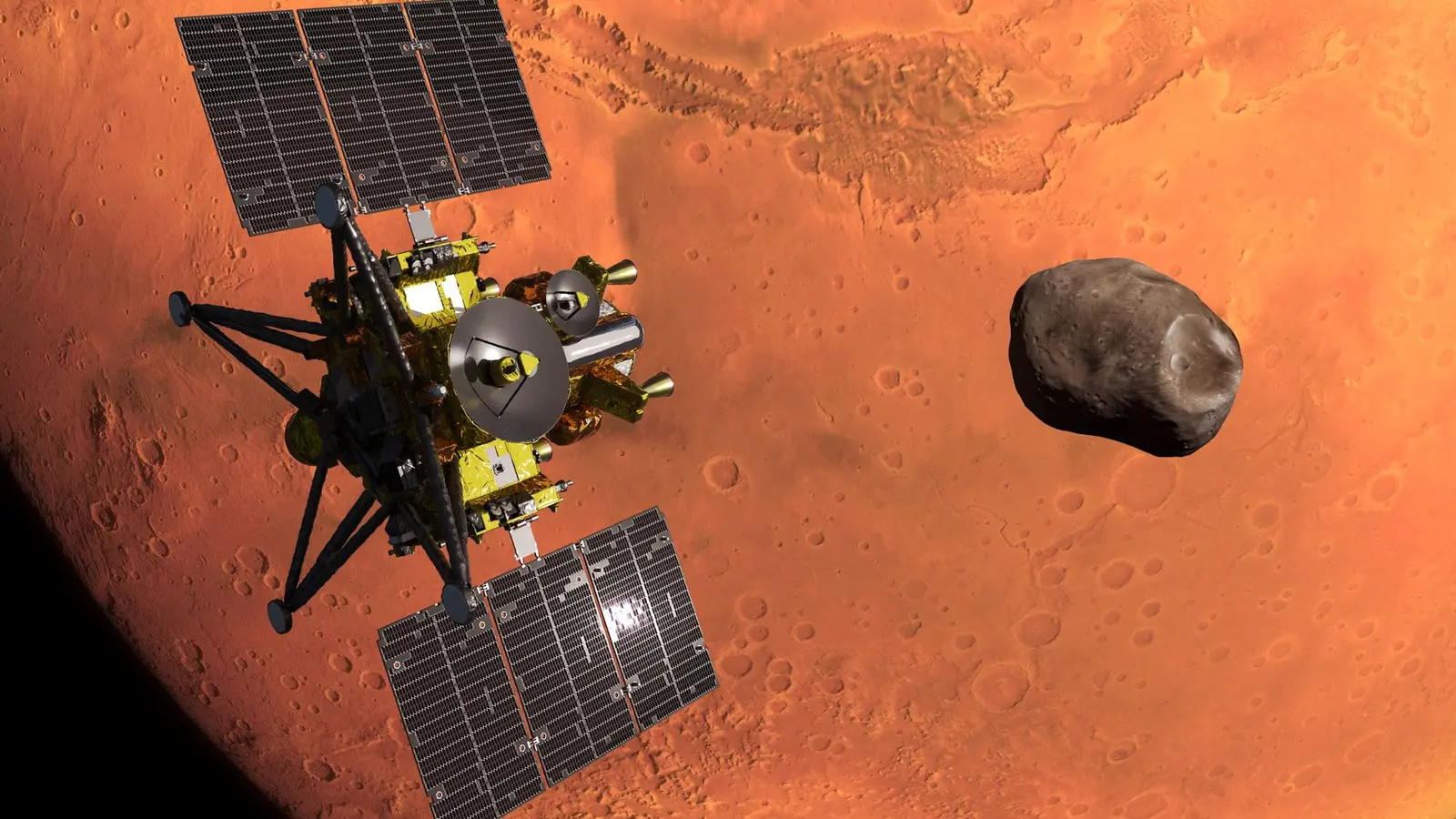
One blow. One crater. A tiny moon that has kept its secrets for billions of years. Phobos orbits Mars so close it completes a lap in less than eight hours. It hugs the planet, slowly spiraling inward, and yet despite centuries of telescopic attention and decades of spacecraft imagery, the moon’s inner makeup remains stubbornly opaque.
Phobos is more than a lump of rock. Its shape is ragged. Its gravity is faint. Together, those facts leave a long list of possibilities about how it came to orbit Mars. Did Phobos begin life as a fragment in a catastrophic Martian collision? Or did an errant asteroid wander into Mars’ embrace and become trapped? The answer may hinge on what lies beneath Stickney, the moon’s dominant crater.
What Stickney might be hiding about Phobos’ origin
Stickney is large by the standards of a 22-kilometre-wide world. The crater spans roughly nine kilometres and it scars most of Phobos’ surface in a way that makes scientists pause. If the crater formed very early, roughly 4.2 billion years ago, it could support the idea that Phobos originated from debris cast into orbit after a massive impact on Mars. If instead Stickney is much younger—closer to 2.6 billion years—then a captured-asteroid origin becomes more plausible.
That timing is not a minor detail. It changes the entire narrative of how Mars built its inner satellite system, and whether the two small moons, Phobos and Deimos, are siblings from the same violent event or unrelated captives from the asteroid belt. Resolving this requires looking beyond surface images. Researchers want to know whether a compacted, dense mass sits beneath Stickney’s rim, or whether the moon’s interior is uniformly porous, like a sponge.
Benjamin Haser and Thomas Andert, in a 2026 paper in Monthly Notices of the Royal Astronomical Society, modelled how a localized denser region under Stickney would subtly alter Phobos’ gravity field, its moments of inertia, and the way it wobbles—its libration. Those tiny signals are the fingerprints scientists can use to test formation scenarios. If Stickney shock-compressed material beneath the crater, that anomaly should show up in precise gravity mapping.

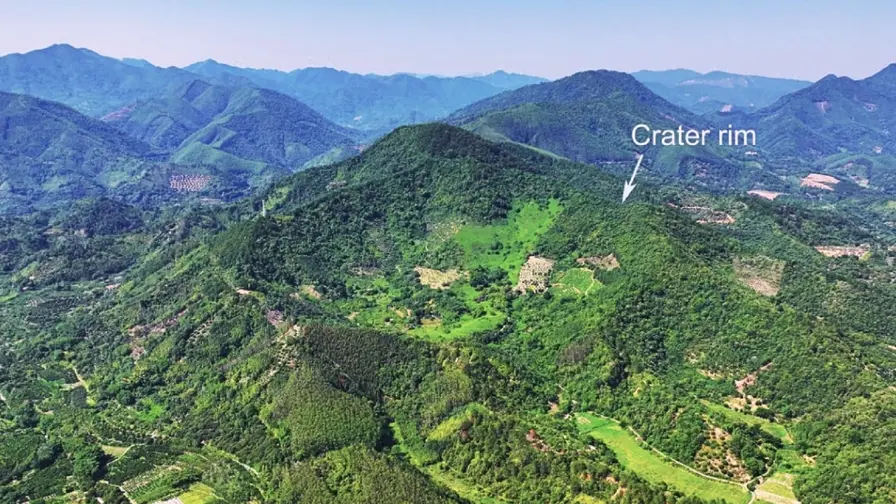
The large impact crater known as Stickney is the largest crater on the Martian moon Phobos.
Spectroscopy and orbital evolution add more pieces to the puzzle. Phobos’ surface spectra share similarities with some carbon-rich asteroids, which feeds the capture hypothesis. But that evidence by itself is not definitive. A rubble-pile asteroid can look similar to re-accumulated impact debris. What researchers lack is a consistent geophysical model that ties shape, density, spin, spectral features, and orbital history into a single, plausible story.
Phobos’ proximity to Mars makes that modelling difficult. Mars’ gravity dominates the environment, so Phobos’ own gravitational fingerprint is weak and tangled with tidal forces from the planet. Extracting meaningful signals is like listening for a whisper in a crowded room. Still, those whispers matter; they may reveal whether water ice lurks beneath a porous regolith or whether compacted rock marks an ancient violent shock.
MMX and the practical hunt for hidden mass
The Japanese Space Agency’s MMX mission is designed to confront these questions directly. Scheduled for launch in late 2026, MMX will attempt an uncommon ballet: operating a spacecraft in close proximity to a tiny, irregular body whose own gravity cannot support stable local orbits. The mission will conduct detailed gravity mapping, take high-resolution imagery, and return physical samples to Earth by mid-2031.
Those samples are crucial. The main spacecraft carries two collection systems. One is a core sampler that can extract material down to two centimetres. The other, a pneumatic sampler provided by NASA, will puff pressurised gas at the surface to loft grains into a return container. Together, they promise both bulk and context: bits of surface that may record exposure age, impact processing, and composition.
Sample analysis on Earth will complement in-situ measurements of Phobos’ gravity field and librations. If a denser mass lies beneath Stickney, the spacecraft should detect subtle deviations in the moon’s gravitational pull and rotational response. That signal, when combined with returned grains, can constrain ages and mechanical histories. In effect, MMX will test whether Phobos is a reassembled outcome of a Mars-shattering event or a captured, loosely bound asteroid.
Phobos’ orbital fate adds urgency. The moon is slowly spiralling toward Mars. In a geologic blink it will either break apart under tidal stress or impact the planet. Studying Phobos now is therefore both archaeology and active observation: scientists can learn about ancient events and watch a system still evolving.
Expert Insight
"Phobos challenges our standard categories," says Dr Elena Márquez, an imagined planetary geophysicist with experience in small-body missions. "You can assemble many plausible pieces—spectra, shape, spin—but until you measure the interior’s mass distribution and get physical samples, the story will remain ambiguous. MMX could finally let us read the moon’s internal record."
Her point is practical. Gravity anomalies tell story chapters that surface spectra cannot. A localized dense root beneath Stickney would read like a sentence: intense heating, compaction, and perhaps melting at the moment of impact. A uniformly low-density interior would speak instead of slow accretion and gentle capture. Either outcome reshapes our understanding of Mars’ early environment and the collisional history of the inner solar system.
Conclusion
Phobos is small, but its implications are large. Whether it is a compacted remnant from a titanic Martian collision or a captured rubble pile, its internal structure carries evidence about the solar system’s violent youth. The combination of precision gravity mapping, libration analysis, and returned samples from MMX gives scientists their best chance yet to read that record.
Stickney crater is the key feature. Under it lies the possibility of a localised mass anomaly that would tilt the balance toward an impact-origin narrative. If no such anomaly appears, the capture model will gain ground. Either way, MMX’s measurements and the laboratory work that follows will transform hypotheses into testable history.
Phobos will not hold these answers forever. Its orbit is changing. The clock is ticking. For planetary scientists aiming to reconstruct Mars’ past, the smallest moon may deliver some of the clearest evidence yet.

“The cosmos has always fascinated me. I write about space missions, astronomy, and the technologies pushing humanity beyond Earth.”

Discussion
Leave a Comment
Comments (3)
Nice writeup but feels a bit dramatic. Phobos is tiny, yes, but weve been over speculations before. still, MMX samples will finally settle some stuff. fingers crossed.
Questioning the 'gravity whispers' bit. Mars tides, noise and spacecraft errors could mask tiny anomalies, can MMX really separate them? skeptical rn
Wow, Stickney might hide a dense root? That's wild. MMX feels like cosmic detective work, tense and thrilling... hope samples tell the tale, pls hurry