
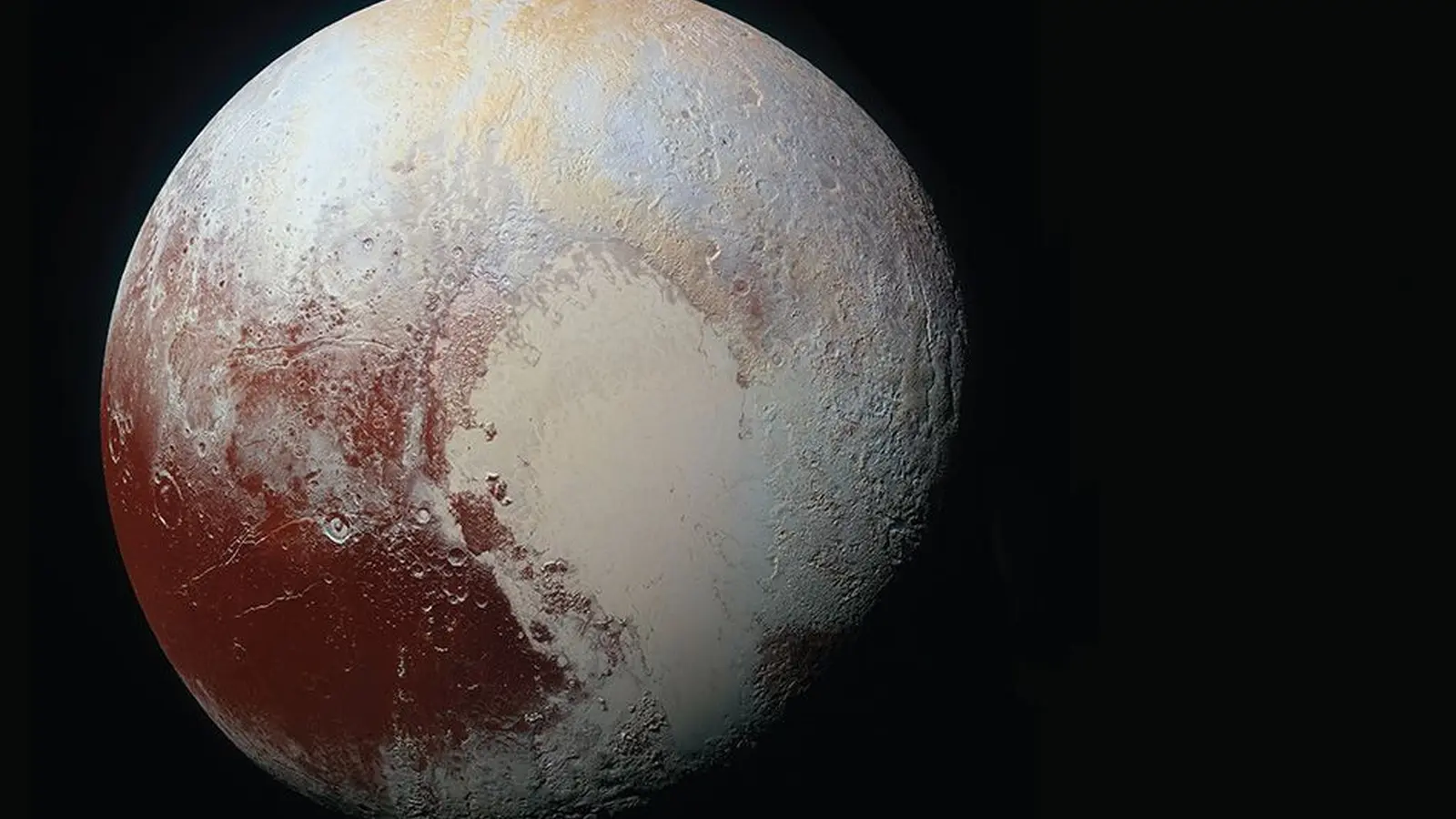
A slow, cold seep on a world at the edge of the solar system. Dark veins on an otherwise bright plain. That is the image New Horizons left behind when it flew past Pluto, and a new analysis suggests those veins may record something extraordinary: liquid nitrogen rising from beneath the dwarf planet's famed heart-shaped glacier and briefly moving across its surface.

For scale, Pluto is about 3/4ths as wide as the continental United States.
Signs in the ice that look oddly familiar
Scientists from the Southwest Research Institute led by Dr. Alan Stern mined New Horizons imagery and found narrow, dark patterns crisscrossing the northern reaches of Sputnik Planitia, the western lobe of Pluto's heart-shaped region. These markings are not random. They organize into lines and patches that echo features we see on Earth when liquid water wets snow and ice.
Pluto's surface and atmosphere are far too cold for nitrogen rain. So what could darken the ice there? Stern and colleagues argue that liquid nitrogen, produced and mobilized beneath the glacier, could be forced upward through narrow conduits and then wet the surface briefly enough to leave visible stains. If that interpretation holds, it would represent the first direct evidence of liquid flow on Pluto in the recent geological past.
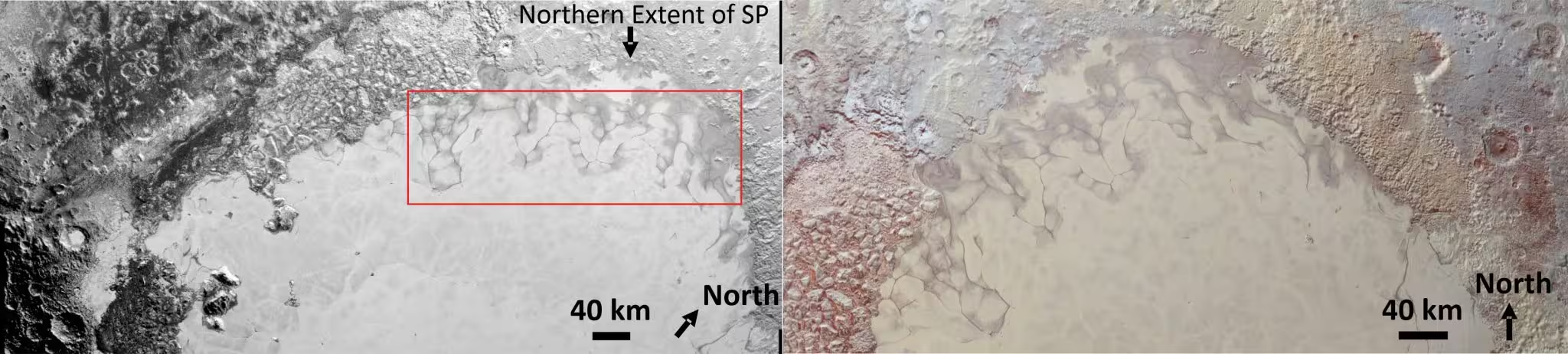
Pluto's northern Sputnik Planitia glacier (in the western or left side of Pluto's brightheart) is shown here in a color mosaic made from New Horizons imagery. The direction of north is shown on the image. The image is ~ 700 x 350 kilometers across. The red box has been added to show most of the region containing dark features attributed to the wetting of the glacier by liquid nitrogen sourced from a “basil melting” process beneath the glacier, as described in the published paper by Stern et al. (2026).

How a cold glacier might briefly turn wet
Sputnik Planitia is not a thin veneer of frost. It is a kilometers-thick accumulation of volatile ices, dominated by nitrogen, that behaves like a glacier on Earth in some ways but under conditions that are alien to our planet. New Horizons imaged city-scale convection cells across the plain, and between those cells are narrow dark lines and broader patches of darker material. The SwRI team suggests that these darker marks are the scars of short-lived liquid flows.
Computer models led by Dr. Orkan Umurhan at the SETI Institute sketch a plausible mechanism. Deep beneath Sputnik Planitia, solid nitrogen under stress could warm and undergo localized melting at the base of the ice. Buoyancy or pressure in the melted pockets could then push liquid upward through narrow pathways, analogous to how lava rises through tubes on Earth or how geyser conduits work on icy moons.
From melt to surface markings
- Melting occurs at depth where the weight of the glacier and internal stresses raise temperatures slightly above the local melting point of nitrogen.
- Liquid nitrogen collects in pockets and becomes buoyant or pressurized relative to overlying ice.
- It moves upward along fractures or narrow channels, reaches the surface, and wets the cold surface briefly before freezing or sublimating away.
When that liquid reaches the surface it darkens the surrounding ice much like meltwater darkens snow on Earth. The SwRI team compared New Horizons images with NASA Landsat 9 photos of Greenland ice and found a strong visual analogy: narrow, dark streaks where liquid has altered the surface.
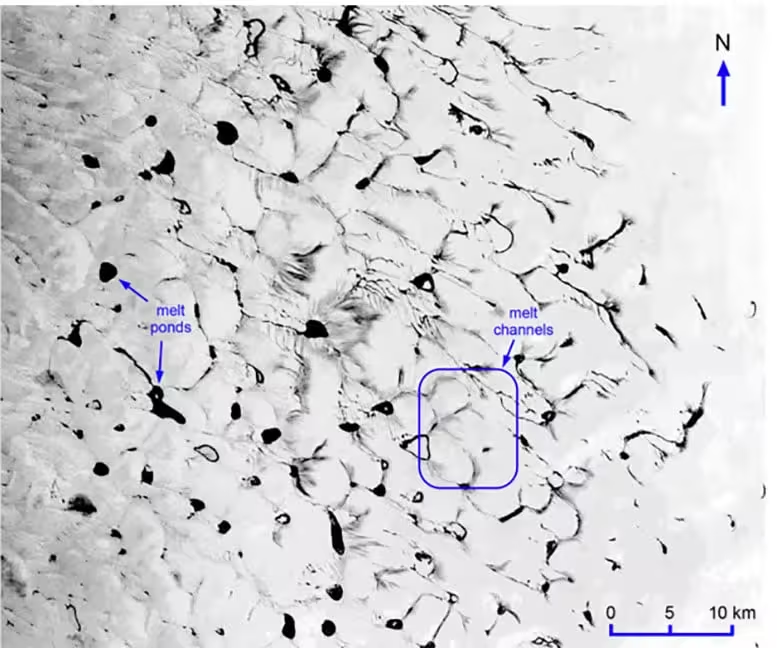
Researchers for an SwRI-led study compared New Horizons images to NASA Landsat 9 images of the Greenland ice sheet. Dark, narrow surface features have been identified here in areas in Greenland where liquid water darkens the ice and snow in a manner analogous to what is now believed to perhaps be occurring on northern Sputnik Planitia on Pluto due to present or recent liquid nitrogen there. The newly published Pluto study identifies very similar features in the northern edge of Pluto’s Sputnik Planitia glacier, suggesting the recent presence of liquid nitrogen there.
Why this matters for planetary science

First, the scenario revises how active we think Pluto still is. Past studies pointed to ancient liquid activity on the dwarf planet. This new work pushes that timeline forward, implying that melting and short-lived flows could be occurring now or did so recently enough to leave very young surface markings.
Second, it challenges laboratory and theoretical work on nitrogen ice. The physical behavior of nitrogen under stress at tens of kelvin is not well constrained by experiments. Umurhan warns that researchers need targeted lab studies of solid-state nitrogen mechanics at extremely low temperatures to understand how and when basal melting would occur. Those results would feed back into models of glacier dynamics not just for Pluto but for other icy worlds as well.
Third, the mechanism could be relevant beyond Pluto. The geysers photographed on Triton by Voyager 2, for example, might be powered by similar processes of melt and pressurization in volatile ices. If narrow conduits and pressure-driven upwelling of cryogenic liquids are common on icy bodies, our picture of surface renewal and volatile cycling across the outer solar system needs updating.
Expert Insight
"Finding evidence that any liquid has recently touched Pluto's surface changes how we think about the dwarf planet's present-day geology," says Dr. Maya Rivera, a planetary geophysicist not involved in the study. "It raises questions about energy sources, the longevity of subsurface liquids, and the kinds of mechanical behaviour ices can show at ultralow temperatures. Those are testable questions, in part, with lab work and in part by future missions that could map more of Pluto at higher resolution."
What remains uncertain
Not every scientist will accept the interpretation immediately. Alternative explanations for dark streaks could include compositional differences in the ices or wind-deposited materials concentrated along convection boundaries. Also, only a portion of Pluto has been imaged at the resolution needed to see these features; more than half the dwarf planet remains mapped only at lower resolution. That means similar phenomena could exist elsewhere but remain hidden.
Confirming the liquid-nitrogen hypothesis will require a mix of approaches. Higher-resolution orbital imaging or, ideally, an in situ mission to measure surface composition and temperature directly would settle ambiguities. Meanwhile, laboratory experiments probing how solid nitrogen deforms, melts, and flows under stress at Plutonian temperatures would refine model predictions.

Conclusion
The idea that Sputnik Planitia may be leaking liquid nitrogen forces a change in perspective. Pluto is not merely a frozen relic. It is a world with active processes, subtle and cold, that can blur the line between solid and liquid. New Horizons gave us a snapshot. Interpreting what we see leads to new questions about heat, stress, and volatility on distant icy landscapes, and about how common such behavior might be among Kuiper Belt objects and icy moons.

“My work centers on sustainability, energy, and environmental science — examining how innovation can lead to a greener future.”

Discussion
Leave a Comment
Comments (3)
Feels a bit overhyped, and the cryo physics sounds handwavy. Still cool tho, but pls be careful with Earth analogies, Triton maybe similar, if they're right that'd be huge
Is this even true? Looks like the dark streaks could be compositional, or an imaging artifact. More data needed, labs, or another flyby. not convinced yet
Whoa, liquid nitrogen oozing on Pluto? mind blown. If true, that tiny world is way more alive than I thought… where's the heat coming from??