
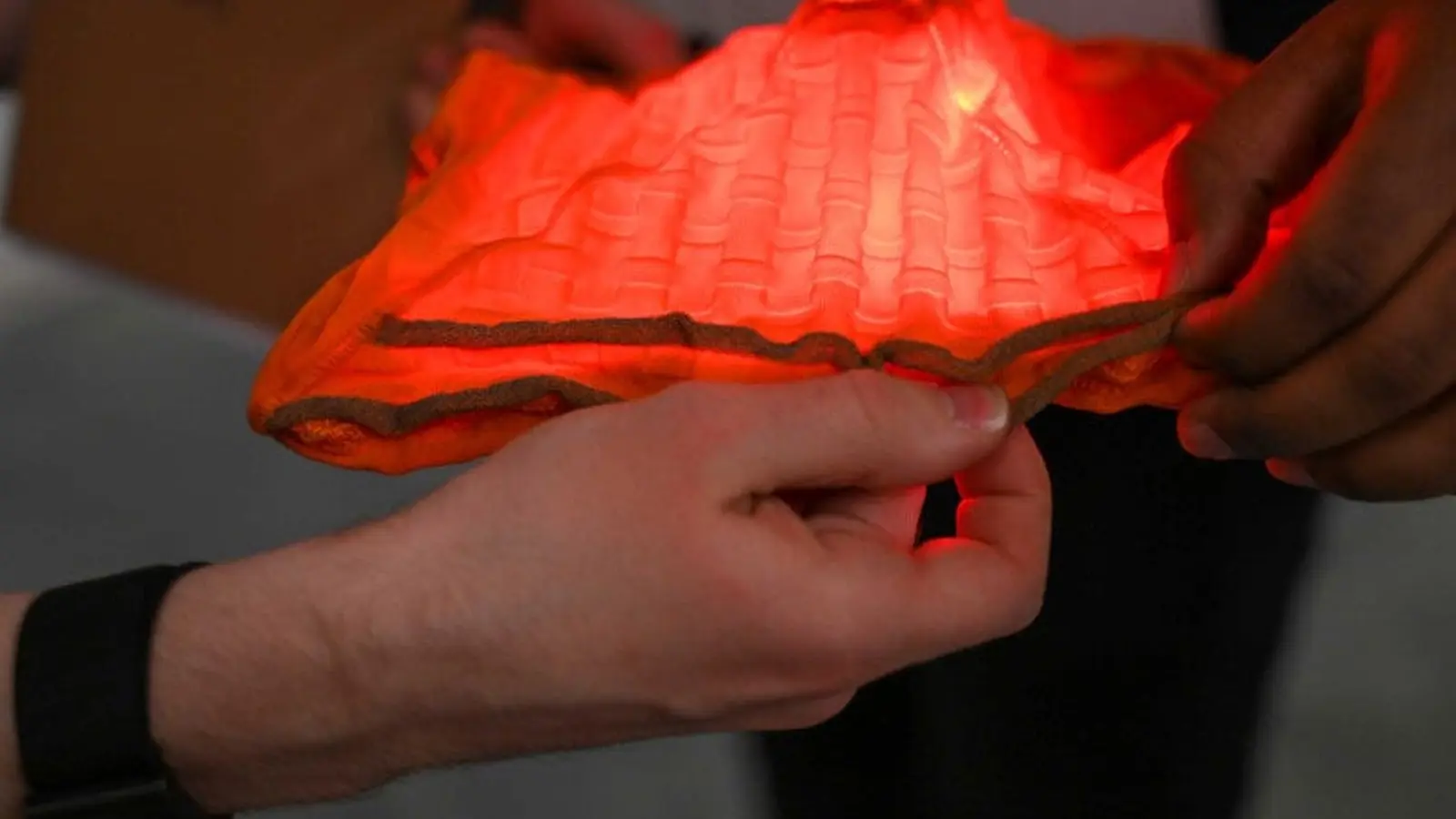
Imagine a lampshade that clicks itself between three colors as you tug a loop of fabric. Or a sleeve that flips like a tiny mechanical toggle with every stride you take. These are not props from a design fair; they are functioning devices made from ordinary yarn and industrial knitting machines.
Turning yarn into purposeful mechanics
Researchers at the Harvard John A. Paulson School of Engineering and Applied Sciences have shown that knitted textiles can be engineered to behave like programmable mechanical elements. The trick lies in multistability: a physical trait that lets a structure rest in more than one stable configuration. In practice, that means a fabric can snap from one shape to another and stay there until enough force flips it back.
This is not molding or heat-setting plastics. Instead, the team used weft knitting—the same automated process that produces hats and gloves—paired with careful yarn selection and stitch patterns. Highly elastic yarns, combined with plating (a technique that places different yarns on opposite faces of the fabric), yield thick, dense knits that naturally curl and hold three-dimensional forms. The effect is similar to why a cut T-shirt edge rolls up, but designed deliberately and predictably.

The researchers used highly elastic yarns to create dense textiles that snap into different configurations.
By arranging horizontal and vertical stripes in specific geometric patterns, the team produced textiles that rapidly snap between multiple stable states. Picture a light switch that clicks and stays in the up or down position. These fabrics behave the same way: each configuration is mechanically locked until an applied force crosses a threshold and drives the snap-through motion.
From mechanical clicks to electrical logic
Adding a conductive thread turned these snapping textiles into functioning electrical switches. When a shell of fabric flips, it either closes or opens a circuit. In demonstration devices, a knitted shell switched an LED on and off with every flip. Another garment-mounted device detected snapping at a knee or elbow and relayed that motion to an Arduino, enabling step counting.
They also built a reconfigurable lampshade containing three multistable switches. Each switch controlled a different color of light as the fabric stretched and snapped between states. These devices and other examples were displayed in a recent Art Lab installation.

Rather than modeling every yarn strand, the team treated each knitted fabric as a continuous material in their simulations. That abstraction produced accurate predictions of the textiles’ behavior and reduced computational complexity. By testing how yarn elasticity and geometric patterning influenced snap-through, the researchers identified design rules to produce multistability reliably.
Compatibility with standard industrial knitting equipment is a practical advantage. The same machines already deployed in garment factories can, with appropriate programming, produce these engineered textiles at scale. That lowers the barrier between lab prototypes and commercial manufacture.
Applications, context, and scientific significance
These findings sit at the intersection of textiles and nonlinear mechanical metamaterials—fields that design structures to bend, buckle, and snap in intended ways. The capacity to embed predictable mechanical states into soft fabrics opens several paths. Wearable sensors that run without batteries could register movements through mechanical states alone. Soft interfaces might provide tactile feedback by changing shape on demand. Reconfigurable architecture elements could be woven into soft robotics or adaptive clothing.
The project was led by recent Ph.D. graduate Kausalya Mahadevan under the supervision of Katia Bertoldi. Their work, published in Advanced Functional Materials, rethinks textiles not merely as passive coverings but as programmable mechanical systems. Mahadevan explained that inspiration came from both textile artists and the lab’s long-standing expertise in nonlinear solid mechanics; combining those perspectives yielded a new way to think about fabric as structural material.
Challenges remain. Long-term durability of conductive yarns, integration of power and signal routing for more complex logic, and the translation of laboratory prototypes into comfortable, washable garments are practical hurdles. Still, the research sets a foundation: with patterning and material choices, knitted fabric can become an active, shape-changing component of devices.
Expert Insight
"What excites me is the elegance of the approach," says Dr. Lena Ortiz, a materials engineer who studies soft sensors. "They harness behaviors that are already present in textiles—curling, buckling—and turn them into repeatable functional responses. That makes manufacturing and adoption more feasible than if you had to invent an entirely new substrate."
Ortiz adds that the ability to model fabrics as continuous materials is a critical step. "It gives designers a toolbox: tune your yarn modulus, tweak stripe geometry, and you can dial in the snap force and the number of stable states. That predictability is what will let these ideas leave the lab and appear in everyday products."
As the line between clothing and machines blurs, this research offers a pragmatic route: use centuries-old craft processes with modern engineering to yield fabrics that do more than cover—they compute, respond, and remember mechanical states.


“The cosmos has always fascinated me. I write about space missions, astronomy, and the technologies pushing humanity beyond Earth.”

Discussion
Leave a Comment
Comments
No comments yet. Be the first.