
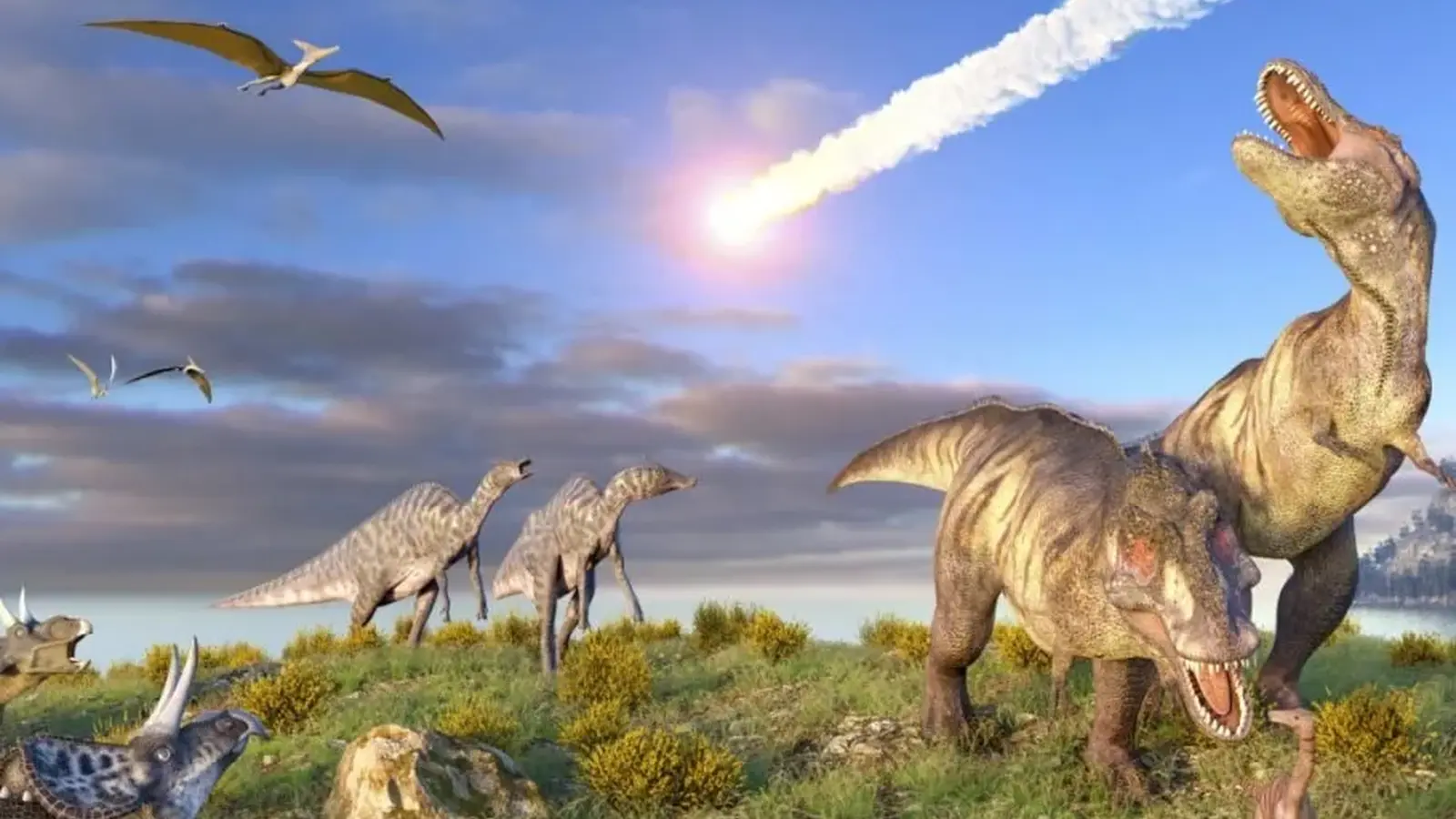
A whisper-thin layer of clay, preserved around the globe, finally speaks. Inside it are microscopic fragments that trace back to the most consequential collision in Earth's recent geological history. For decades researchers debated the nature of the object that struck 66 million years ago and wiped out roughly three quarters of species, including all non-avian dinosaurs. Now teams from the University of British Columbia, institutions in Paris, Brussels and Vienna report a close match: a very rare carbon-rich meteorite known as a CO carbonaceous chondrite.
The chemical autopsy that solved a 66-million-year mystery
Scientists applied ultra-precise measurements of nickel isotopes to the fine clay layer that marks the Cretaceous-Paleogene boundary. That layer contains vanishingly small particles from the impact event because the incoming body largely vaporized on contact. Nickel isotopes act like a forensic fingerprint. The pattern in those isotopes points to material consistent with carbonaceous chondrites of the CO class, a primitive family of meteorites thought to preserve the original ingredients of the early solar system.
Carbonaceous chondrites are uncommon among meteorites recovered on Earth. Only about 5 percent belong to that group. The CO subtype is even rarer. Laboratory tests on the boundary clay also revealed unusually low abundances of volatile elements relative to many known meteorites. Elements such as carbon, zinc, water-bearing minerals and notably sulfur were present in lower amounts than expected.

Put simply, the rock that punched the Chicxulub crater was rich in well-preserved, primordial material but relatively poor in volatile compounds that evaporate easily. That detail helps refine how the global catastrophe unfolded. It does not overturn the impact hypothesis. Instead it shifts emphasis away from the notion that the asteroid injected vast sulfur aerosols that alone darkened and chilled the planet for years.
How then did sunlight dim and ecosystems collapse? The new evidence supports an older, physically brutal idea: the primary source of long-lived atmospheric haze was not the asteroid's own volatiles but the enormous volume of pulverized Earth rock thrown into the atmosphere. The impact excavated the roughly 10 to 15 kilometer-wide body at tremendous speed, forming the Chicxulub crater beneath what is now the Yucatán Peninsula. Estimates put the strike velocity near 64,000 kilometers per hour. The blast vaporized the impactor and vaporized, melted and lofted enormous quantities of target rock and sediments. That debris rained back down, and the finest particles remained aloft long enough to suppress sunlight and upset climate systems.
Where might such a CO carbonaceous chondrite have come from? Researchers suggest origins in the distant, colder regions of the solar system or from the outer reaches of the asteroid belt, possibly perturbed into an Earth-crossing path by gravitational interactions with Jupiter. The identification narrows the list of plausible source reservoirs and gives planetary scientists a clearer target when modeling solar system dynamics and impact risks.
The study, published in Science Advances, joins a body of work that combines field geology, laboratory isotope geochemistry and planetary dynamics. Together these methods are building a more detailed portrait of the object that abruptly ended the age of dinosaurs and reshaped life on Earth.

“My work centers on sustainability, energy, and environmental science — examining how innovation can lead to a greener future.”

Discussion
Leave a Comment
Comments (2)
Is the CO link solid tho? Low sulfur but lots of pulverized rock, curious about the models, feels like more work needed.
Wow, that nickel-isotope fingerprinting is wild. Makes the whole extinction feel so... precise and kinda eerie.