
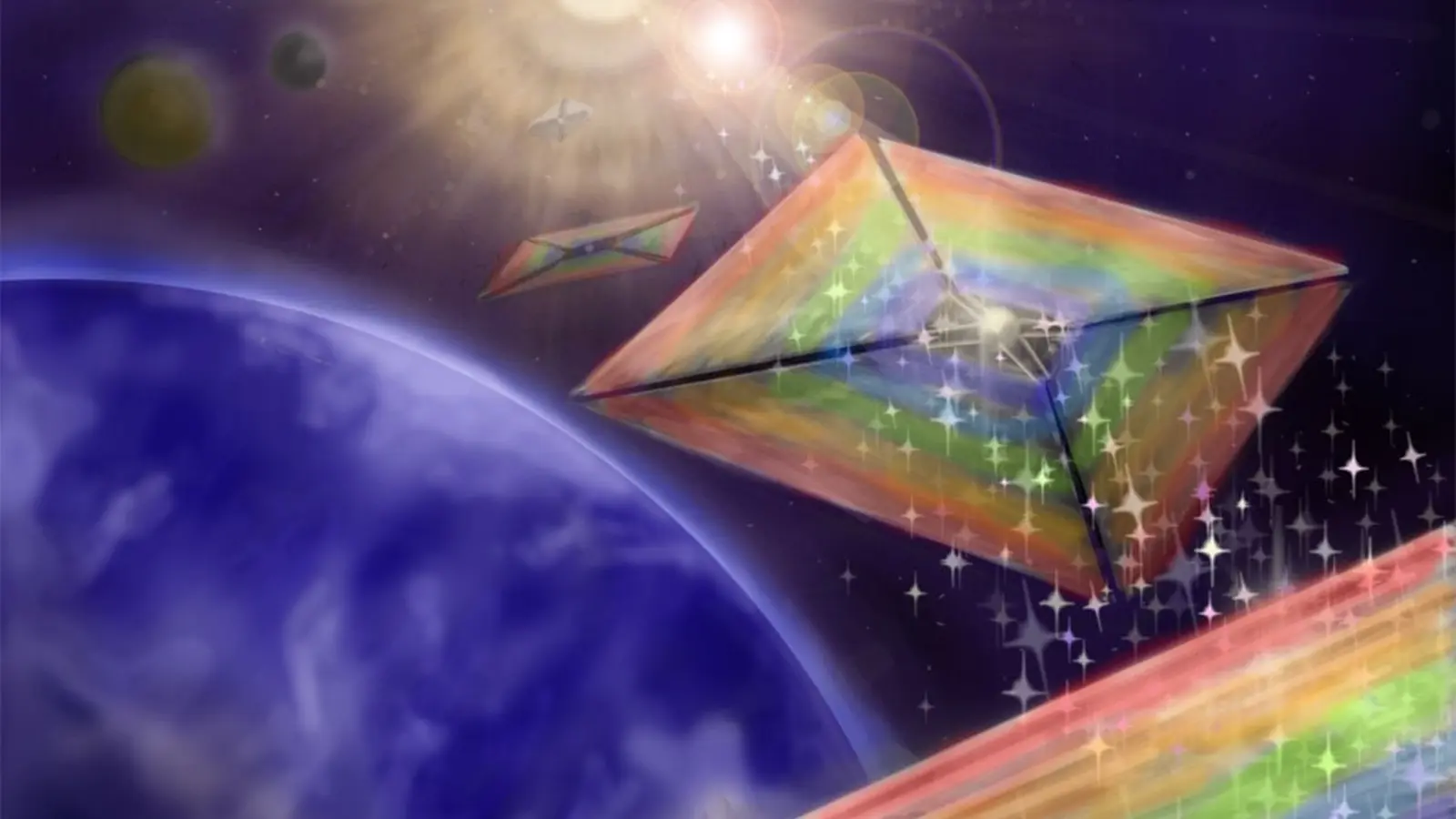
Imagine a wafer-thin sail, glinting under a focused laser, racing away from Earth at a large fraction of the speed of light. For a few thrilling moments the sail surges forward, pushed by pure photon momentum. Then something unexpected happens. The very light that accelerated the craft begins to push back.
Why photons sometimes stop being friends
Traditional thinking treats light as a helpful shove. Photons carry momentum; when they strike a reflective surface they transfer that momentum and accelerate the object. Solar sails exploit that principle with minimal moving parts and no propellant. The idea scales up: hit a thin sail with a powerful laser and you could, in principle, fling a tiny probe to another star within decades rather than millennia.
But a recent paper by Chao Shen and Jiaze Li at Harbin Institute of Technology, posted on arXiv, points to a subtle relativistic complication. The authors break down the photon-sail interaction into three distinct contributions: incident photon momentum, specular reflection where photons bounce off like billiard balls, and diffuse scattering where absorbed light is reemitted in random directions. Each mechanism matters at different levels. All three behave nicely at low speeds. At relativistic speeds, the math — and the physics — change.
As a sail accelerates away from its light source, two effects conspire to reduce thrust. First, Doppler redshift lowers the frequency and energy of incoming photons. Fewer energy, less push. Second, light aberration changes the apparent direction of incoming and outgoing photons as seen in different frames. The result is a declining return on the laser’s investment: the faster the sail goes, the less thrust each photon contributes.

Where push turns to pull
The surprising tipping point appears near seventy-five percent of the speed of light. Past that threshold the diffusely scattered photons, which earlier played a small but benign role, start to appear from the Earth frame as being preferentially directed forward. By Newton’s laws, every forward-directed reemission produces a backward reaction on the sail. In plain language: a weak force that once aided acceleration becomes a drag force that fights it.
The paper’s calculations show the net force from the driving laser still remains positive beyond that speed, but the efficiency of acceleration drops sharply. For mission designers this matters. If the energy you pour into the beam yields diminishing returns beyond a specific velocity, the overall mission architecture, laser power budget, and sail material choices all need rethinking.

The analysis is deliberately focused on radiative physics. That keeps the math clean, but it also omits other real-world hazards. Interstellar gas and dust would impose additional drag and risk, and intense laser illumination raises thermal concerns for any real sail material. The authors treat the sail as an idealized mirror. In practice engineers are experimenting with metamaterials and photonic crystals tuned to particular wavelengths. Those engineered surfaces could alter scattering behavior, perhaps offsetting some of the relativistic drag or stabilizing the sail within the beam.
Engineering and mission implications
What do these findings mean for interstellar concepts such as laser-driven probes or diffractive sails? First, they underline that any plan to reach relativistic speeds must model radiative transfer in a relativistic framework, not just classical optics. Second, sail design becomes a systems problem: optical performance, thermal limits, structural stability, and control all feed into whether you can maintain acceleration or must accept a practical speed ceiling.
Could clever materials flip the script? Possibly. Metamaterials can be engineered to redirect scattered light in preferred directions. That offers a potential route to minimize forward-directed reemission in the observer frame or to actively steer the momentum budget. These approaches remain theoretical at the interstellar scale, but they point toward a research program that pairs materials science with relativistic dynamics.
Expert Insight
"This paper highlights an often-overlooked kink in the road to interstellar flight," said Dr. Leila Campos, a propulsion specialist at a national space laboratory (comment presented here as informed perspective). "You can’t treat photon pressure as an unchanging commodity once velocities get extreme. Materials and beam strategies must evolve together if we want viable probes at significant fractions of light speed."
There are practical takeaways. Mission planners should include relativistic scattering models early in design trade studies. Experimentalists can test scaled analogues in high-power laser facilities to probe scattering behavior under intense illumination. And materials researchers should prioritize optical control over broad bandwidths so that sails do not become victims of the physics they rely upon.
Interstellar travel remains one of humanity’s most audacious engineering challenges. The path forward is unlikely to be a single silver-bullet innovation. Instead it will be an accumulation of better models, smarter materials, and tested subsystems. Papers such as the one from Harbin Institute of Technology add an important piece to the map by revealing where light starts to bite back. That knowledge doesn’t close the door on laser-driven sails. It simply tells engineers where to hammer harder.

“The cosmos has always fascinated me. I write about space missions, astronomy, and the technologies pushing humanity beyond Earth.”

Discussion
Leave a Comment
Comments (2)
Is this even practical tho? If diffuse scattering becomes drag at ~0.75c, do we need exotic metamaterials or scrap the beam idea, or am I missing something
Wow didnt expect photons to fight back, that’s wild 😮. So even if you beam harder, returns drop fast, materials gotta be clever, not just bigger lasers!