
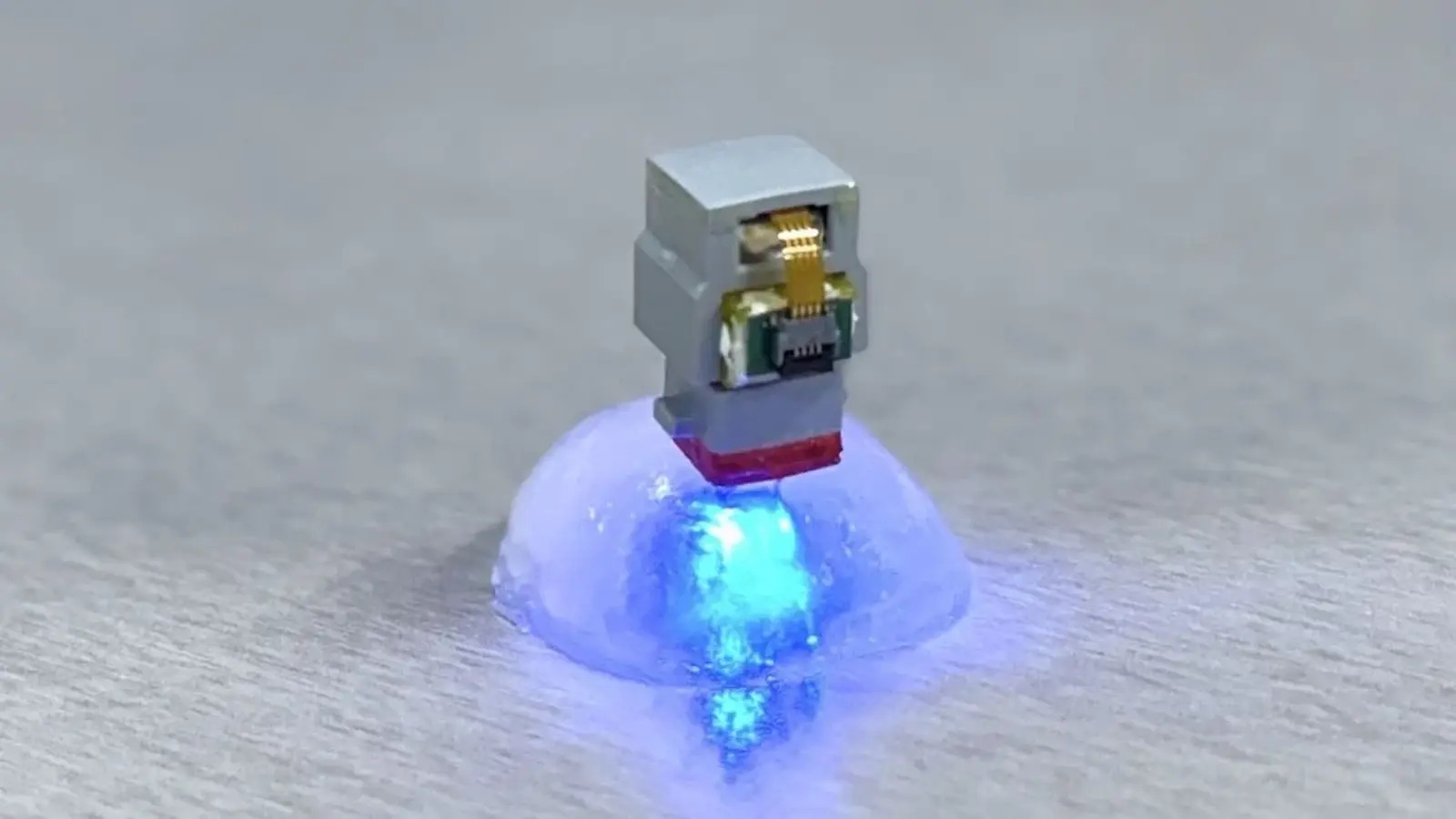
The scene was almost cinematic: a researcher in Chicago sent a command over the internet and, a fraction of a second later, a tiny device inside a freely moving rat in Daejeon, South Korea, responded. Ten thousand six hundred ninety-six kilometers of fiber and hardware collapsed into a 109 millisecond pause between decision and action.
How they pulled off a remote neural experiment
It was an engineering test with obvious scientific promise. Teams at KAIST and Yonsei University described a system called RAPIDO in a paper in Science Advances. The headline: commands issued in Chicago travelled over existing internet infrastructure to a computer in the Korean lab, and from there a wireless link triggered a compact brain implant inside a rat. Average round-trip response time: roughly 109 milliseconds. Fast enough for many neuroscience experiments. Fast enough to feel instantaneous.

A freely moving rat carrying the wireless RAPIDO brain implant.
But RAPIDO is not just a remote switch. It combines two interventions in a single, small package that rats can carry while behaving naturally. One channel delivers programmed doses from a refillable cartridge. The other emits light through a miniature LED to stimulate genetically targeted cells, an optogenetic approach. Researchers can trigger these functions separately, stack them on a schedule, or run them on preprogrammed sequences delivered via the internet.
What the experiments actually tested
The team ran two separate behavioral assays to validate the platform. The first focused on the refillable drug-delivery capability. RAPIDO was used to infuse varying doses of cocaine directly into the nucleus accumbens, a brain region tightly linked to reward and motivated movement. The result was dose-dependent changes in locomotion. Those effects were reproducible two, three, and four weeks after implantation, showing repeatable delivery across time without repeated surgery.

Overview of the brain implant and its key function.
The second experiment isolated the implant's optical control. Instead of using the implant to deliver cocaine, researchers injected the drug intraperitoneally and used the implant only to emit light. Optogenetic activation targeted the RhoA signaling pathway during conditioning. Rats that received cocaine but no light developed a clear place preference for the compartment associated with the drug. Animals whose RhoA pathway was activated by the implant did not develop that same preference. In short, light stimulation altered how the rats learned to value the cocaine-paired environment.


Commands sent from Chicago remotely activated a RAPIDO brain implant in Daejeon, South Korea, 10,596 kilometers away.
These are proof-of-concept demonstrations. They show the platform can reproducibly change brain chemistry and neural signaling, and that those manipulations yield measurable behavioral outcomes. They do not demonstrate a treatment for addiction, nor do they claim immediate clinical applicability.
"Our brain implant allows researchers to carry out repeated, long-term, and remotely controlled drug and optical interventions in freely moving animals without repeatedly handling the animal or replacing the implant through additional surgery," KAIST electrical engineer Jae-Woong Jeong, who led the study, told ScienceAlert. "This makes it possible to conduct longitudinal experiments with less direct intervention and reduced influence from experimenter presence."
Jeong was candid about the limits. "The biggest challenge is demonstrating long-term safety and reliability in the human brain," he said, noting that clinical translation would demand exhaustive testing of biocompatibility, packaging, delivery systems, and fail-safe controls. Optogenetics adds another layer of complexity because it requires safe gene delivery to make cells light-sensitive.
Why remote control matters for neuroscience
Imagine experiments where the mere presence of a human in the room does not bias behavior. Or collaborations where a specialist thousands of kilometers away can run precisely timed interventions without moving from their desk. Remote activation reduces handling stress on animals, enables multi-site teamwork, and supports extended longitudinal studies that track how neural circuits adapt over weeks.
At the same time, this architecture raises practical and ethical questions. Remote access needs ironclad cybersecurity and robust fail-safe mechanisms. For human translation, repeated drug delivery systems must meet high standards for sterility, dosing accuracy, and long-term tissue response. And if optogenetics ever enters human therapy, safe and targeted gene delivery will be a gating issue.
Technically, RAPIDO shines by combining several features previously seen only in isolation: refillable cartridges, wireless control, programmable schedules, and targeted light stimulation. Earlier work from the same group included smartphone-controlled implants for mice with replaceable drug cartridges. RAPIDO bundles those advances and adds internet-scale remote operation.
Expert Insight
Dr. Lina Morales, a neuroengineer who studies implantable interfaces, offered a grounded perspective. "This is an important step for distributed neuroscience research. The technical achievement is significant: achieving sub-200 millisecond control over a wireless implant across continents is nontrivial. Practically, it opens doors for multisite experiments and reduces handling confounds. But the road from bench tool to clinic is long. Safety, durability, and the ethics of remote intervention must guide any translation plan."
Conclusion
RAPIDO is best read as a research platform that expands experimental reach. It is a tool that lets scientists probe cause-and-effect in brain circuits with new temporal flexibility and less physical intrusion. The demonstration that a lab in Chicago could trigger a device in Korea is a technological proof that points to bigger questions: how to do remote science responsibly, how to secure neural devices, and how to turn elegant animal research into safe, effective human therapies. For now, RAPIDO offers researchers a fresh way to test hypotheses about brain function and behavior, while reminding us that engineering advances often arrive before the ethics and regulations that will shape their future use.
Related research and further reading are available in the original Science Advances publication by Jeong and colleagues, 2026.

“My work centers on sustainability, energy, and environmental science — examining how innovation can lead to a greener future.”

Discussion
Leave a Comment
Comments (3)
Impressive tech, sure. feels overhyped though, animal model limits, and optogenetics in humans is a whole other planet. Needs stricter regs, tbh
is this even legit? 109 ms across continents sounds wild, but who controls access, and what if it gets hijacked...
wow, that remote implant stuns me, instant sci-fi vibes! but also kinda creepy, privacy nightmares if hacked...