
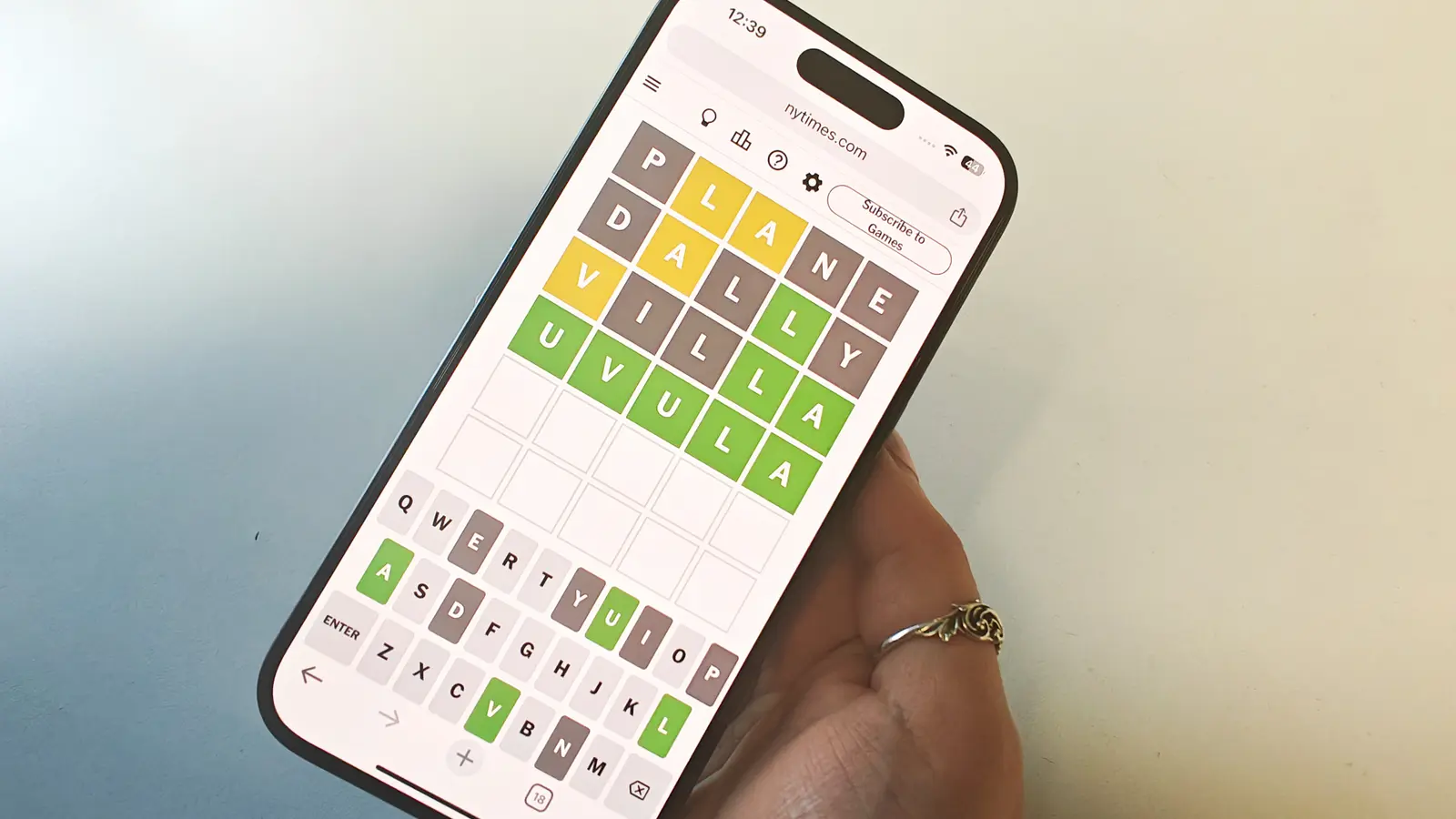
Picture this: six tries, five letters, and the world of English distilled into colored tiles. For most players, Wordle is a brief daily puzzle, a dash of ritual. For a group of engineering students and their professor at Binghamton University, it became a laboratory for testing a fundamental idea from information theory.
An information-first playbook
Wordle hands you uncertainty on a silver platter. You guess a five-letter word, and the game answers with green, yellow, or grey. Those colors are not just feedback; they are data. The Binghamton team rewired the usual intuition about guessing. Instead of chasing the most likely candidate word at each turn, they asked a different question: which guess will reduce the pool of possibilities the most?
That question points directly to Shannon entropy, the 20th-century metric Claude Shannon introduced to quantify uncertainty in information sources. In plain terms, entropy measures how much you stand to learn. A guess that produces many different possible feedback patterns across remaining candidate words carries high expected information. A guess that only ever produces the same pattern is nearly worthless.
The approach is practical as well as elegant. You feed the game’s color-coded response into a small program and the algorithm ranks available guesses by their expected information gain. Choose the top-ranked word, enter it into Wordle, update the feedback, and repeat. The method favors words that slice the candidate space broadly, not necessarily words that are individually likely to be the answer.

That shift in objective is subtle but powerful. As one student on the team explained, a guess does not need to be the best single answer; it just needs to be informative enough to steer you faster toward the solution. In computer trials, the entropy-focused strategy solved about 99% of puzzles tested, compared with roughly 90% for a heuristic that prioritizes common letters.
From classroom exercise to peer-reviewed paper
What began as an assignment in a systems-science course matured into a published study. The students applied classroom theory to a familiar, constrained task and found that a static statistical measure could guide dynamic decision-making. The project showcases a type of engineering education that expects students to move beyond equations and into applied problem solving.
There is an accessible appeal to the method. No insider knowledge of Wordle’s word-list is required beyond the normal player experience; what matters is computing how feedback would vary across candidates. That makes the technique reproducible, transparent, and a neat teaching example of how abstract math can shape everyday strategy.

The entropy-first strategy solved 99% of Wordle puzzles in simulations.
Of course, this is not a magic bullet for human players who lack instantaneous computation. To use the approach in live play you would either run a local script or consult a precomputed table. But the conceptual lesson reaches beyond Wordle: maximizing expected information is often a better long-term tactic than maximizing immediate success probability.
Implications, limits, and human play
Why does the entropy method outperform a letter-frequency heuristic? Because English letter frequencies and positional biases are blunt instruments when the candidate list has already been narrowed by prior guesses. At that stage, a guess that probes rarer patterns can produce decisive feedback, whereas chasing the most common letters may leave players stranded among many similar candidates.
The study’s performance figures come from simulations that model many possible secret words and response patterns. They show robustness: the entropy strategy excels across a wide range of puzzles, not just cherry-picked cases. Still, there are practical limits. Running entropy calculations requires more computational effort than instinctive guessing, and human players might prefer aesthetically pleasing or memorable starter words.
Beyond casual play, the work offers an instructive case study for people designing search algorithms, diagnostic tests, or experimental policies. Whenever you can choose probes and receive categorical feedback, asking which probe maximizes expected information is a principled way to accelerate discovery.
Expert Insight
'This is a textbook example of theory guiding practice,' says Dr. Elena Marquez, a cognitive scientist who studies decision strategies. 'People often default to the most probable option, but when uncertainty is structured, the most informative action can be counterintuitive. That has parallels in diagnostics, survey design, and even planetary exploration, where each measurement must be chosen to reduce uncertainty efficiently.'
Marquez adds that the appeal of the study lies in its clarity: measurable uncertainty, a finite candidate set, and straightforward feedback create an ideal sandbox for testing information-maximizing strategies.
The Binghamton team published their findings in the Northeast Journal of Complex Systems under the title 'Solving Wordle Using Information Theory.' Their paper documents algorithms, simulation results, and examples that both players and instructors can replicate. It is a tidy reminder that playful problems often make the best teaching moments for deeper concepts.

In the end, the story is not about beating a casual game. It is about recognizing when to seek information over immediate gratification. For a daily five-tile puzzle, that mindset turns uncertainty into an asset. And for students and educators, it turns classroom theory into something you can see work, one colored square at a time.

“The cosmos has always fascinated me. I write about space missions, astronomy, and the technologies pushing humanity beyond Earth.”

Discussion
Leave a Comment
Comments (2)
is this even true for casual play? seems great for scripts but for humans, computing entropy on the fly is unrealistic... unless there are precomputed tables? also curious about bias in the word list
wow didnt expect entropy to be such a flex in Wordle! students turned a class exercise into legit research, kinda inspiring. makes me wanna try a script... but also cool teaching moment