
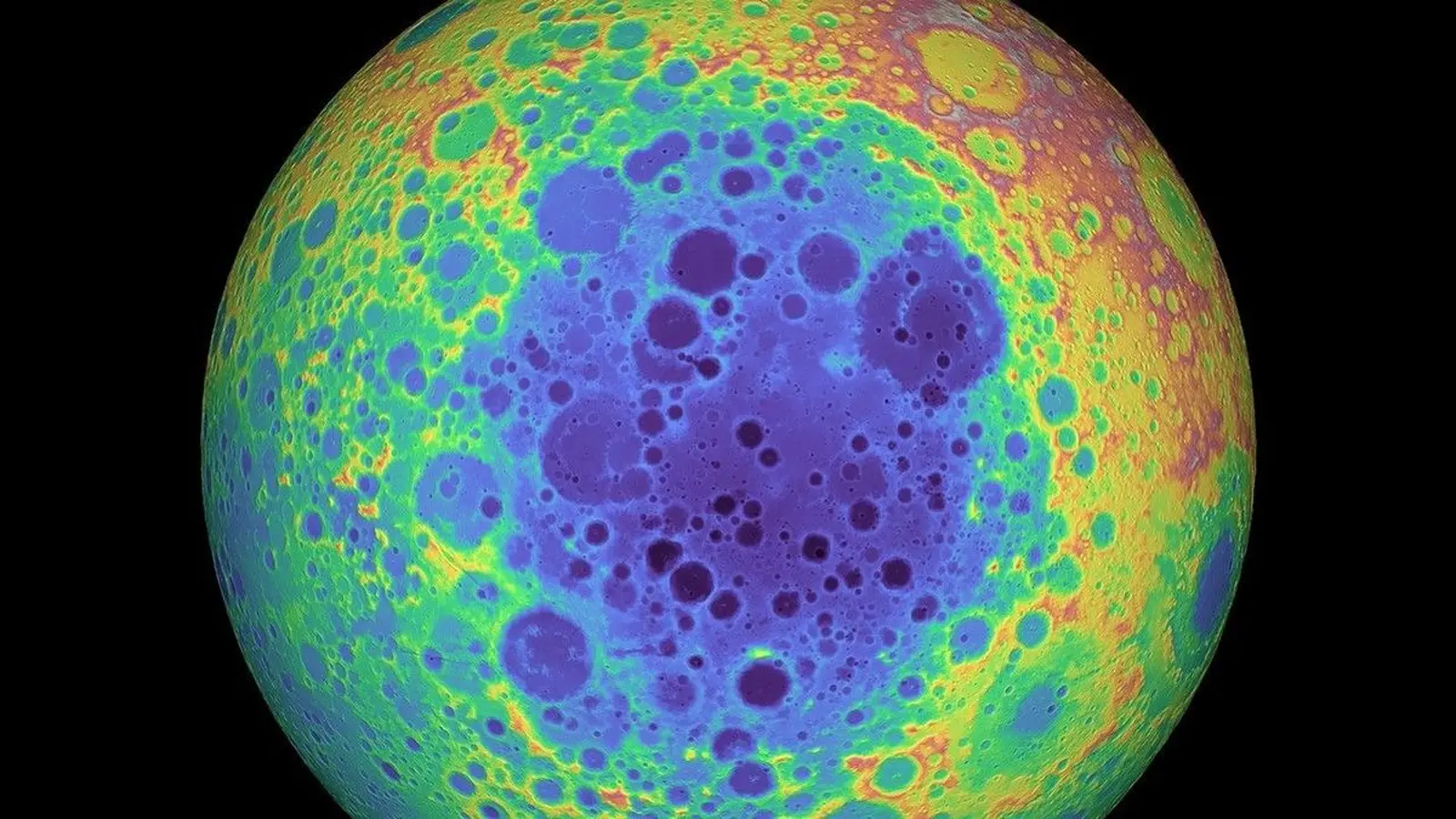
Scientists now think a single, colossal collision early in the Moon’s history may have hurled mantle rocks closer to the surface than anyone expected — and right where future Artemis crews might walk.

Scientists from the Center for Lunar Origin and Evolution, a virtual NASA organization led by Southwest Research Institute, studied materials excavated when a large impactor created the ancient South Pole-Aitken (SPA) basin (blue), a massive structure on the Moon’s far side. Two complementary studies determined that SPA’s surrounding area contains mantle-derived rocks (orange and black), offering information about the interior of the Moon and its earliest history. Proposed landing sites (white squares) for upcoming Artemis missions to the lunar south pole lie within the region, allowing astronauts access to study these materials.
When a moon-sized bullet changed everything
Picture a rocky body, perhaps the size of a small planet, striking the lunar surface at an oblique angle. It did not hit head-on. It skimmed down from the north toward the south, cutting an elongated path and carving what we now call the South Pole-Aitken basin — the largest and one of the oldest impact features on the Moon.
That’s the scenario produced by new high-resolution impact simulations led by researchers with the Center for Lunar Origin and Evolution. The simulations reproduce the basin’s long, tapered outline and reveal surprising detail about the impactor itself: it was likely differentiated, with an iron core and a rocky mantle, much like a miniature protoplanet.
Speed. Momentum. Heat. When that body struck, it excavated a cavity far deeper than typical lunar craters and melted rock near the impact site. Vast quantities of crustal and mantle material were blasted outward; some of it escaped into space, and much of it rained back down over the basin floor and surrounding terrain.
Gravity whispers what rocks can't shout
Models alone only tell part of the story. The second study turned to gravity measurements from NASA missions — notably GRAIL and LRO — to map density variations beneath and around SPA. By combining those gravity data with physical models of crust and mantle structure, researchers tracked where denser, mantle-derived rock is likely buried.
The result: pockets of mantle material not confined to the basin’s deepest interior but mixed through portions of the ejecta blanket and nearer to the lunar south pole than prior estimates implied. Later, smaller impacts inside SPA appear to have exhumed some of these deposits, bringing mantle fragments closer to the surface in places that line up with candidate Artemis landing sites.
Why does this matter? Mantle rocks record processes from the Moon’s formative years. They preserve information about early melting, differentiation, and the composition of the interior — clues essential to reconstructing how the Moon and, by extension, the inner Solar System evolved.
Artemis: a chance to sample the deep without drilling
Previous assessments suggested that the deepest mantle material ejected by the SPA collision would lie far from regions accessible to astronauts. The new synthesis of impact physics and gravity mapping changes that expectation. Some mantle-derived fragments may now be within reach at or near candidate south polar landing zones.
That could be transformative. Instead of relying solely on deep drilling or distant robotic missions, Artemis teams might collect rocks whose chemistry and mineralogy speak directly to the Moon’s interior. Such samples could tighten constraints on the timing of lunar differentiation, the nature of lunar volcanism, and the ingredients present during the Moon's earliest epochs.
- Access to mantle rocks would help test models of lunar formation and the Moon’s thermal history.
- Returned samples could refine isotopic chronologies that date major events in the early Solar System.
- Fieldwork by astronauts would allow context-driven sample selection — a scientific advantage over brief robotic grabs.
How the studies were done
The impact study used three-dimensional hydrodynamic modeling to recreate a low-angle collision from the lunar north to south. Variables included impactor size, internal structure, angle, and velocity. That allowed researchers to reproduce the basin’s asymmetric shape and predict the distribution of ejected material.
The companion gravity study employed high-resolution gravity anomalies combined with mechanical models of the crust and mantle. Regions with higher-than-expected mass were interpreted as likely containing denser, mantle-derived materials mixed into the ejecta. Together, the two approaches provide a cross-checked picture: one from cause (the impact) and one from effect (subsurface mass distribution).
Expert Insight
"We now have a practical roadmap for where to look," said Dr. William Bottke, director of the Center for Lunar Origin and Evolution. "The SPA basin is not only an archive of the Moon’s earliest violent episodes; it also points to sampling opportunities that could answer core questions about lunar origin and evolution."
Dr. Gabriel Gowman, lead on the gravity analysis, added that the models suggest traceable mantle signals in regions the Artemis program is already considering. "The data argue that some of the mantle-derived material is accessible at the surface or just beneath it, rather than buried kilometers away," he noted. These are paraphrased interpretations of the published findings framed here to highlight the practical implications for mission planning.
What comes next for lunar exploration
Confirming these findings will require targeted remote sensing, refined landing-site analysis, and ultimately on-site investigation. Orbital spectrometers and ground-penetrating instruments could narrow candidate zones where mantle fragments are concentrated. Robotic scouts could validate those sites before crewed missions arrive.
Field geology on the Moon will be different from Earth. No atmosphere. No weathering. But the principle is the same: context matters. An astronaut who can inspect an outcrop, pick complementary samples, and document geological relationships provides science that no solitary rock chip can.
Conclusion
The story of the South Pole-Aitken basin is evolving from a chapter about a single, violent impact into a practical map for exploration. New simulations and gravity mapping together suggest that material from the Moon’s mantle may be closer and more accessible than previously believed — potentially within reach of Artemis missions. If that proves true, upcoming expeditions could unlock direct, tangible evidence about how the Moon formed and how planetary bodies differentiate.

“My work centers on sustainability, energy, and environmental science — examining how innovation can lead to a greener future.”

Discussion
Leave a Comment
Comments (3)
Cool result, feels a bit hyped tho. Even if mantle bits are nearer, finding intact exposures for picking is still hard, sample context matters
sounds neat, but is this even real? simulations + gravity mapping can be misleading, need sample confirmation idk
Wow, if mantle rocks are really that close to the pole this is huge! Artemis might actually grab ancient deep samples 😮 can't wait