
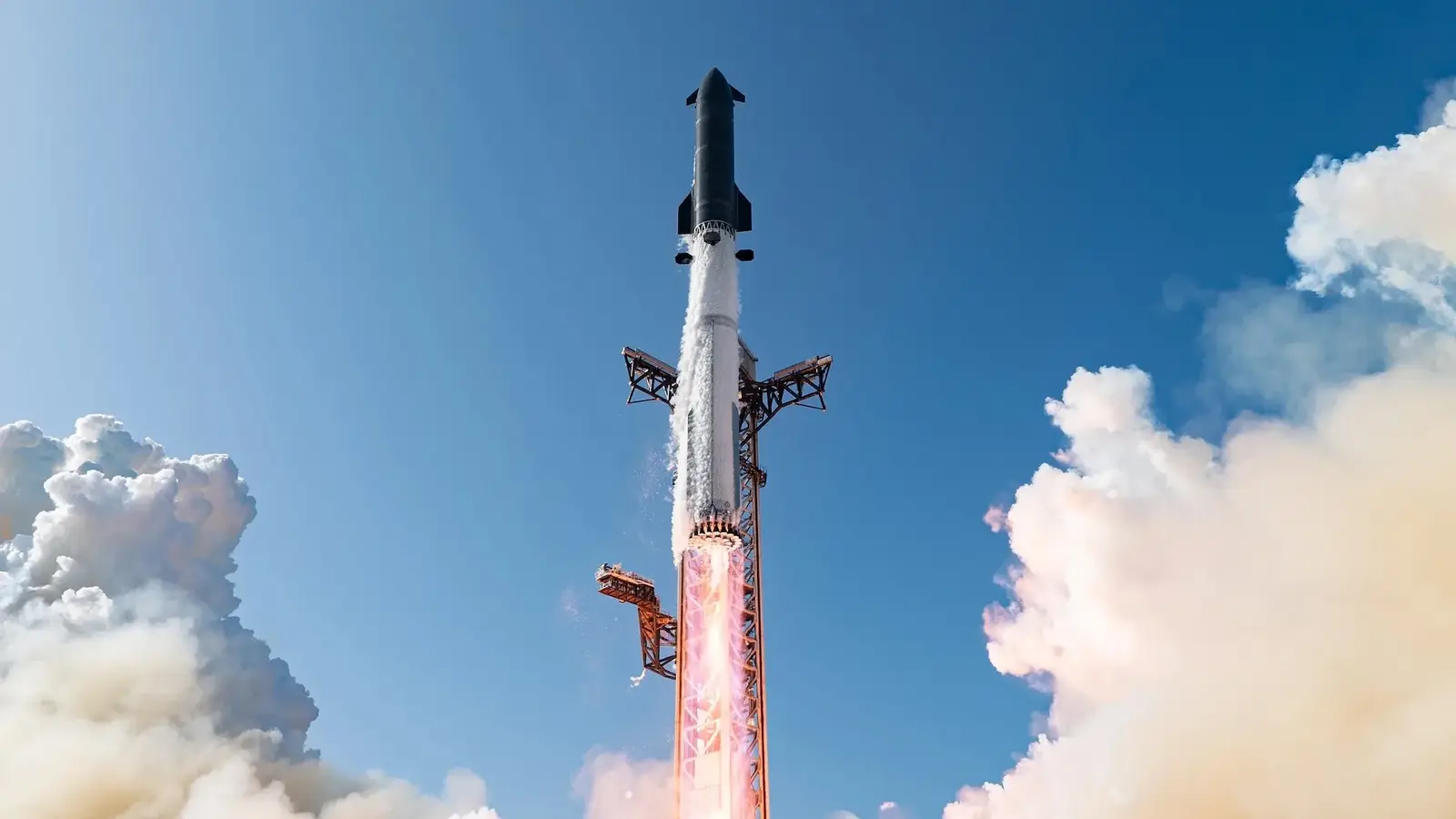
Picture a launch pad that no longer hosts the workhorse rockets of the 2010s. That day, according to SpaceX leadership, will come once Starship proves it can fly repeatedly and reliably several times in a single week. The idea is simple: concentrate scarce engineering and production resources on the vehicle that can raise launch cadence from occasional to daily, and beyond.
Why Starship changes the game
Falcon 9 rewrote parts of rocketry history. First flown in 2010, its recoverable first stage turned routine reuse from theory into practice and pushed SpaceX toward nearly 700 missions to date. Still, Falcon 9 and Falcon Heavy retain one expendable element: their upper stages are not recovered. Starship is different. Both the booster and the second stage are being developed as fully reusable vehicles, designed to return and fly again.
Size and payload matter. The current Starship V3 stands about 124.4 meters tall, dwarfing Falcon 9’s roughly 70-meter frame. Where Falcon 9 can loft around 25 tonnes to low Earth orbit and Falcon Heavy about 63 tonnes, Starship aims to carry in excess of 100 tonnes. That leap in capacity reshapes which missions make sense for which rockets, and frees SpaceX to consolidate a wide range of commercial and government launches onto a single, scalable platform.

Operational ripple effects and commercial implications
Elon Musk has said that once Starship demonstrates repeated, reliable flights within a week, it makes strategic sense to pull engineering and manufacturing focus away from Falcon vehicles and toward Starship to ultimately achieve multiple launches per day. Industry analysts expect commercial Falcon 9 missions to decline sharply as Starship becomes available, with some projections suggesting a shift as early as 2028 for many customers.
One immediate practical impact concerns Starlink. A large share of Falcon 9’s recent manifest has been devoted to building out the Starlink broadband constellation. Since 2023, Falcon 9 has carried hundreds of Starlink satellites into orbit. But newer, larger Starlink satellites are too big for Falcon 9 fairings and only fit inside Starship. Once Starship is operational at scale, SpaceX can accelerate upgrades to its constellation and deploy higher-capacity satellites faster.
There are secondary benefits too. A fully reusable system compresses launch costs per kilogram, unlocks new architecture for deep-space missions, and simplifies logistics when one vehicle type can cover many mission profiles. Yet the transition will not be instantaneous. Falcon rockets have a proven pedigree and an extensive customer base. Phasing them out will require demonstrated Starship reliability, regulatory approvals, and customer confidence.
Spaceflight rarely moves in straight lines. Technological ambition meets fiscal realities. But the calculus is clear: concentrate limited resources on the platform that promises higher cadence, greater payload, and full reusability. For SpaceX, that future hinges on Starship proving it can fly, recover, and fly again—often.

“The cosmos has always fascinated me. I write about space missions, astronomy, and the technologies pushing humanity beyond Earth.”

Discussion
Leave a Comment
Comments (2)
Is it realistic to retire Falcons by 2028? Seems risky to bet the whole manifest on Starship, what if testing drags or regs block flights, then what? curious
wow, Starship could really force Falcon 9 into retirement? wild. If they nail rapid reusability and weekly flights, the whole launch biz flips. But regs and safety could slow it…