
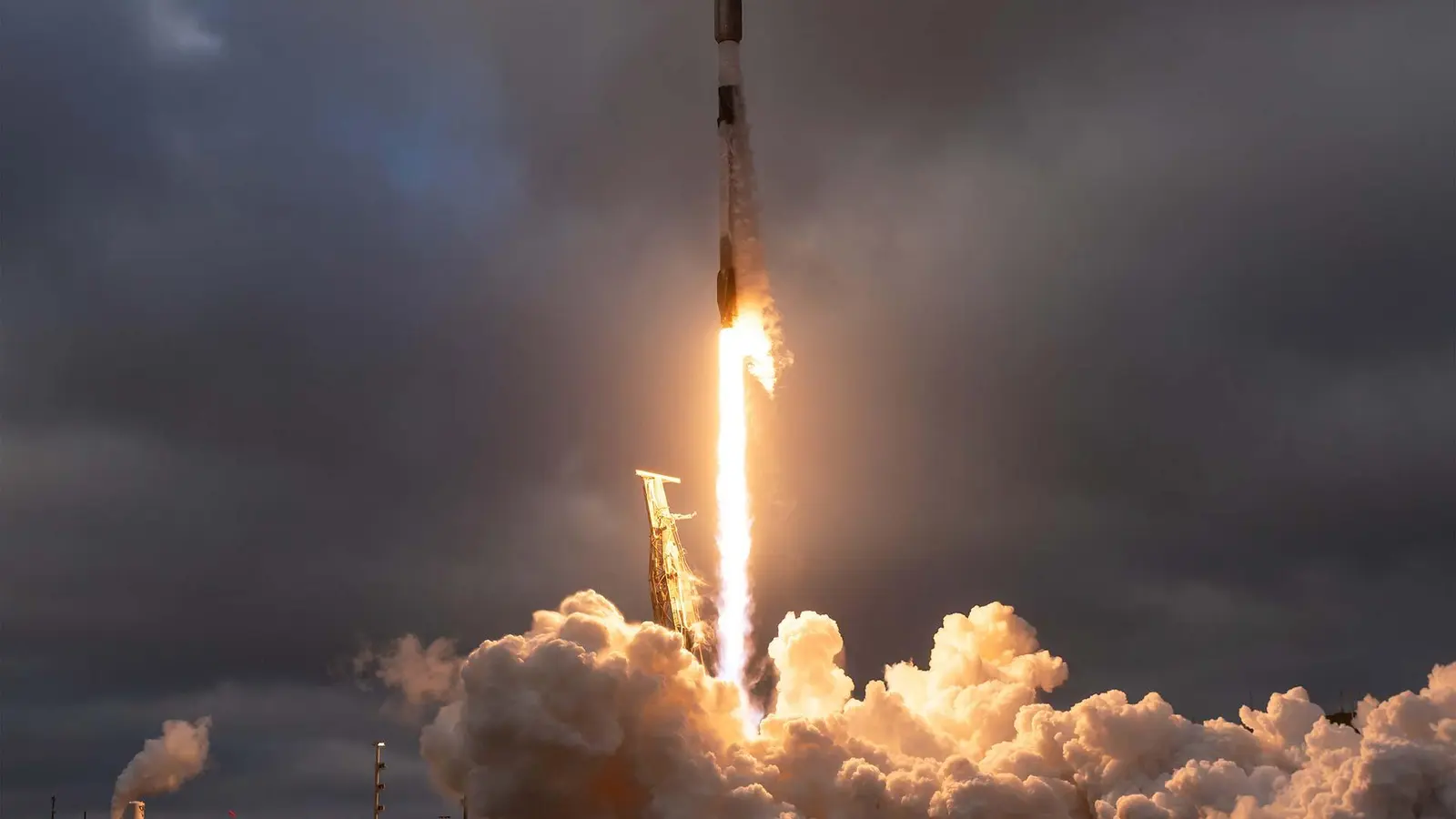
Two rockets. One company. Thirty eight minutes between liftoff. That short gap is now a new milestone for SpaceX, which on the night of 15 August demonstrated an operational tempo few providers can match.
Rapid launches, tight choreography
The first Falcon 9 lifted off from Cape Canaveral at 21:12 Eastern Time, carrying eight Globalstar communications satellites built at the company’s Louisiana facility. SpaceX reported on X that all eight spacecraft reached their intended low Earth orbits; deployment began roughly 56 minutes after launch and took about six minutes.
While that rocket climbed and the upper stage completed its maneuvers, a second Falcon 9 rose from Vandenberg Space Force Base at 21:50 Eastern Time to begin the classified USSF-366 mission for the U.S. Space Force. Details about USSF-366 remain scarce for security reasons, but analysts tracking launches have suggested the payloads may be based on SpaceX’s Starshield concept, which adapts Starlink hardware for national-security tasks.
Why does this matter? Because it highlights two capabilities that underpin modern space operations: fast turnaround and hardware reuse. Both boosters came back safely. The Cape booster landed at Cape Canaveral about eight minutes after launch on what was its 14th flight. The Vandenberg booster touched down on the autonomous droneship Of Course I Still Love You about 8.5 minutes after liftoff; that stage has now flown 18 missions.
SpaceX said the pair of launches improved its previous shortest interval between orbital flights by 27 minutes. That earlier benchmark dated to 31 August 2024, when two Starlink missions were flown in quick succession. The new record underlines how routinely SpaceX can execute high-frequency missions across its U.S. launch sites.

Context: Starlink, Starshield and mission secrecy
SpaceX’s business model blends commercial broadband deployment with bespoke government work. The company operates the largest satellite constellation to date: Starlink, which now numbers roughly 11,000 satellites and continues to grow. Around three quarters of Falcon 9 launches this year have supported Starlink launches, a pattern that accounts for much of the company’s cadence and manifest planning.
Starshield is the company’s adaptation of Starlink hardware and software for defense or intelligence missions. It uses modified bus designs and software suites tailored to secure data links, threat detection, or protected communications. For classified flights like USSF-366, public information is limited; analysts infer possible configurations by tracking booster recovery zones and published launch windows.
Operational implications are straightforward. Short intervals between launches reduce the time between satellite deployments, speed constellation growth, and increase responsiveness to government tasking. At the same time, rapid scheduling demands tight integration across processing, range safety, payload integration, and recovery teams.
SpaceX’s success here is not magic. It is the product of iterative refinement: standardized Falcon 9 hardware, routine reusable booster retrieval, and streamlined ground operations. Those elements together permit a frequency of missions that few competitors can match.
Even so, secrecy around national-security payloads reminds us that launch cadence is only one piece of the puzzle. Mission design, orbital insertion accuracy, and satellite commissioning all matter. A fast launch tempo is most valuable when paired with reliable on-orbit performance.
These two missions also nudged SpaceX’s Falcon 9 launch total for 2026 to 96 flights, a striking figure that demonstrates how dominant a single vehicle can be when optimized for reuse and mass-produced satellite deployment.

“My work centers on sustainability, energy, and environmental science — examining how innovation can lead to a greener future.”

Discussion
Leave a Comment
Comments (2)
Is this even sustainable tho? 96 flights already in 2026 sounds impressive but what about space junk, orbital collisions, and long term ops… curious
wow that was insane, 38 minutes? Space ops moving at warp speed. Love the reuse tech, but kinda surreal seeing an 18th flight booster land. Wild