
The moment an archaeologist lifts a sliver of mammoth ivory from its matrix, the past becomes intimate. These are not towering monuments. They fit on a thumbnail. Yet they carry a lifetime of careful observation, practiced hands, and choices about what mattered to people arriving in the Upper Danube more than 40,000 years ago.
A tiny find that reopens big questions
In 2025, excavators from the University of Tübingen recovered two miniature bird carvings from the Aurignacian deposits of Hohle Fels Cave in the Swabian Jura of southwestern Germany. The cave complex is part of the UNESCO World Heritage ensemble known for some of the oldest figurative art anywhere on Earth. The two new pieces are carved from mammoth ivory, each measuring about 2 by 1 by 0.5 centimeters. That places them well below the typical 3 to 9 centimeter range for contemporaneous figurines, making them the smallest known examples of Ice Age bird art.

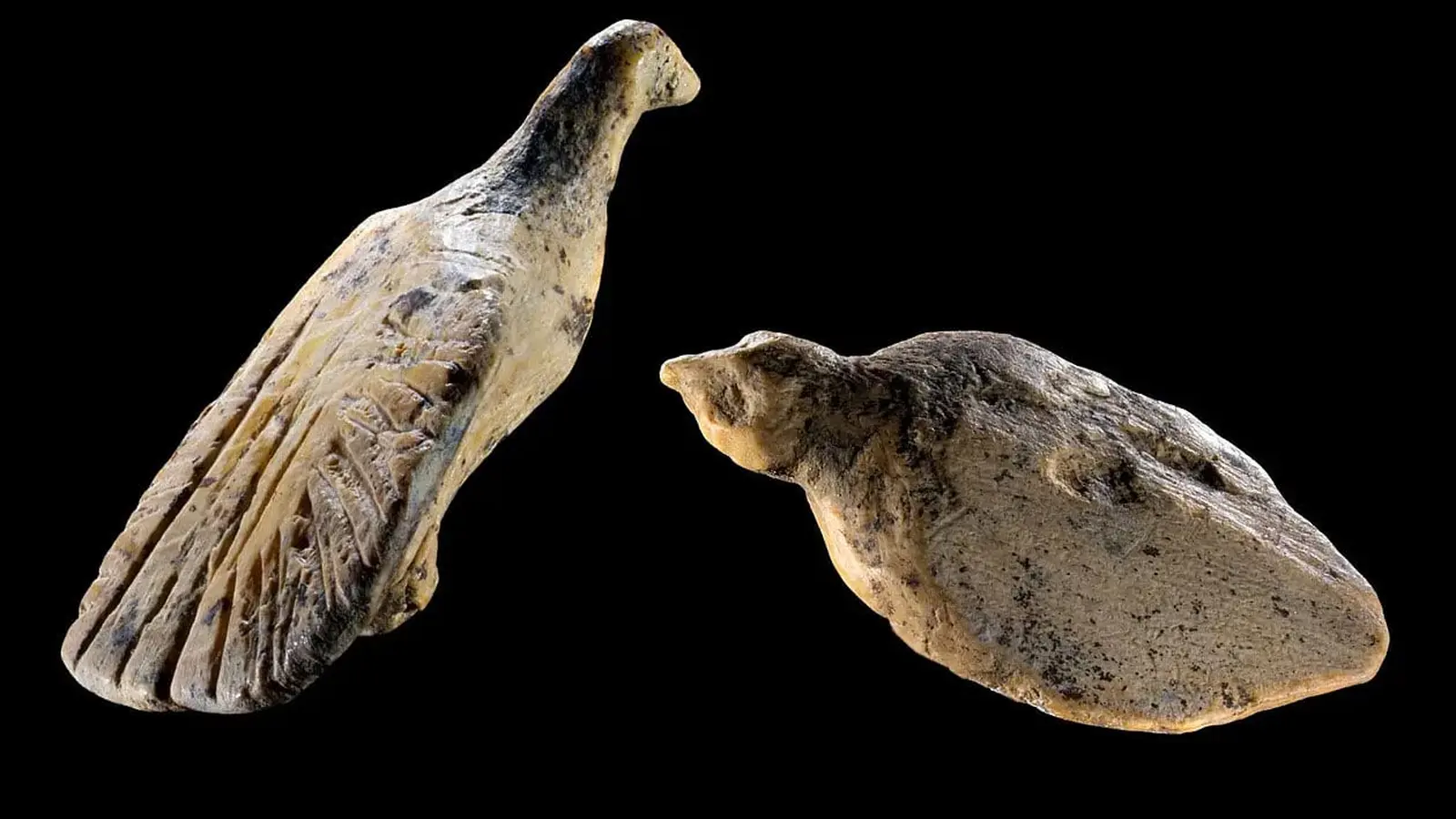
Depiction of a lying bird from the Ice Age site of Hohle Fels, approximately 40,000 years old.
One figure appears to be resting, eyes prominent, posture compact, perhaps brooding. The other is incomplete yet dynamic, wings extended, beak defined, incised marks suggesting feathers. The two were found approximately 1.5 meters apart in the same stratigraphic layer. Their proximity and similar technique open the possibility that a single carver made both, or that a closely connected group shared a style and purpose.
What these carvings reveal about Aurignacian artists
University of Tübingen archaeologists emphasize skill and intent. "The figurines demonstrate that the earliest artists were skilled ivory-carvers, who could depict delicate motifs in miniature form," says Professor Nicholas Conard, director of excavations. "Additionally, it seems that specific depictions are associated with specific sites."
The detail is striking for such tiny objects. The resting bird carries prominent eyes carved with care. The winged example bears a distinct beak and a series of fine incisions that read as feathering under magnification. Where many Swabian Jura animal carvings feel static and monumental, these two capture behavior: a bird lying low, perhaps brooding over eggs, and a bird in motion, landing, taking off, or engaging in a display.

Excavations at the UNESCO World Heritage Site Hohle Fels in 2025.
Even so, species identification remains tentative. The resting figure resembles a ptarmigan, a bird that appears in the faunal record at Hohle Fels. The winged carving might also be a ptarmigan, but grouse or even a bird of prey cannot be ruled out. As with much Paleolithic art, the maker chose recognizable traits but left room for multiple readings.

The objects are feather-light in weight. "The figurines in their present state weigh only 1.3 and 0.7 grams and are the smallest and finest depictions from this period 40,00-years-ago," notes Conard, who is scientific director of the Museum of Prehistory and Ice Age Art, known by the acronym urmu. Despite their size, they provoke large questions about function and meaning.
Why bird imagery may matter at Hohle Fels
Bird carving in Hohle Fels is not an isolated curiosity. The cave now yields three carefully executed bird figurines, a concentration not matched at other sites across the Swabian Jura. Elsewhere in the region, mammoths and large predators dominate the figurative record, followed by bears, horses, fish, and bison. The repeated appearance of birds at Hohle Fels suggests a local signature, a cultural emphasis on avian forms tied to place, memory, or ritual.
The purpose of the tiny sculptures remains speculative. They might have been personal talismans, worn or carried by individuals. They could have served as identity markers or teaching tools, objects used to name species and behaviors for younger members of a band. Some Paleolithic communities transformed hollow bird bones and mammoth ivory into flutes; birds and sound were embedded in everyday life. Stefanie Kölbl, managing director of urmu, notes the continuity between landscape and practice. "Our region and landscape have always been the home of a vast range of birds, and nearby Lake Schmiechen is today a bird sanctuary," she says. "Even 40,000 years ago, birds were here. Their song filled the air, and some species came to the region in the course of annual migrations. Their calls signaled warnings, and the residents of the region often used their hollow bones and even mammoth ivory to make flutes that produced magical sounds."
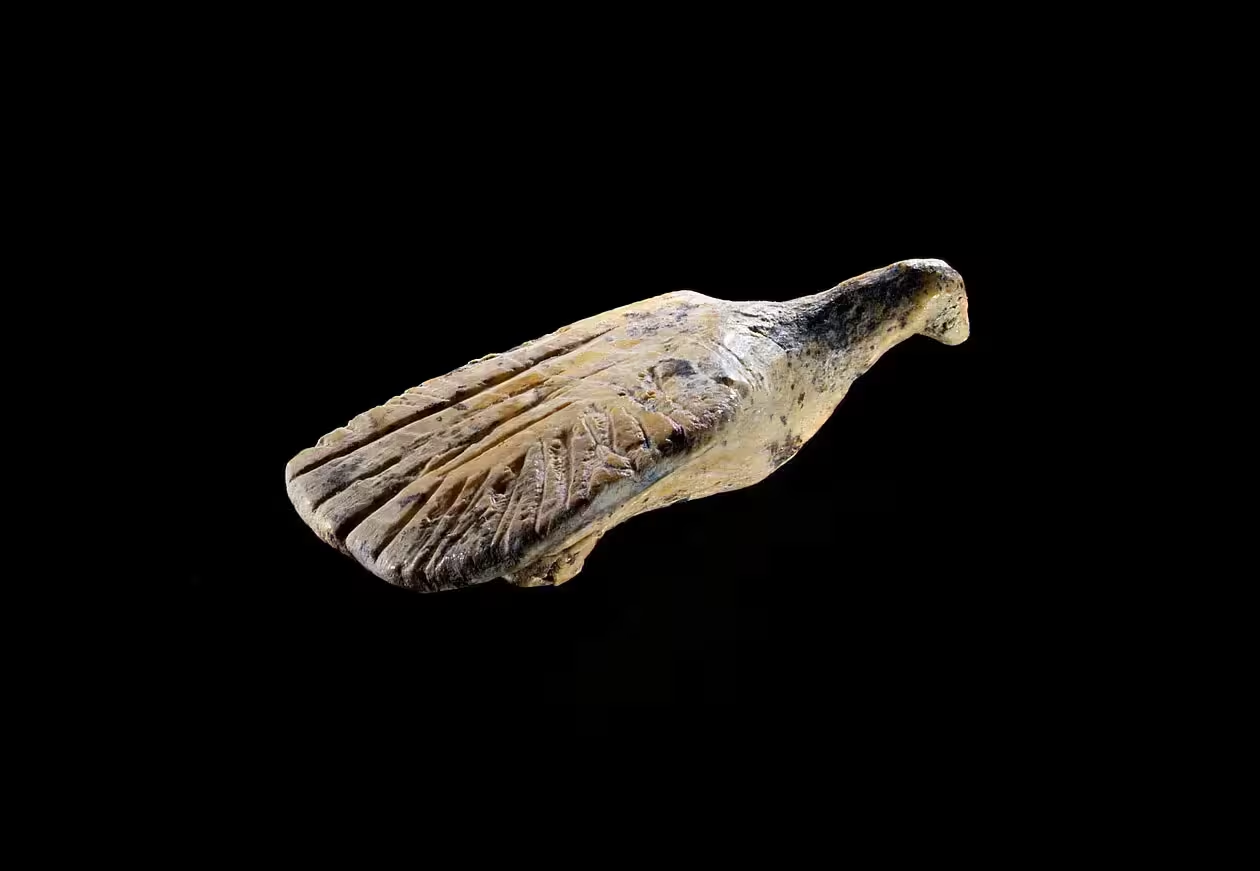
Depiction of a bird with outstretched wings from the site Hohle Fels Cave, approximately 40,000 years old.
Beyond immediate interpretation, the find has methodological implications. The tiny scale demands high-resolution microscopy, residue analysis, and careful conservation. Traces of tool marks reveal the sequence of incisions, while micro-wear studies can indicate whether the pieces were hung, handled, or placed in special contexts. That technical picture helps archaeologists reconstruct how Aurignacian people thought about small-scale representation and the value of portable art.
Expert Insight
Dr. Elena Mars, a Paleolithic specialist who studies portable art, comments: "Miniaturization requires choices. An artist must decide which features to keep and which to omit. That selection tells us what mattered visually and symbolically. These birds are not tests of skill alone. They encode ecological observation and perhaps social information about seasonality, hunting, or belief."
The carvings will be on public display at the Museum of Prehistory and Ice Age Art in Blaubeuren as part of a temporary exhibition titled Feather Light, Research Heavy: Discover the Miniature Birds in Ice Age Art. The show runs through April 4, 2027, where visitors can view these delicate objects alongside other Paleolithic artifacts, including the famous Venus of Hohle Fels.
Conclusion
Small objects can shift large narratives. These thumbnail birds extend our view of Aurignacian creativity, showing that Ice Age artists worked in multiple scales and with deliberate choices about subject and technique. Hohle Fels continues to yield surprises. Each new find recalibrates how we imagine the lives of the people who lived in the Swabian Jura at the dawn of figurative art.


“The cosmos has always fascinated me. I write about space missions, astronomy, and the technologies pushing humanity beyond Earth.”

Discussion
Leave a Comment
Comments (3)
Interesting find, but calling them 'recalibrating narratives' feels a bit dramatic. Still, tiny art and the microscopy details are the star.
Wait are they sure about species id? Looks like a stretch, or am I missing something here?
Wow didnt expect such tiny mammoth-bird carvings, chills. So intimate, makes me feel weirdly close to them...