
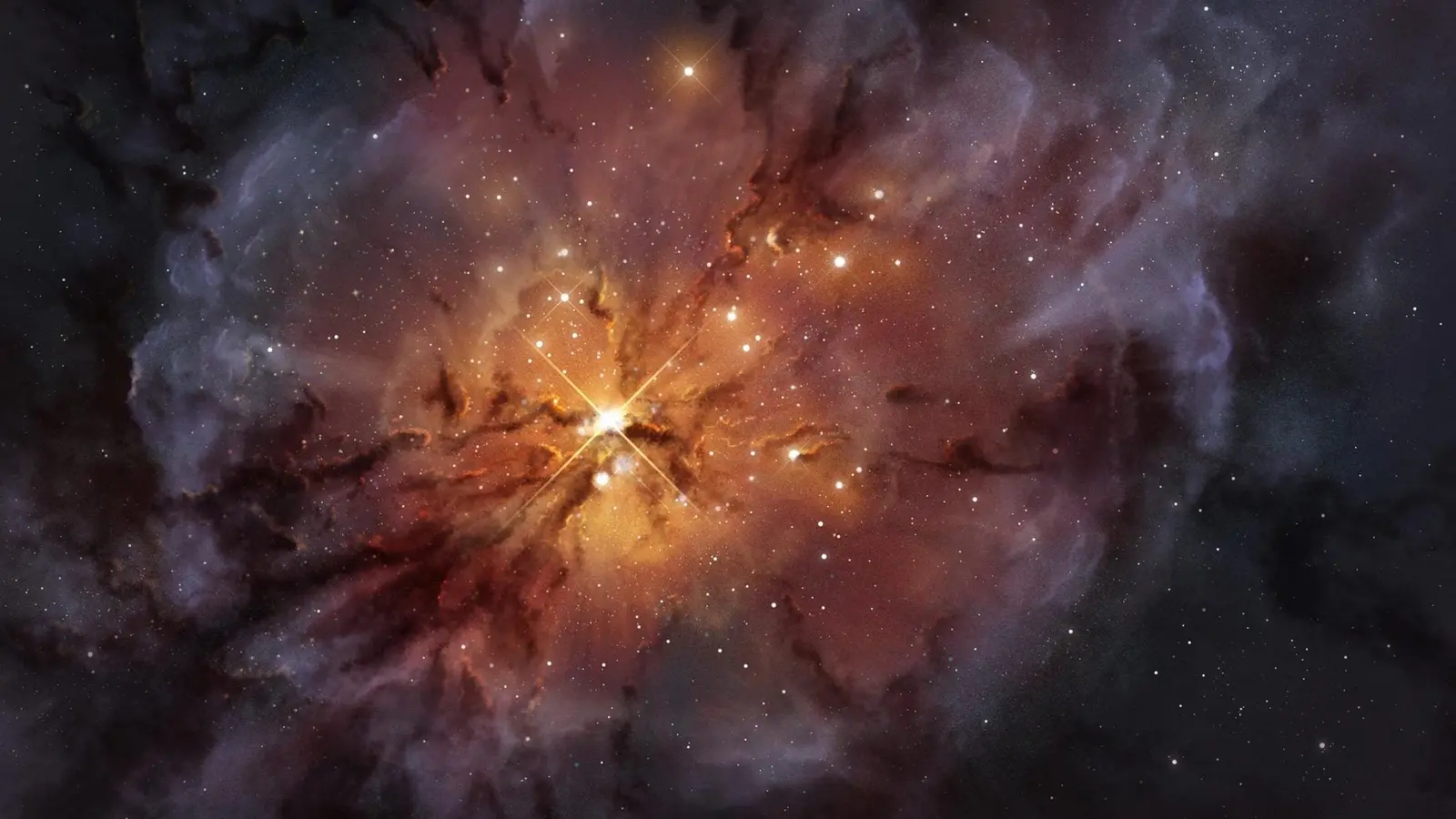
Imagine peering back across 13 billion years and finding whole galaxies that seem to glow with an almost impossible brightness. That is what the James Webb Space Telescope has shown us: an abundance of luminous galaxies in the cosmic dawn, far earlier and brighter than models predicted. But what if those objects are not intrinsically brighter? What if the light is simply finding clearer corridors to reach us?
Clearing the cosmic fog
New work by teams at the Simons Foundation’s Flatiron Institute and the University of Texas at Dallas offers a different explanation. Instead of requiring dramatically higher star-formation rates, the study suggests that intense ultraviolet light emitted by young, massive stars can punch holes through the surrounding gas and dust. The result: more starlight escapes into intergalactic space and eventually into our telescopes.
The key actor is Lyman-alpha radiation, a specific ultraviolet photon produced when hydrogen atoms transition between energy states. In stellar nurseries of the early universe, this radiation is abundant. When Lyman-alpha photons strike gas or dust, they transfer momentum. That sounds modest. But hydrogen behaves unusually. Absorbed Lyman-alpha light is almost immediately re-emitted at the same wavelength, and then it can be absorbed and re-emitted again by neighboring atoms. The photons scatter. Their repeated interactions multiply their push on the surrounding medium, creating a light-driven pressure that can accelerate low-density material outward.
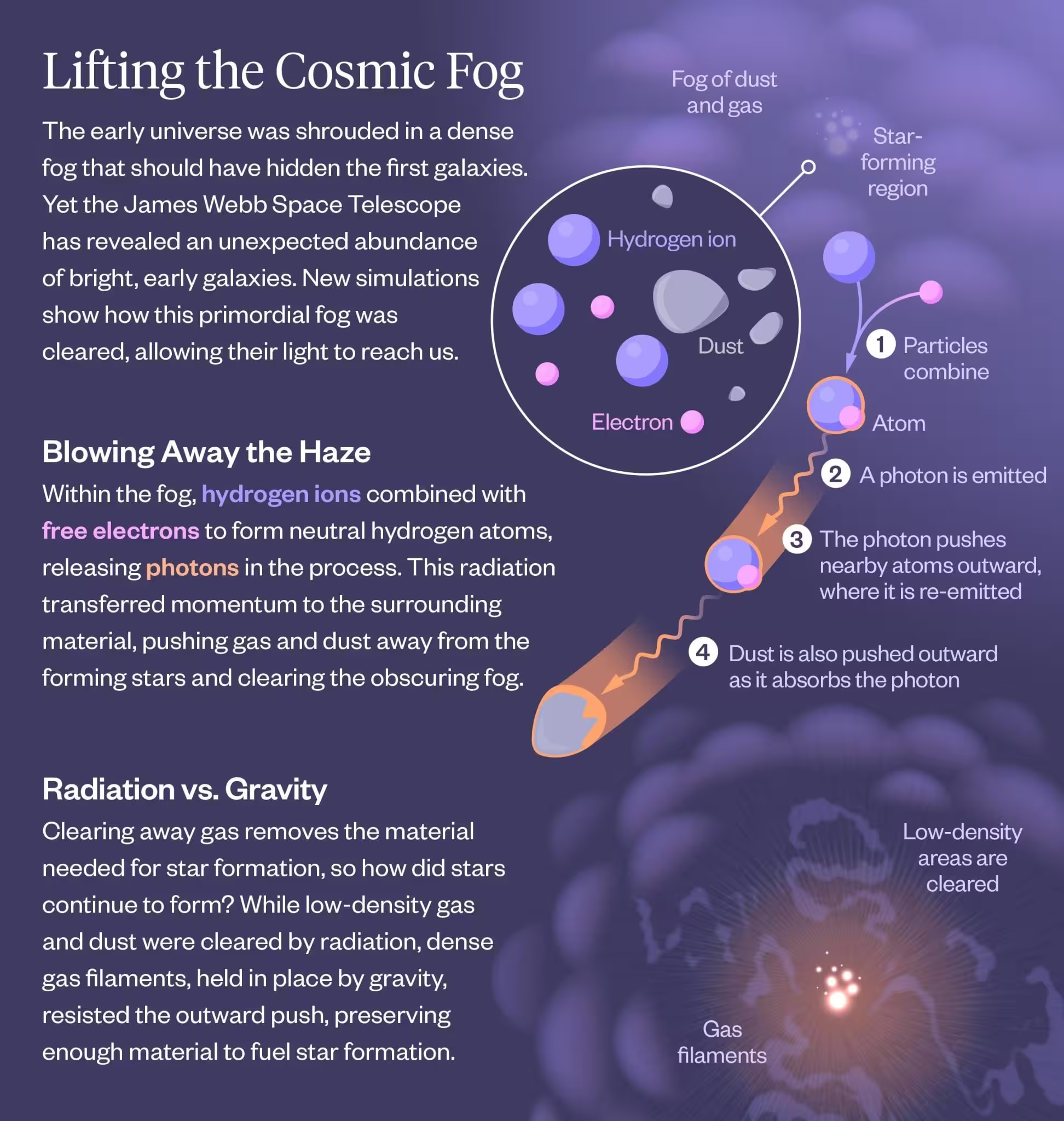
An infographic explaining how radiation propelled light-blocking gas and gust. Credit: Lucy Reading-Ikkanda/Simons Foundation
Think of it like sunlight trying to clear fog. A single beam does little. Now multiply that beam by thousands of tiny reflections and you can nudge the fog aside. In dense clumps where stars are actively forming, gravity wins. The gas stays bound, continuing to feed star formation. In the more tenuous zones between those clumps, however, the radiation pressure can dominate. Gas and dust are expelled, sometimes at high velocity, carving low-opacity channels through which ultraviolet and visible photons can travel.
Modeling the push of light
Directly simulating this interaction is hard. The scattering of Lyman-alpha photons involves countless absorption and re-emission events, and resolving that physics in three-dimensional galaxy-scale simulations demands huge computational resources. To make progress, Shyam Menon at the Flatiron Institute and Aaron Smith at UT Dallas took a pragmatic route. They analyzed snapshots from a detailed simulation of a primordial star-forming region and computed how much momentum Lyman-alpha radiation would impart to the surrounding gas under realistic conditions.
Their calculations show a striking dichotomy. Dense knots of gas, where gravity is strongest, remain largely unaffected. Radiation is trapped but cannot dislodge the material feeding the stars. Elsewhere, where densities drop, Lyman-alpha pressure can launch explosive outflows. Material is accelerated and ejected, thinning the medium that would otherwise absorb or scatter starlight. That thinning increases the effective transparency of these early galaxies.
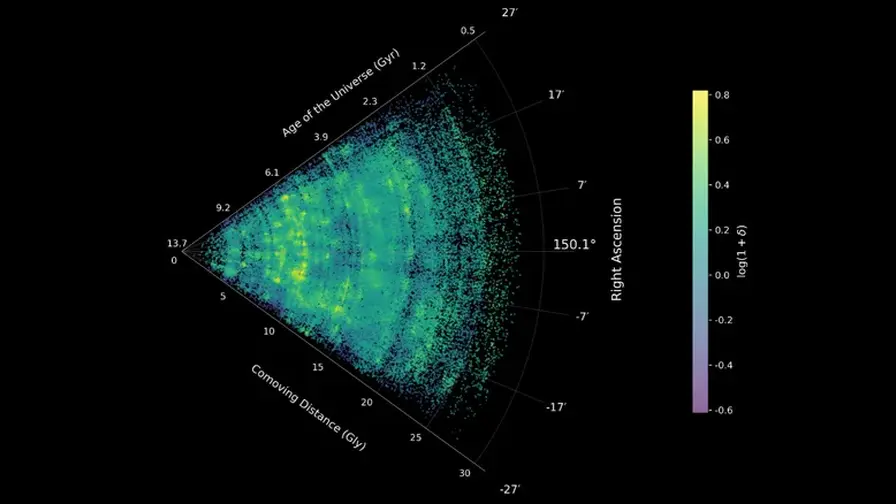
The implication is simple but powerful. The galaxies Webb finds bright may not be radiating an order of magnitude more light; they may simply be better at letting light out. When telescopes measure luminosity, they record photons that escape the galaxy. Clear corridors amplify apparent brightness without changing the intrinsic power of the stars.
What this means for cosmic history
This idea touches several ongoing debates. One is the timeline of reionization, the epoch when the first luminous sources ionized the neutral hydrogen filling the universe. If Lyman-alpha clearing is common, early galaxies could contribute ionizing photons more efficiently than previously estimated, by creating channels for ultraviolet radiation to leak out. That would affect models of how quickly and patchily reionization proceeded.
Another consequence concerns the demographics of early galaxies. Photometric surveys that detect high-redshift objects tend to select the brightest sources. If brightness can be strongly influenced by geometry and clearing, catalogs may over-represent systems with favorable sightlines. Our census of early galaxy formation might be biased toward those that have recently expelled low-density gas and dust.
There are caveats. Dust properties in the first few hundred million years are uncertain. Moving gas changes the radiation transfer in complex ways. And full three-dimensional radiation-hydrodynamic simulations, which would capture the interplay among stars, gas, dust, gravity, and Lyman-alpha scattering in one coherent framework, remain computationally demanding. Recent progress has produced reliable two-dimensional models, but researchers want to scale those methods to 3D.
Expert Insight
"This work changes how we should read the light from the earliest galaxies," says Dr. Leah Ortega, an observational cosmologist at the University of Arizona who was not involved in the study. "It is a reminder that what we detect is shaped by both source physics and the medium around it. When radiation carves channels, it hands us a biased view, and that bias must be folded into interpretations of Webb data."
"If Lyman-alpha pressure is as effective as these calculations suggest, then some apparent anomalies in early-bright galaxy counts may resolve without resorting to exotic star formation physics," adds Dr. Ortega. "Still, verifying this will require more advanced simulations and new observational tests, for example targeted spectroscopy that traces gas kinematics and scattering signatures."
Conclusion
The James Webb Space Telescope has opened a window onto an unexpectedly luminous early universe. The new analysis from Flatiron and UT Dallas proposes that powerful Lyman-alpha radiation can clear low-density gas and dust, creating clearer escape routes for starlight and boosting apparent brightness. That process provides a plausible, physically grounded explanation for Webb’s surprising haul of bright, distant galaxies, while raising fresh questions about how we model reionization and interpret early-universe surveys. Better simulations and observational campaigns that probe gas motion and scattering will be crucial next steps.

“The cosmos has always fascinated me. I write about space missions, astronomy, and the technologies pushing humanity beyond Earth.”

Discussion
Leave a Comment
Comments
No comments yet. Be the first.