
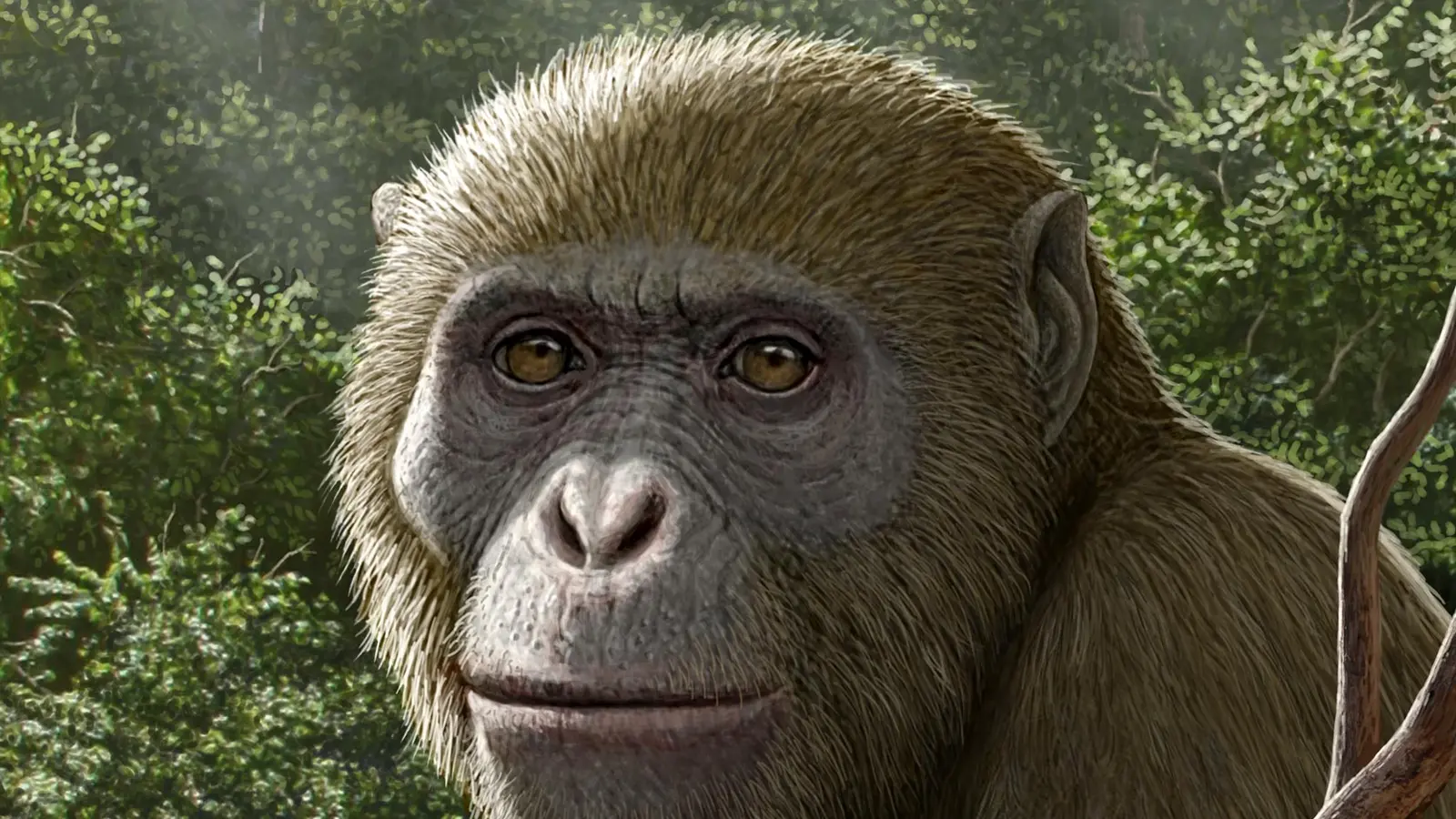
A single lower jaw, discovered in the windswept sediments of northern Egypt, has sharpened a question scientists have been asking for decades: where did the family tree of modern apes really begin? The jaw belonged to an ape species that lived about 17 to 18 million years ago, and its anatomy is forcing paleontologists to rethink the geographic stage on which ape evolution played out.
Field teams from the Mansoura University Vertebrate Paleontology Center and collaborators at the University of Southern California excavated the fossil at Wadi Moghra. For years, North Africa was a blank spot on the map of early ape evolution: East Africa, Asia and Europe had yielded fossils that helped sketch out hominoid history, but the north remained conspicuously empty. That absence shaped assumptions. Scientists tended to place the earliest diversification of apes farther south. Now, the record has a new and provocative entry: Masripithecus moghraensis.
Masripithecus is known so far from a remarkably informative fragment: a lower jaw that preserves a set of teeth and a jawline unlike other Early Miocene apes. The discovery was made during field seasons in 2023 and 2024, and the name itself combines Masr, the Arabic word for Egypt, with the Greek píthēkos, meaning ape; the species epithet celebrates the Wadi Moghra locality where it was found.

Masripithecus moghraensis mandibular fragment with right M3 at the moment of discovery.
What the teeth tell us about life and diet
Teeth are fossils that keep behaving like clues. This jaw carries enlarged canines and premolars, plus molars that are rounded and heavily pitted across their chewing surfaces. The jaw itself is robust. Those features combine into a clear message: Masripithecus was a dietary generalist with a strong leaning toward fruit, but it could also break down harder items such as seeds or nuts when seasons demanded it.
That kind of dietary flexibility is more than trivia. During the Early Miocene, climate systems were shifting. Northern Africa and the Arabian margin were moving toward more seasonal patterns. A primate able to switch between preferred foods and fallback items would have an ecological advantage when fruit was scarce. In short: dental anatomy ties directly to survival strategies in a changing landscape.
A different place for the common ancestor
Beyond diet, the fossil reshapes a bigger argument about hominoid origins. The research team used a combination of approaches: comparative anatomy across fossil and living apes, DNA from extant species, and advanced Bayesian dating methods that integrate fossil ages to estimate branching times. Those methods placed Masripithecus closer to living apes than any comparably aged East African fossil. That is a striking result.
How does this change the map? If Masripithecus sits near the branch that leads to living apes, then northern Africa and the adjoining Middle East emerge as plausible candidates for where the common ancestor of today’s apes lived. Geological reconstructions support this idea. During the Early Miocene, the African and Arabian plates were continuing to move north, and episodic sea-level changes periodically exposed corridors between continents. Those windows would have allowed animals to disperse into Europe and Asia as land connections appeared.
This interpretation does not demand that Masripithecus is the single ancestor of all modern apes. Rather, its presence makes a northern biogeographic scenario far more credible. The hominoid fossil record is patchy; new discoveries can tilt our inferences. Finding an ape like Masripithecus in North Africa fills a conspicuous gap and produces a clearer, more continuous picture between African and Eurasian fossil assemblages.
Expert Insight
"Discoveries like this change the questions we ask," says Dr. Maya Fontaine, a paleoanthropologist not involved with the excavation. "We used to treat North Africa as peripheral in early ape evolution. Now it looks like a crossroads. That has implications for how we model dispersal events, ecological adaptation, and the timing of divergences among hominoids."
Expert voices from the study team reflect that shift in perspective. Hesham Sallam of Mansoura University described years of searching for fossils that could fill the northern blank in the ape record, and his team’s persistence paid off. Shorouq Al-Ashqar, a first author, interpreted the chewing anatomy as evidence for dietary flexibility tied to changing climate. Erik Seiffert, a co-author, said the results have altered his view of ape origins, moving him away from a solely East African-centered scenario.

Sallam Lab team from Mansoura University Vertebrate Paleontology Center.
Why this matters for the wider story of apes
The implications ripple outward. If apes were diversifying in northern Africa and the Middle East, then the routes and timings of subsequent dispersals into Europe and Asia need revisiting. The sequence of branching events in hominoid phylogeny — the evolutionary tree — depends on both anatomical comparisons and where those fossils come from. Filling geographic gaps reduces the risk of distorted hypotheses driven by an incomplete record.
Methodologically, the study highlights the value of integrative analyses. Morphology, molecular clocks, and stratigraphic ages each carry uncertainty. Jointly analyzing them under powerful statistical frameworks gives results that are more robust to the quirks of any single line of evidence. That approach will be essential as more fossils come to light in underexplored places.
Conclusion
Masripithecus moghraensis will not close the book on ape origins. But it opens new chapters. A single jaw from Wadi Moghra turns a long-standing assumption on its head and invites renewed fieldwork in North Africa and adjacent regions. The fossil record is not a finished puzzle. Often it is a map that improves as explorers keep looking.
The discovery reminds us of a simple truth: evolution left traces in many places, and sometimes a small fragment can change the story in a big way.

“The cosmos has always fascinated me. I write about space missions, astronomy, and the technologies pushing humanity beyond Earth.”

Discussion
Leave a Comment
Comments (3)
Feels kinda overhyped, but neat find. quick comment: more sites and better context before we redraw ape history, or we're jumping too fast
interesting claim. is the phylogeny robust? Could a single jaw really shift the whole map or is it sampling bias? needs more fossils imo
wow didnt expect Egypt to pop up like that... Masripithecus might flip the maps, if that's true then dispersal routes need serious rethinking, wild find!