
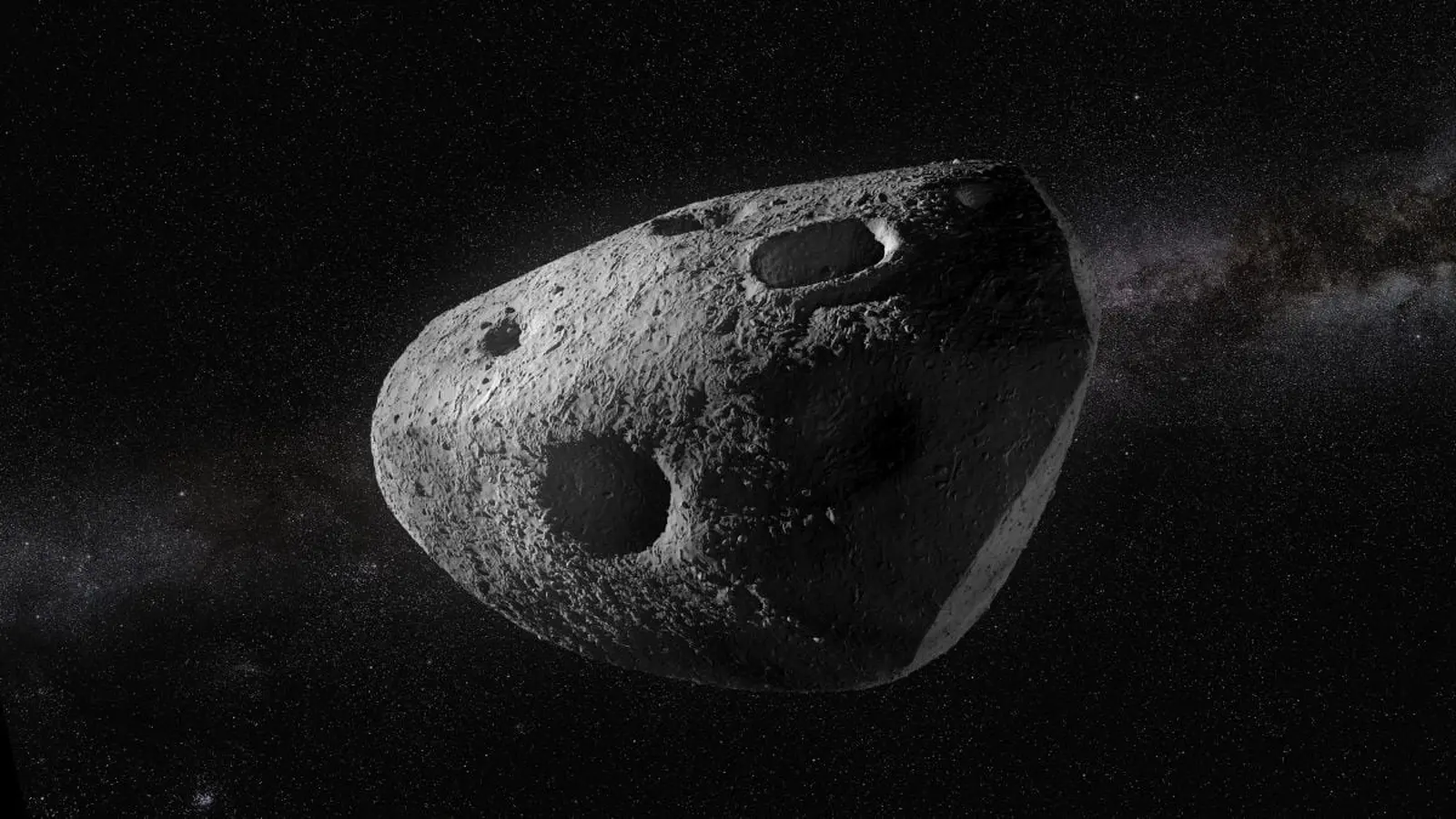
Picture a 370-metre rock sweeping past Earth at tens of thousands of kilometres. Close enough, in astronomical terms, to make the planet’s gravity tease and prod its surface. Close enough that tidal forces will tug on its spin and possibly stir the regolith. Close enough that we plan to watch with the best instruments we have.
Scientists do not expect an impact. Decades of observations have narrowed Apophis’ path to a very precise corridor through near-Earth space. Yet precision on paper can collide with messiness in reality. The mess in this case is human-made: fragments of metal, paint flakes, dead satellites and other debris floating in high Earth orbit.
When Earth tugs on a rolling rock
On its 2029 close approach Apophis will skim past our planet at under 32,000 kilometres. That places it well inside the region where Earth's gravity can meaningfully alter an asteroid's rotation and surface. That’s the science opportunity. Gravity could trigger landslides, provoke seismic events on the asteroid and expose materials buried beneath the weathered exterior. Two missions are already lined up to study those effects.
NASA’s OSIRIS-APEX and ESA’s RAMSES aim to observe the flyby. They will look for changes in shape, spin rate and any ejecta that betray internal structure. If everything goes as planned, these spacecraft will deliver a textbook case of how a planet’s gravity reshapes a small body.
But what if something else nudges Apophis before those observations begin? Even a minor collision with space debris would not send the asteroid into a new orbit around Earth. It would, however, complicate the science. A crater, a puff of ejecta, or a sudden change in spin could blur the signal from Earth’s tidal influence. Which change came from us? Which from a stray bolt or fragment? Untangling those would not be trivial.
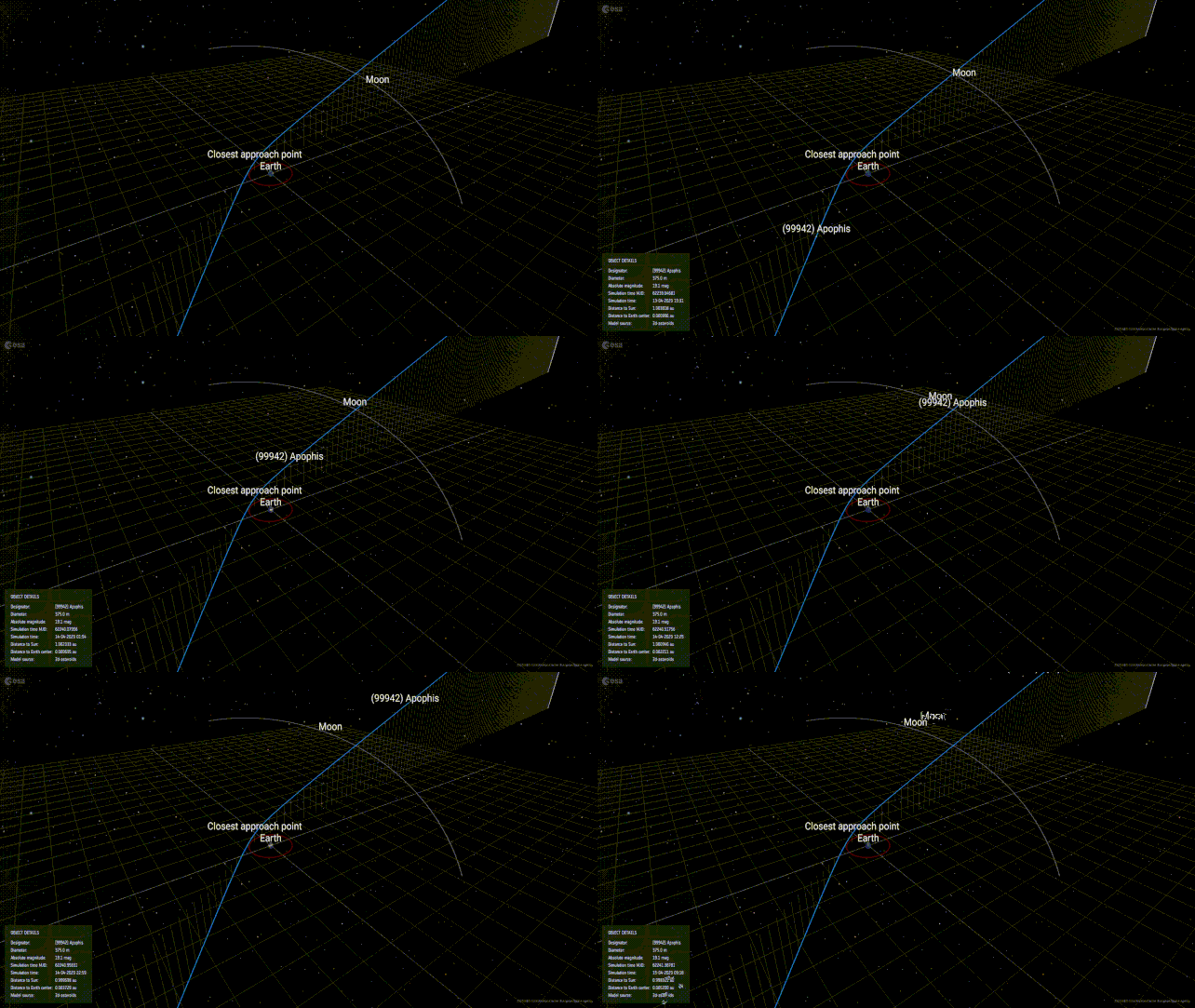
The projected trajectory of Apophis carries it harmlessly past both Earth and the Moon.
Simulating a brush with space junk
Physicists Giulia Schettino and Alessandro Rossi from Italy’s Institute of Applied Physics modelled the scenario. They took the well-determined trajectory of Apophis, populated the geosynchronous region with tracked objects and then added a plausible population of unseen fragments. The geosynchronous region sits roughly 36,000 kilometres above Earth. Objects there orbit at the same rate the planet turns. It is a crowded and valuable slice of space for satellites.
Rossi and Schettino expected to find negligible risk. They anticipated a null result. Instead, their simulations revealed a small but non-zero chance that Apophis could suffer an encounter with something human-made. Not a cinematic collision. Not a change to its path around the Sun. But a bump. A scratch. A plume.
Why does this matter beyond headlines? Because the scientific payoff of the flyby depends on a controlled experiment: Earth tugs, we observe. Add an unexpected impact and the “control” is gone. Data interpretation grows ambiguous. Instruments could still detect impact signatures. That might even be useful. But it mixes two physical processes into one messy dataset.
.webp "Tiny Asteroid Passed Within 270 Miles of Earth in 2025")
There is also the question of cascading debris. Would a small impact trigger the kind of chain reaction known as Kessler syndrome, where collisions create ever more fragments that then produce further collisions? The answer from the study is reassuring. Geosynchronous environs are far more sparse than low Earth orbit. Ejecta from an Apophis impact would be unlikely to spark a runaway cascade that threatens other satellites.
What the work really exposes is our ignorance. We track big satellites and obvious debris. But thousands of smaller fragments remain effectively invisible to current surveys, especially at high altitudes. Those fragments are the wild cards. They are small enough to evade routine tracking but large enough, on rare occasions, to alter a carefully planned observation campaign.
Expert Insight
"The 2029 encounter is a rare natural experiment," says Dr Priya Menon, an astrophysicist who studies small-body dynamics at a university research centre. "We will learn about internal structure, cohesion and the response of regolith to tides. But experiments need clear inputs. Unknown debris is an unknown input. That forces us to think twice about surveillance and modeling before the event."
Menon points out that the upcoming generation of surveillance telescopes will help. The European Space Agency and its partners plan enhanced monitoring of high Earth orbits in the next few years. Better detection capability will reduce uncertainty about fragment populations and let mission teams refine observational strategies.
Operational adjustments are possible. For instance, if telescopes identify a candidate fragment on an intersecting path, teams can time observations to isolate impact signatures or reposition instruments to catch ejecta. Flexibility will be key. So will international cooperation, because debris and missions do not respect national boundaries.
What missions will watch—and what they hope to see
RAMSES and OSIRIS-APEX carry complementary payloads. Surface instruments like seismometers and gravimeters could pick up the mechanical signal of an impact. Orbital imagers and spectrometers would look for fresh material and the composition of any plume. Together, they could distinguish between tidal reshaping and collisional effects, provided we know what to look for and when.
Interpretation will take careful cross-referencing: time-stamped imagery, in situ measurements and pre-encounter monitoring of near-Earth debris. If a plume is recorded, spectrometers may determine whether it is consistent with regolith excavated by tidal shaking or with an energetic strike by man-made metal and composites. That level of forensic detail can salvage scientific value even from a messy event.
Conclusion
Apophis’ 2029 close pass is both threat-free for Earth and fragile as a scientific opportunity. A tiny, unlikely collision with space debris would not endanger humanity, but it would complicate a once-in-a-generation chance to watch gravity rewrite a small world. The study by Rossi and Schettino is a clear reminder: our clutter in orbit is not just an operational nuisance. It can interfere with experiments in deep space science.
The pragmatic takeaway is straightforward. Invest in better surveillance of high-altitude debris. Sharpen international data sharing. And treat Apophis’ approach as an impetus to tidy up the orbital environment before the day arrives.

“My work centers on sustainability, energy, and environmental science — examining how innovation can lead to a greener future.”

Discussion
Leave a Comment
Comments
No comments yet. Be the first.