
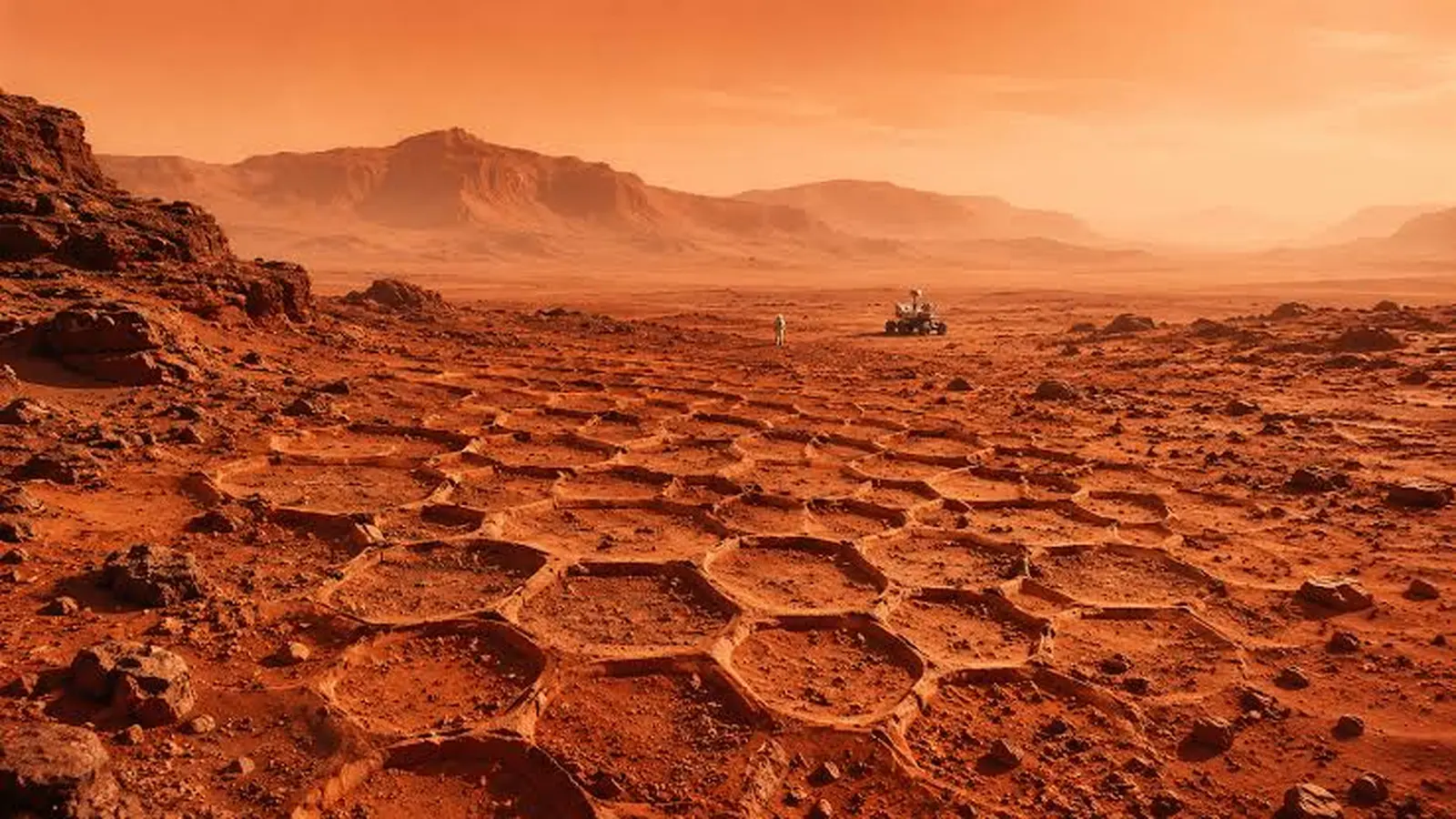
A close-up texture that looks like a weathered honeycomb has surfaced in NASA Curiosity's recent images. Tiny, polygonal plates, each only a few centimeters across, tile part of Gale Crater. The pattern stopped engineers on the ground. Planetary geologists sat up and leaned in. Why would Mars wear a cracked mud skin?

NASA’s Curiosity Mars rover captured this close-up view, revealing the distinct honeycomb texture of these polygon fractures.
What the rover actually saw and why it matters
Curiosity rolled over to a patch of bedrock that, at first glance, looks like dried lakebed on Earth. The polygons measure roughly 4 to 8 centimeters across. That is small compared with the broad, meter-scale polygons orbiters detect elsewhere on the planet. Yet scale is not the only story here. Size, arrangement, and chemistry together help scientists decode the environmental processes that once shaped the surface.
Ground-level images give a different kind of evidence than orbital photos. From above, satellites such as HiRISE have catalogued vast, meter- to kilometer-scale polygon networks across Hellas Planitia and other basins. Those larger polygons often point to processes like thermal contraction, permafrost dynamics, or tectonic stress. The textures Curiosity photographed are modest by comparison. They are intimate. They preserve surface details that only a rover can resolve: microfractures, sediment layers, and mineral coatings that hint at wetting and drying cycles.
Scientists currently favor one explanation: these polygons are ancient mud cracks. On Earth, fine sediments shrink and split into polygons when wet surfaces repeatedly dry and crack. If similar cycles occurred in Gale Crater billions of years ago, then those cycles would record episodes of standing water followed by drying intervals. That suggests a climate that could intermittently support liquid water at or near the surface.
Context in Martian history and competing ideas
Gale Crater is already famous. Curiosity has spent years sampling its rocks and finding minerals that require water to form. The new polygons add another chapter. A 2023 Nature study used Curiosity data to argue that intense wet-dry cycles during the Noachian-Hesperian transition, around 3.8 to 3.6 billion years ago, could have produced similar cracks. If those interpretations hold, the polygons are more than patterns. They are weather reports from an early, intermittently wetter Mars.
But caution is warranted. Planetary surfaces can imitate one another. Freeze-thaw cycles, thermal contraction, or even volcanic and tectonic stresses can create polygonal networks. Orbiters often reveal polygons that are tens to hundreds of meters across, formed by different mechanisms than centimeter-scale polygons. Distinguishing mud cracks from periglacial or tectonic polygons requires careful cross-examination of shape, spacing, and the local chemistry preserved in the rock.
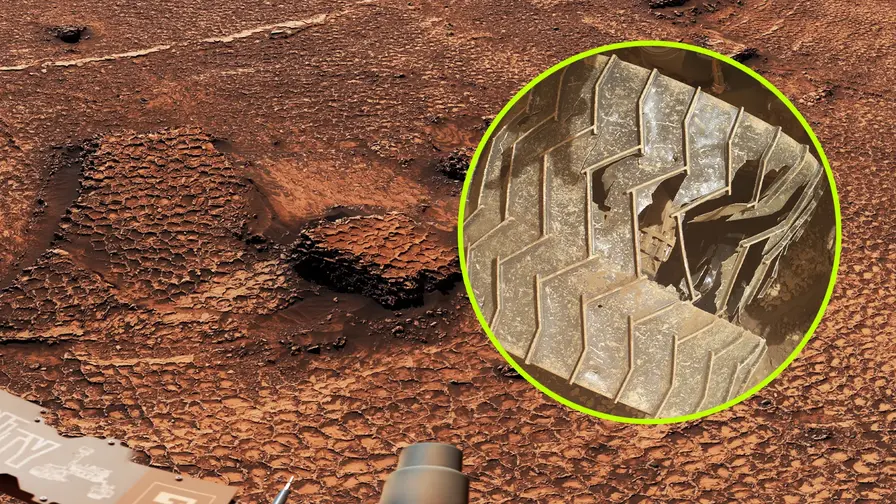
Curiosity’s instruments provide that kind of cross-check. Cameras map the geometry. Spectrometers analyze mineral composition. The team has measured shape statistics and chemical signatures, searching for clay minerals and salts that commonly form in evaporating basins. Those minerals would tilt the balance toward a wet-dry origin.
There is also a temporal angle. The Noachian-Hesperian transition marks a key climate pivot for Mars. If the cracks formed then, they join other evidence indicating that Mars may once have supported environments with episodic surface water. That does not mean vast oceans or a long-lived Earth-like hydrological cycle. But it does imply windows of habitability—brief intervals when liquid water and more moderate conditions might have existed.
Expert Insight
"Seeing these small polygons up close is like finding a single page torn from an ancient climate diary," said Dr. Ashwin Vasavada, Curiosity mission scientist at NASA's Jet Propulsion Laboratory. "The rover gives us textures and chemistry that orbiters cannot. Together, these clues help us test whether those patterns were sculpted by drying mud or by cold, shrinking ground."
Dr. Vasavada's remark captures the practical difference between perspectives. Remote sensing maps extent and distribution. Rovers provide the microscopic evidence. Both are essential. The team expects follow-up analyses to refine the chronology and environmental interpretation. That work includes targeted spectroscopic scans and comparisons with other sites in Gale Crater where Curiosity has documented lacustrine deposits.
What comes next for Curiosity and Martian geology
Curiosity will continue to image and sample polygon-bearing outcrops. The goal is twofold: establish whether the polygons represent repeated wet-dry cycles, and determine how those cycles fit into Mars’ broader climatic evolution. If mud cracks are confirmed, researchers will map their distribution and chemistry to infer water chemistry, duration of wet intervals, and potential habitability implications.
Future missions add context. Orbiters will keep scouting polygons at regional scales. Upcoming landers and rovers can target complementary sites. Meanwhile, laboratory experiments on Earth help close the interpretive loop: geologists simulate repeated wetting and drying in Mars-like sediments, watching which minerals form and which crack patterns develop.
Conclusion
Tiny polygons, only a few centimeters wide, have opened a new window into Gale Crater’s past. They do not solve the puzzle of ancient Martian climate alone, but they provide a crucial piece. The texture of that honeycomb-like crust is an invitation to look closer, to connect orbital maps with in-situ chemistry, and to ask harder questions about when and how water shaped the Red Planet.

“My work centers on sustainability, energy, and environmental science — examining how innovation can lead to a greener future.”

Discussion
Leave a Comment
Comments (2)
Hmm is this really mud cracks or freeze-thaw doing the trick? Satellites show big polygons, these are tiny — curious about the chemistry tho, if it's clays then maybe...
Whoa, tiny honeycomb mud cracks on Mars? Gives me chills, like a climate diary left in stone. If water puddled there even briefly… wow, just wow