
.webp)
How Dark Stars Might Echo in Today's Gravitational Hum
Dark stars are hypothetical objects that may have formed in the early Universe, powered partly by heat from dark matter rather than nuclear fusion. If they existed, some could have grown enormously before collapsing into massive black holes, potentially helping explain how the first supermassive black holes formed so quickly.
A faint, ancient chorus
Listen closely and the Universe whispers. Not with light, but with a slow, deep thrum: gravitational waves at nanohertz frequencies. These waves are so low in frequency they resemble a distant, persistent hum rather than the sharp chirps LIGO has made famous. Pulsar timing arrays, networks that track the clock-like ticks of millisecond pulsars across the sky, have now found evidence of that background hum. The discovery raises a provocative question: could some of those waves carry a record of events from the Universe's very first billion years?
Two researchers at Colgate University, Sohan Ghodla and Cosmin Ilie, tackled exactly that idea in a recent Letter published in Physical Review D. They connected two puzzles that have been nagging astrophysicists: why do we see supermassive black holes already in place very early in cosmic history, and what creates the gravitational-wave background that PTAs are now sensing?
Why pulsars can tell us about cosmic dawn
Pulsars act as galactic metronomes. Their radio pulses arrive with astonishing regularity. A passing gravitational wave stretches and squeezes space, subtly altering those arrival times. Monitor many pulsars for years, and a correlated pattern emerges when a stochastic background of waves is present. That is what PTA collaborations worldwide are starting to see.
At nanohertz frequencies, the dominant astrophysical source is expected to be supermassive black hole binaries: pairs of black holes with masses of a billion Suns or more spiraling toward each other. These titanic systems emit slowly, but persistently, and collectively their mergers create the background PTA experiments detect.
But there is tension. Observations with the James Webb Space Telescope, Chandra, and other facilities have revealed unexpectedly massive black holes when the Universe was only a few hundred million years old. How did such giants assemble so quickly? The standard pathways—small stellar black holes growing by accretion or successive mergers—strain to produce seeds large enough, soon enough.
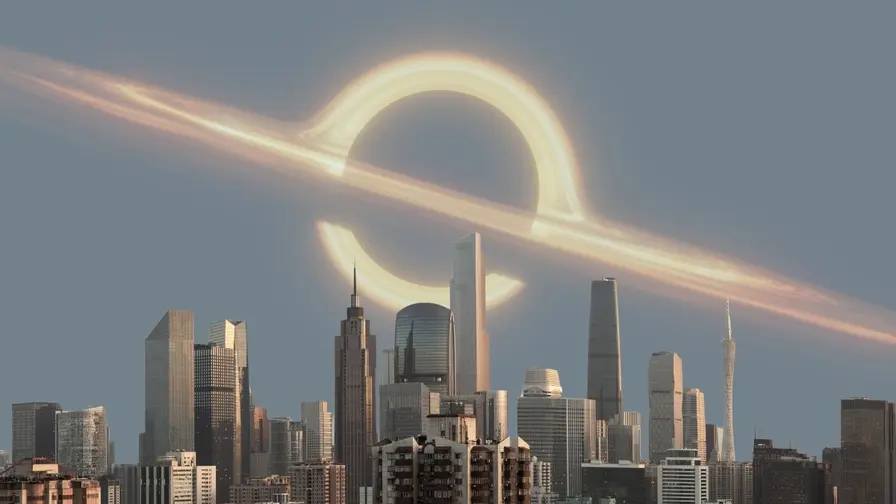
How Dark Stars could seed giants
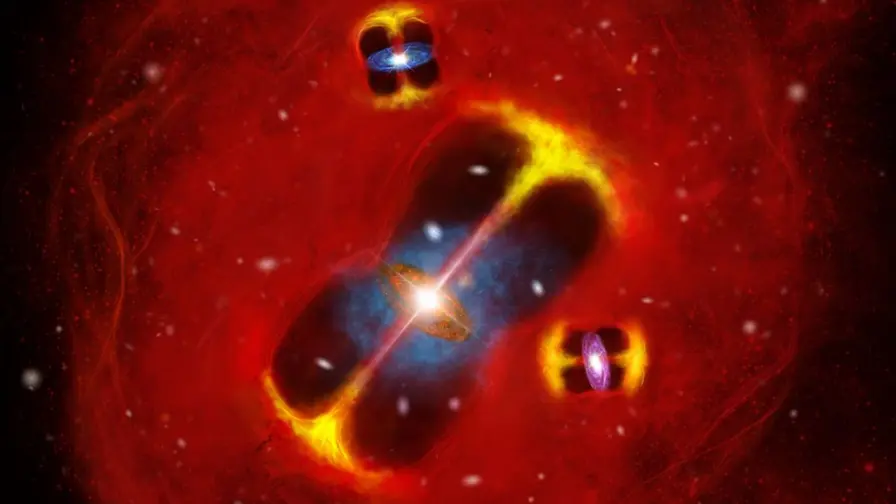
Enter dark stars. Under certain dark matter scenarios, particularly those involving WIMP-like particles, the annihilation or capture of dark matter inside primordial halos could heat the first protostars. The star would stay puffed up and cool, avoiding the rapid onset of fusion. That allows it to accrete mass for far longer than a normal star would. The result: objects that could swell to millions of solar masses before their inevitable collapse into black holes.
Ghodla and Ilie compared two seeding channels. One is direct-collapse black holes, rare but already considered in past literature. The other is the more exotic path: supermassive dark stars collapsing into massive black hole remnants. They modeled how those seeds evolve as their host dark-matter halos grow, how frequently they pair and merge, and what gravitational-wave background those mergers would produce by the present day.
The finding was striking. If remnants of supermassive dark stars existed with a number density near one in a thousand cubic megaparsecs, their descendants could contribute a large, possibly dominant, share of the PTA signal. Direct-collapse seeds, by contrast, are predicted to be far less common—roughly one in a million cubic megaparsecs in the scenarios tested—and produce a much weaker background.
.avif)
Predicted nanohertz gravitational-wave backgrounds from descendants of early supermassive black-hole seeds. Models in which black holes originate from collapsed supermassive Dark Stars can reach the gravitational-wave background measured by Pulsar Timing Arrays, whereas the much rarer direct-collapse-black-hole population considered in the study produces a substantially weaker signal.
What this means for seed abundances
There is an observational payoff. Current PTA measurements already place upper limits on how common such ancient seeds can be. Produce too many massive seeds, and the predicted gravitational-wave background exceeds what PTAs observe. Produce too few, and astronomers must rely on later, more efficient assembly mechanisms to explain the early supermassive black holes seen by telescopes.
The study suggests seed densities in the range of roughly 10 to the minus 2 up to 10 to the minus 1 per cubic megaparsec would start to overproduce the PTA signal, though exact constraints hinge on the masses and environments of the original halos. Crucially, the mergers producing the observed waves happen long after the seeds formed. Yet PTA data can restrict populations that existed at redshifts greater than ten, giving a rare observational window onto cosmic dawn.
Expert Insight
"This is a neat example of cosmic archaeology," said Dr. Mira Santos, an astrophysicist who studies black hole formation. "We often think of gravitational waves as probes of recent cataclysms. But the Universe preserves memory in surprising ways. If dark-star remnants were common, their footprints could still be audible in the PTA band today. That connects particle physics, early-star formation, and gravitational-wave astronomy in a way that telescopes alone cannot."
Her comment underlines a broader point: gravitational-wave detectors operating at different frequency ranges are complementary. LIGO and its successors catch the high-pitched bangs of stellar-mass mergers. Space-based missions like LISA will bridge to the intermediate band. PTAs fill the lowest notes. Together, they compose a full spectral record of black-hole growth across cosmic time.
Implications and future prospects
If dark-star remnants do contribute substantially to the PTA background, the implications are wide-ranging. For particle physics, it would motivate specific properties of dark matter that allow heating and long-lived dark-star phases. For galaxy formation, it changes the expected timeline of black hole occupation and feedback. For observational astronomy, it sets testable predictions: improved PTA sensitivity, tighter counts of high-redshift quasars from JWST and future X-ray missions, and better constraints on host-galaxy halo masses could either support or rule out dark-star-dominated scenarios.
What comes next is clear. PTAs will keep gathering data, expanding the number and sky coverage of precisely timed pulsars. That will refine the spectral shape of the background and separate contributions from nearby supermassive binaries versus a cosmological population of ancient descendants. Cross-checks with deep surveys of the early Universe will tighten limits on seed populations and their environments.
In short, the hunt for origins of supermassive black holes now has a new listening strategy. Instead of relying solely on photons from the first billion years, astronomers can also eavesdrop on the Universe's gravitational memory.
Conclusion
The idea that dark stars—stars powered in part by dark matter—could leave an imprint on the gravitational-wave background measured today is provocative and testable. Ghodla and Ilie's work shows how ancient physics might still be audible in our instruments, linking the smallest scales of particle behavior to the largest structures in the cosmos. The coming decade of improved PTA datasets, combined with deeper astronomical surveys, will tell whether we are indeed hearing echoes of hidden stars from the dawn of time.

“My work centers on sustainability, energy, and environmental science — examining how innovation can lead to a greener future.”

Discussion
Leave a Comment
Comments (3)
Interesting link btw between particle physics & GW, but seed density limits seem very model dependent. JWST + PTAs will decide, imo
Is this even true? PTAs picking up echoes from billion-year-old dark stars sounds a bit.. speculative. Where's the smoking gun?
Wait, so ancient dark stars could still be "heard" today? mind blown… if true that's wild, but need more data, pls