
A diver hovers above a scatter of cannon muzzles on the sea floor. Cold light catches the edge of a coin. It gleams with a history that crosses continents.
How a handful of coins unlocked a four-century mystery
For almost 300 years fragments of a seventeenth-century wreck lay on the seabed off England's south coast, catalogued by anglers, local divers, and the occasional chance find. Only in the 1990s did investigators begin to piece together what remained: cannons, anchors, domestic objects and—most arresting of all—a concentration of gold coins that did not originate in Europe. Those coins set historians and maritime archaeologists on a long chase that has now established the wreck's identity as the Dom van Keulen, a Dutch trading vessel that sailed from Morocco in the autumn of 1633 and foundered near Salcombe, Devon.
The identification is the result of parallel lines of evidence. Archaeological survey measured the wreck and recorded its artefacts. Numismatics traced the coins to Barbary ducats minted on the Moroccan coast. And archival research, notably by independent historian Ian Friel consulting the UK National Archives, turned up a period account that described the Dom van Keulen battling tempestuous weather, springing a leak and sinking while its crew survived.
What the cargo tells us about seventeenth-century trade
The ship's manifest, reconstructed from finds and historical sources, reads like a compressed map of early modern commerce. Beyond the gold, excavators documented 150 bags of gum arabic, 64 bags of saltpeter, hundreds of goat skins and a mass of manufactured goods bound for northern markets. Contemporary accounts suggest the vessel originally carried some 9,000 Barbary ducats, the highly pure West African gold coins that flowed through Moroccan ports into European hands.
Dave Parham, Professor of Maritime Archaeology at Bournemouth University, and Venetia Porter, formerly Senior Curator for Islamic and Contemporary Middle Eastern Art at the British Museum, have edited a new book that traces three decades of work on the wreck. Their synthesis places the find within broader questions: how Moroccan and West African gold entered Dutch financial systems, how goods from North Africa circulated through northern Europe, and how maritime networks shaped the Dutch Golden Age economy.

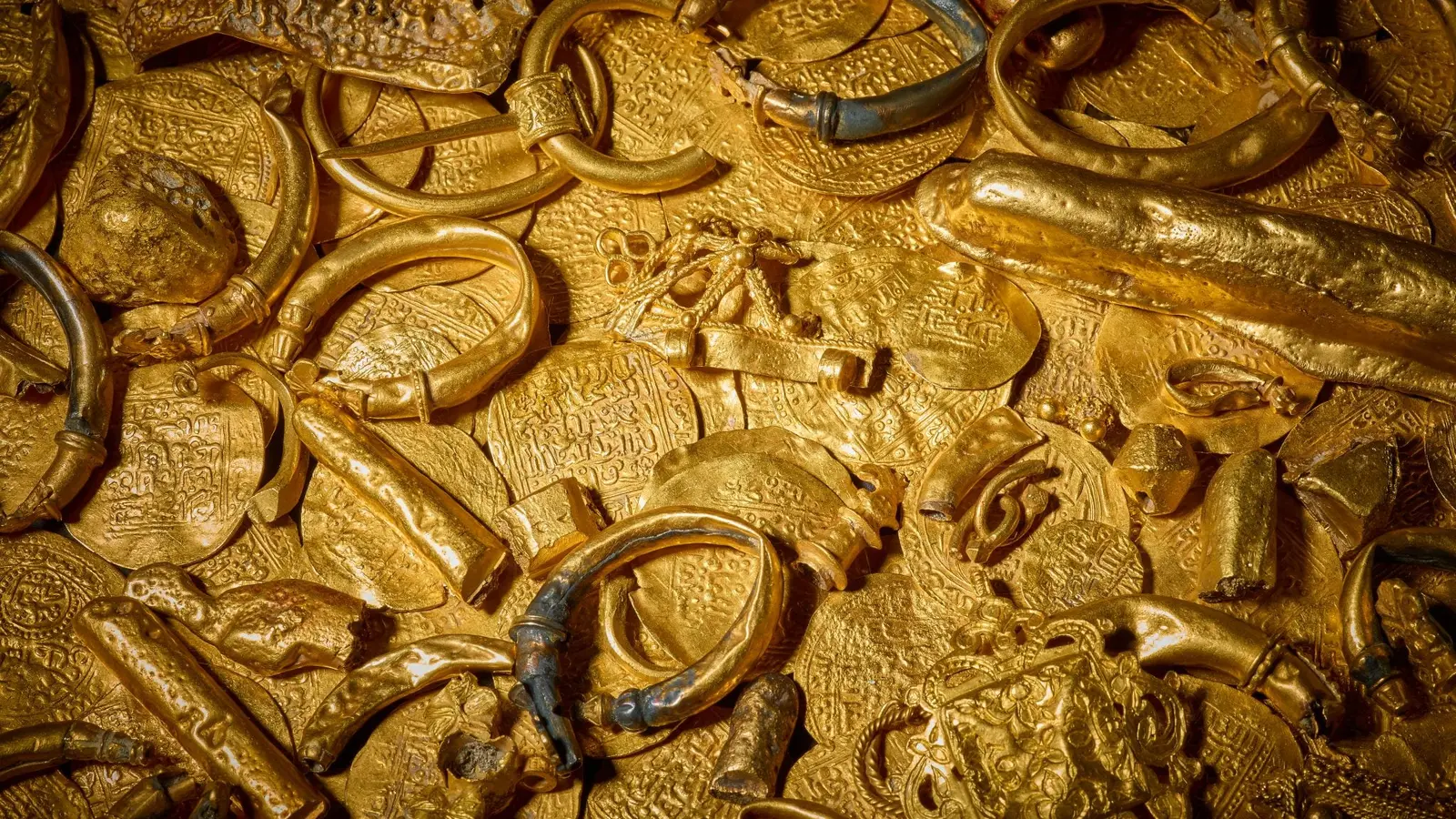
Examples of the gold coins recovered from the wreck.
The coins themselves are not only numismatic curiosities. Metallurgical and surface analyses—techniques common in archaeometry such as X-ray fluorescence and microscopic provenance studies—help confirm origin and circulation patterns. In many cases, imported ducats were melted and reminted into Dutch coinage. That process underscores a fluidity of money and material practice across the early modern Atlantic and Mediterranean worlds.
Objects that make history tangible

What remains on the seabed is modest in scale yet rich in implication. The wreck site measures roughly 30 meters in length and sits around 18 meters down. Divers recovered cannons and anchors, alongside domestic items such as a pewter bowl and spoon, a fish-shaped sounding weight used for measuring depth, a stamp seal, jewelry and a small gold finger nugget. Many of these objects now form part of the British Museum collection, where they provide a physical counterpoint to archival narratives.

Other recovered artifacts include a pewter bowl and spoon, a ceramic sounding weight shaped as a pilchard, a stamp seal, and a finger nugget.
Jeremy D Hill, Head of Research at the British Museum, has observed that finding African gold beneath the Devon seabed prompts more questions than it answers. How was this cargo assembled? Through what networks did coins and commodities move? The combination of material evidence and textual records offers a rare, multi-dimensional answer: a merchant vessel linking North Africa, West Africa and the Low Countries became part of the same maritime fabric that connected Britain to continental trade.
Protection, monitoring and the ethics of underwater heritage
The Dom van Keulen site is protected under the Protection of Wrecks Act 1973 and managed with restricted access. Licenses for diving are issued by the Secretary of State at the Department for Digital, Culture, Media and Sport. On the surface, monitoring is carried out by the National Coastwatch Institution at Prawle Point, and local marine patrols contribute under Operation Birdie, aimed at preventing looting or unauthorised interference. These measures reflect a contemporary consensus: submerged cultural heritage requires stewardship if research value is to be preserved.
Expert Insight
"This wreck is a textbook example of how maritime archaeology and archival research must work together," says Dr. Laura Mendes, senior maritime archaeologist at the University of Southampton. "Coins and cargo provide material proof of trading relationships; archives supply route details and human stories. When both line up, the past becomes more than a catalogue entry. It becomes a route map for historical economy and cultural exchange."
The combination of careful fieldwork, conservation and interdisciplinary analysis has reshaped how specialists think about commodity flows in the seventeenth century. It also highlights the technical side of modern maritime archaeology: side-scan sonar to map seabed topography, diver-based recording methods to document scatter patterns, and conservation labs where fragile metalwork and organic materials are stabilised for study and display.
Conclusion
What began as isolated finds has turned into a well-documented case linking Morocco's gold to Dutch maritime commerce and to a ship lost off the English coast. The Dom van Keulen is more than a wreck. It is a node in a network that moved money, goods and people across oceans, and a reminder that the seabed still preserves remarkable testimony to global history. Recovering and interpreting that testimony requires patient detective work, technical skill and a commitment to protecting fragile archaeological contexts for future generations.

For readers interested in deepening their understanding, the book From Morocco to the Coast of England: The Story of the Dom van Keulen and its Remarkable Cargo gathers the full narrative, combining excavation reports, coin studies and archival transcription that document nearly three decades of research.

“My work centers on sustainability, energy, and environmental science — examining how innovation can lead to a greener future.”

Discussion
Leave a Comment
Comments (3)
Fascinating find, but hope local divers aren't frozen out. must balance study with community access, right? quick thought
is this even true? archives vs coins, curious how certain the ID is, feels neat but kinda provisional...
wow, that image of coins glinting under cold water gave me chills. who knew Moroccan gold ended up here? mind blown