
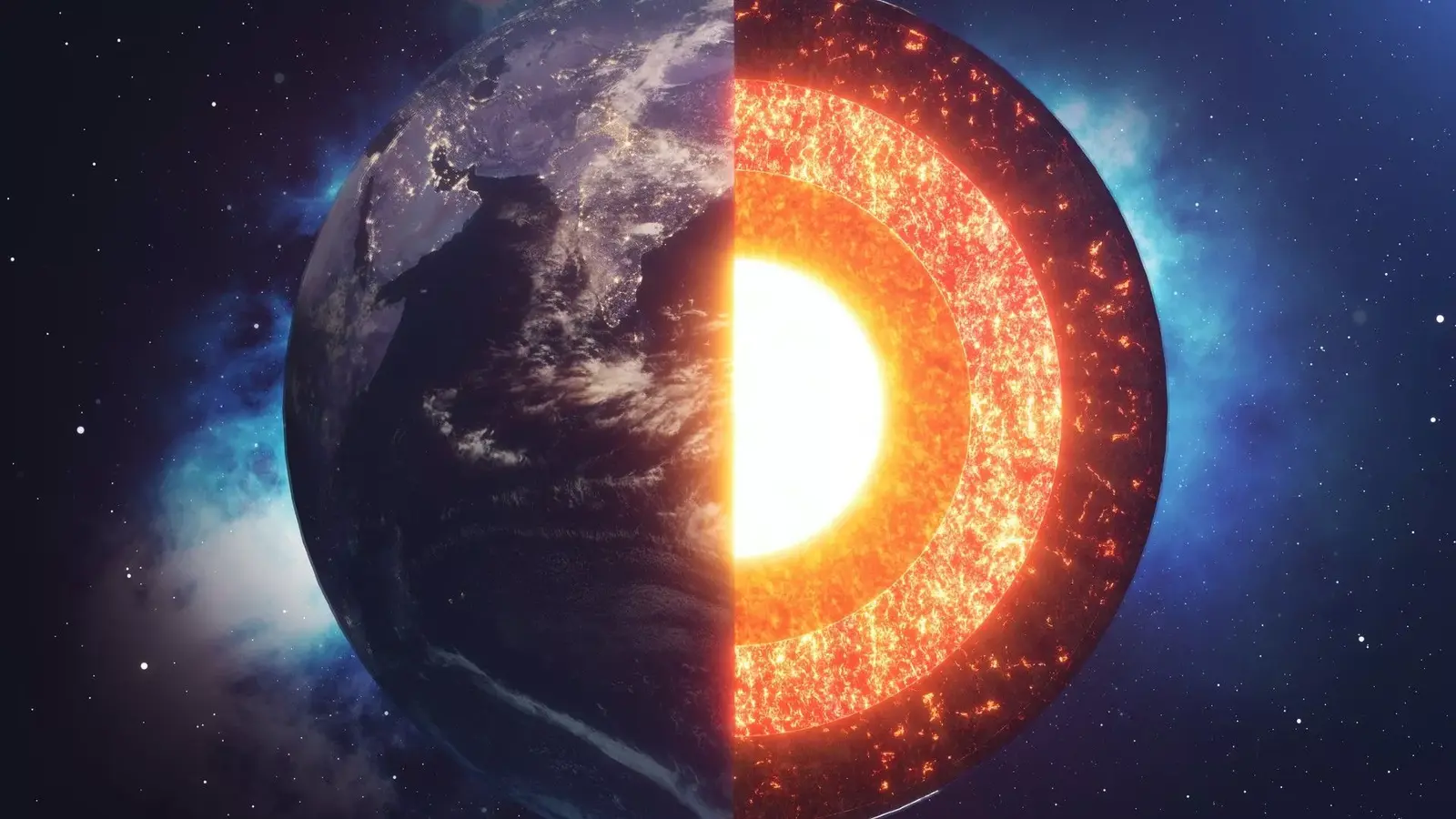
Imagine the center of our planet running cooler than every textbook has assumed for decades. A team of high-pressure physicists now suggests just that: the iron at the boundary between Earth’s solid inner core and its molten outer shell may melt at temperatures more than 1,000 degrees Celsius lower than many prior estimates. If true, that revision reshapes how we think the planet kept its magnetic shield alive for billions of years.
A quieter furnace under our feet
The inner core is an object the size of the Moon, nested inside an outer core roughly comparable to Mars. Both are dominated by iron. The motion and convection of the molten outer core generate Earth’s magnetic field, a geodynamo that has protected the atmosphere and life for at least four billion years. But there is a long-standing puzzle: models of Earth’s cooling history often place the start of inner-core solidification at only about 0.5 billion years ago. That leaves roughly 3.5 billion years during which the geodynamo must have run without the energy boost supplied by inner-core crystallization.
Resolving that paradox requires a better handle on the melting temperature of iron at the extreme pressures found at core depths. If iron melts at lower temperatures than previously thought, the core could have been cooler for much of Earth’s history, and simple secular cooling of the whole core might have provided sufficient energy to sustain the geodynamo prior to inner-core formation.

How the new measurements were made
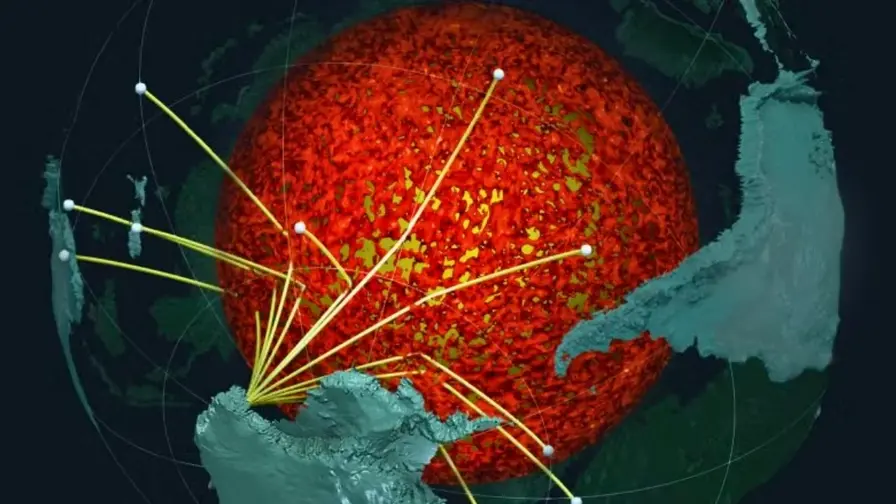
Replicating core conditions is notoriously difficult. The research team compressed tiny iron samples between diamond anvils to reach pressures near two million atmospheres, a regime similar to the center of the planet. The experimental twist was in how they heated the samples. Instead of the usual continuous laser heating, the group applied ultra-short electrical pulses measured in microseconds. That technique delivers tight control over temperature transients and reduces chemical and structural changes that can complicate interpretation.
Rather than hunting directly for visible signs of melting, the investigators monitored how input energy affected temperature behavior. They looked for the point where added energy stops raising temperature and instead goes into changing phase, the hallmark of melting. At the pressure corresponding to the inner-core boundary, pure iron showed a melting range between about 4,420 and 5,220 kelvin. After adjusting for the light elements alloyed into Earth’s core, the preferred central estimate dropped to roughly 4,284 kelvin. Compared with many previous studies that placed melting above 6,000 kelvin, this is a substantial downward revision.
Implications for the geodynamo and mantle structure
When those lower melting temperatures are fed into thermal evolution models of Earth, a different narrative emerges. The researchers found that steady cooling of the core alone could plausibly have supplied the power needed to drive the geodynamo for most of Earth’s history, until inner-core crystallization began a bit over half a billion years ago. In their words, a core-driven dynamo powered mainly by secular cooling becomes a more likely scenario.
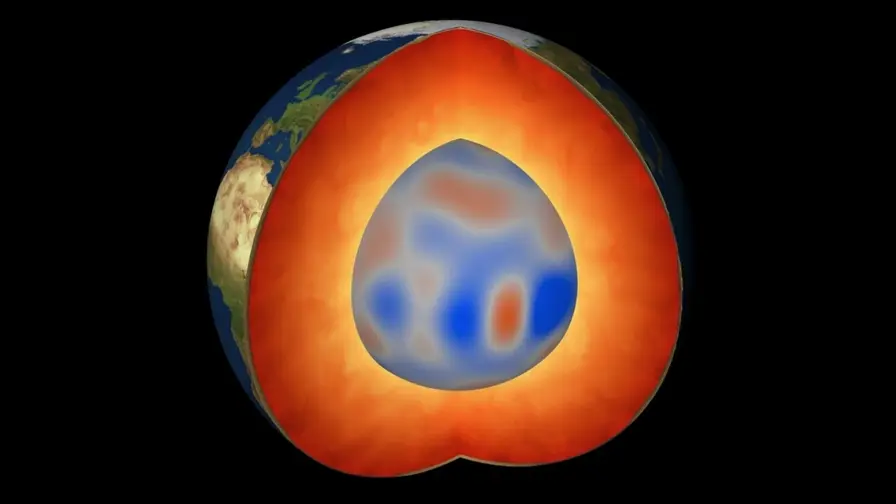
A cooler core boundary also ripples outward into mantle science. The interface between core and mantle could be colder than thought, which would make partial melting of rock there less likely. That matters because seismologists have detected large, enigmatic low-velocity provinces near the core-mantle boundary that some interpret as chemically distinct blobs, very hot material, or even partially molten zones. If the boundary is cooler, those interpretations need revisiting.
Not everyone is ready to accept the change. A number of experimentalists who have spent decades recreating core pressures have tended to derive higher melting temperatures. The study’s lead, a high-pressure specialist, acknowledged the contrast and predicted a period of scrutiny and debate. One senior experimentalist commented that the new approach felt like a subtle but important reappraisal, while another veteran researcher called the results a kind of return to older estimates and urged careful methodological checks before overturning the consensus.
Expert Insight
"If the melting point of iron at core pressures is lower, it simplifies one branch of Earth’s thermal history," says Dr. Lena Ortiz, a geophysicist who has worked on numerical dynamo models. "A cooler core reduces the need to invoke exotic early heat sources to explain a long-lived magnetic field. That said, the geodynamo is a system with many moving parts—compositional convection, radioactive decay, and heat flow at the core-mantle boundary all play roles—and we need multiple independent experiments and models to converge before we rewrite textbooks."
Methods matter—and so do uncertainties
Part of why the new measurements revise earlier numbers is methodological. Extrapolating melting temperatures from experiments performed at somewhat lower pressures can introduce uncertainty. The authors argue their pulsed electrical heating reduces artefacts and gives tighter control on transient thermodynamics. Yet the margin of error in these extreme-condition experiments remains non-trivial. Small differences in sample chemistry, pressure calibration, or the way temperature is inferred can swing the final estimate by hundreds of degrees.
Critics stress that independent replication will be essential. Multiple laboratories, using different heating schemes and diagnostics, must test whether this lower melting range holds. If it does, the result will reshape not only theories of the geodynamo but also our understanding of core composition, mantle convection, and the thermal evolution of terrestrial planets in general.
Conclusion
This study injects fresh oxygen into a long-running debate about how Earth’s magnetic field persisted before the inner core froze. A cooler core lowers the bar for secular cooling as a viable power source for the ancient geodynamo, and it forces geoscientists to re-evaluate the thermal and chemical interactions at the core-mantle boundary. The path forward is clear: independent confirmations, integrated thermal and compositional models, and careful attention to experimental subtleties will determine whether this cooler vision of Earth’s heart becomes the new standard.

“My work centers on sustainability, energy, and environmental science — examining how innovation can lead to a greener future.”

Discussion
Leave a Comment
Comments (3)
Feels a bit overhyped. experiments at these extremes are tricky, wait for repeats. if that's real then textbooks in trouble tho
is this even true? one weird technique tweak and numbers jump. labs gotta replicate, small pressur cal errors can change 100s K... skeptical.
whoa if the core's that much cooler, mind blown. kinda comforting tho, life survived with a chill furnace? curious how labs replicate this...